
A Portrait of Freedom
A 1819 portrait of a formerly enslaved man reveals the presence of Muslims at the nation’s founding.
From
A Portrait of Freedom
Episode 1 | 24m 44sVideo has Closed Captions
A 1819 portrait of a formerly enslaved man reveals the presence of Muslims at the nation’s founding.
An 1819 portrait of a formerly enslaved African man reveals the presence of Muslims at the nation’s founding.
From
Problems playing video? | Closed Captioning Feedback
Problems playing video? | Closed Captioning Feedback
A Portrait of Freedom
Episode 1 | 24m 44sVideo has Closed Captions
An 1819 portrait of a formerly enslaved African man reveals the presence of Muslims at the nation’s founding.
From
Problems playing video? | Closed Captioning Feedback
Where to Watch American Muslims: A History Revealed
American Muslims: A History Revealed is available to stream on pbs.org and the PBS app.
Providing Support for PBS.org
Learn Moreabout PBS online sponsorship♪♪ [Asma Khalid] This is a portrait of a man who spent most of his life enslaved.
[Precious Rasheeda Muhammad] He's in a center of Islamic learning, and then, boom, just like that, he becomes a captive of the slave trade.
[Khalid] Shipped to North America, he was forced to work for over 40 years before he won his freedom.
He was 60 years old.
-60 years old, he becomes... -Yeah.
-...a free man.
-You're a slave until you're 60.
And his life started anew then.
[Khalid] His name was Mamadou Yarrow and he was a Muslim.
[Charles Willson Peale] He said, "Man is no good unless his religion comes from the heart."
[Terrence Johnson] Enslavers thought these people are without intelligence, without a soul.
The assumption is that when they came, their gods died.
[Khalid] But Yarrow's faith survived.
[Muhammad] He gives us a story of what it was like to gain freedom, and then live after that and practice as a free person.
I don't think we have any other story like that.
That's what's so powerful about it.
[Khalid] I'm one of three journalists following a trail.
[Aymann Ismail] There was one of the founding fathers imagining - Muslim Americans.
- Absolutely.
[Khalid] Each of us examining a defining moment in American history.
Strong words.
[David Langbert] Very powerful words.
-He wanted this mosque here... -Yes.
-...in the US?
-They were all so proud of it.
[Khalid] Tracing a legacy that's coming back into view.
There's never been an America without Muslims.
[Zain Abdullah] This is not a foreign story.
It's a part of the American story.
♪♪♪ ♪♪ [Khalid] So much of America's story has happened here in Washington, D.C.
It's part of the reason I work here.
I'm surrounded every day by 250 years of history.
As a Muslim born and raised in the United States, I've always been curious about the roots of Islam in our country.
I knew many of the earliest Muslims to arrive came from Africa, but I didn't realize how much of their story is still unknown to most of us.
It appears as if between 10 to 15%.
Some say even 30% of the enslaved Africans came from Muslim parts of West Africa.
Thousands of Muslims were enslaved in the Americas, including what became the United States.
[Sylviane Diouf] They were parts of the social and cultural and economic development of the Americas for half a millennium.
[Khalid] We know that some African Muslims left their names.
They show up in plantation records and runaway slave ads.
Others left their writings, many of them in Arabic.
A few left their image.
Among them was Mamadou Yarrow, also known as Yarrow Mamout.
He was painted not once, but twice.
It's one of the things that makes him stand out.
He gives us a story of what it was like to gain freedom, and then live after that and practice as a free person.
I don't think we have any other story like that.
[Khalid] Yarrow's story has survived in the archives of the American Philosophical Society in Philadelphia, in the writings of the artist who first painted him after painting presidents, including portraits of George Washington, John Adams, and Thomas Jefferson.
[David Gary] We are looking at one of 26 diaries written by Charles Willson Peale, a very important early American portrait painter, one of the most important.
This diary goes back to 1818 to early 1819.
The diary is rather small.
As you can see, it's about 58 pages of text.
The Yarrow section takes up about three and a half pages.
It's the biggest vignette in the diary from this period.
[Khalid] Writing in late 1818, Peale describes a visit to Washington, D.C., where he heard about an old African man, Yarrow, living in Georgetown, in surprising circumstances.
"He is comfortable in his situation, having bank stock and lives in his own house..." -[Charle's voice] "...house... I shall be able to give him a more particular account of him, as I propose to make a portrait of him, should I have the opportunity of doing it."
[Khalid] The diary was a vital resource for the author who first pieced Yarrow's story together, drawing on Peale's account and a wide variety of other sources, from census data to shipping records.
[James H. Johnston] I was here at this library many years ago, and I saw this painting by James Alexander Simpson, a local artist who painted it in 1822.
Georgetown is a lily white community, and so to see a painting of a black man at this library was sort of unusual.
That's what started the whole project.
Where did Yarrow come from exactly?
[Johnston] We don't know for sure, but he was a Fulani Muslim and the Fulani were moving from Mali into Senegal, Guinea and other places in West Africa at the time.
Islam comes to Africa itself via the trans-Saharan trade routes and over North Africa down into West Africa.
Islam was implanted in Africa for over a thousand years.
The spread of Islam went hand in hand with the spread of literacy in Arabic.
So there were schools for boys and girls.
There were also institutions of higher learning, and they traveled all over not only West Africa, but to Mecca, to Egypt to learn.
They also are interested in not necessarily being Arab, as it were, but practicing Islam through this African sensibility.
[Khalid] This was the world Mamadou Yarrow knew until he reached his teens, when everything changed.
Around 1750, Yarrow and his sister were sold to British slave traders after being captured, likely in a local war.
[Muhammad] He's in a center of Islamic learning and then, boom, just like that, he becomes a captive of the slave trade, and he becomes one of the estimated 12.5 million people that from 1525 to about 1867 were taken from Africa to the New World.
[Khalid] Yarrow and his sister survived the Middle Passage, a brutal Atlantic crossing that could take several months.
The ship, The Elijah, brought them to Annapolis, Maryland.
In the summer of 1752, they were put up for sale, listed in a newspaper as pieces of property.
[Johnston] This is a page from the "Maryland Gazette," a weekly newspaper published in those days.
So it says, "Just imported in The Elijah, directly from the coast of Africa.
[Johnston] "A parcel of healthy slaves consisting of men, women and children."
So they're bringing children over as well.
[Khalid] "And it will be..." Is it... [Johnston] Disposed of on board the said vessel.
[Khalid] "For sterling money, bills of exchange, gold, or paper currency."
In Annapolis, Yarrow and his sister were separated.
What became of her is unclear.
The historical record preserves even fewer stories of enslaved women than it does of enslaved men.
But we find Yarrow again not long after on a tobacco plantation in Montgomery County just outside of Washington, D.C.
Years later, records suggest he had a son here with a woman who was also enslaved.
♪♪♪ Around 1790, Yarrow's life changed again when his enslaver brought him to Georgetown.
Today it's one of Washington's most exclusive neighborhoods.
Back then, it was a working port town on the banks of the Potomac River.
How does he end up in Georgetown?
He was originally purchased by one of Georgetown's most famous families, the Beall, or Bells.
Samuel, initially, who makes him his manservant, or might be a fancy name for a valet.
I think he was smart enough to to learn how to be around his enslaver.
It's different if you're a field hand or you're in sort of doing other kinds of chores that may have even helped to preserve him from not being broken down in certain kinds of ways, as others are and controlled in that way.
In order to make money, the Bells, or Bealls, like for him to be industrious.
They also required that he give whatever he makes to them, but they give some of the money back.
And so what type of work was Yarrow doing?
He made charcoal.
He had that technique.
He sold baskets.
He also made bricks.
He commanded one and a half times what a white brickmaker could.
[Khalid] In Georgetown Yarrow joined a growing community of black people, both enslaved and free.
Many of them and their descendants are buried at Georgetown's Mount Zion Cemetery.
Established in the early 1800's.
This graveyard gives us a glimpse into the type of community Yarrow was entering.
Yeah.
We don't want you to look at him in isolation.
We want you to understand that there were people, a community in which he was part, that shared the same kinds of goals.
[Khalid] And most of these would have been black men, women, children... -Black men.
And we have some who may have, perhaps, even even known Yarrow or certainly they knew of the kind of existence that he was living because they had lived it.
[Khalid] And Yarrow himself, though, -is not buried here, right?
-He is not buried here.
-He was buried in his backyard?
-As far as we know he is buried in, in his backyard.
-Haven't found him yet... -Yeah.
-...but we, we, we hope to one day if he is there.
[Khalid] Yarrow spent the early 1790s working for his first enslaver's son, Brooke, while around him, the newly formed nation took shape and Washington, D.C.
was established as the nation's capital on the farmland next door.
What happened to Yarrow next is recorded in Peale's diary.
When Charles Willson Peale came to paint his portrait in 1819, he was so intrigued by Yarrow's story that he went to Margaret Beall, Brooke Beall's widow.
She told him it was true.
[Peale] "Early in the morning went to see some of the family who had knowledge of him for many years, whose ancestors had purchased him from the ship that brought him from Africa.
The widow Bell told me that Yarrow was always an industrious, hard working man and had served them faithfully for many years, and her husband, intending to build a large house in Georgetown, told Yarrow if he would be very industrious in making the bricks for that house, that when he made all the bricks that he would set him free."
[Khalid] So he obtained his freedom... -Yes.
-...by essentially agreeing to make bricks.
The man who had contracted the promise died, and before he got his freedom.
But his wife was able, understanding what her husband's desire was, carried through with it.
[Peale] "The widow told Yarrow that as he had performed his duty, that she had made the necessary papers to set him free, and now he was made free."
[Khalid] So Yarrow becomes a free man in August of 1796?
-[Johnston] That's correct.
-And he would have been what age at this point?
He was 60 years old.
60 years old he becomes a free man.
-Yeah, you're a slave until you're 60.
And his life started anew then.
[Peale] "After Yarrow obtained his freedom, he worked hard and saved his money until he got $100, which he put into an old gentleman's hand to keep for him.
That person died and Yarrow lost his money.
However, he still worked as before and raised another $100, which he put into the care of a young merchant in Georgetown.
But this merchant became a bankrupt.
Yet not dispirited, he worked hard and saved a third sum amounting to $200.
Some friend of Yarrow advised him to buy bank stock in the Columbia Bank, and he was amongst the first who contributed to that bank.
[Khalid] With his money, Yarrow bought a plot of land on what was then the outskirts of Georgetown, now a quiet street named Dent Place Northwest.
The man who'd arrived from Africa on a slave ship was now a landholder, one of the first black people of any faith to own land in the DC area in his own name.
This is the Recorder of Deeds ledger book from 1800 in Washington, DC.
It's very old book and it's all in this beautiful script.
And this is his deed of Yarrow's house.
[Khalid] 10th day of January, 1800.
Wow, okay.
And do you see Yarrow's name here?
Oh, here it is.
You see his name.
- Yes.
-Y-A-R-R-O-W.
And it gives him a half lot in Georgetown, that was a piece of property 35-feet wide and 150 feet deep.
So it was a big piece of property.
What did having this land allow him to do personally?
He brought his son in to live with him.
Brought his wife in to live with him.
-So he was able to have a family... -Yes.
-...in a way that so many slaves were often separated from families.
-That's correct.
That's correct.
-Families were broken apart.
[Khalid] Yarrow became well known in Georgetown as a freedman owning property.
He was also known for his faith, for being a Mohametan, what many Americans called Muslims back then.
[Peale] "Yarrow has been noted for sobriety and cheerful conduct.
He professes to be a Mohametan and is often seen and heard in the streets, singing praises to God and conversing with him.
He said, 'Man is no good unless his religion comes from the heart.'
The acquaintances of him often banter him about eating bacon and drinking whiskey, but Yarrow says it is no good to eat hog and drink whiskey is very bad."
Enslaved Africans did not lose their customs, their religions, their culture.
They continued to, as much as they could in the confines of enslavement, to be true to who they were.
In the picture, it seems that he kept the tradition of wearing the beard, which was something distinctive to Muslim men.
He had his head covered.
So that's also something that's distinctive to Islamic practice.
[Abdullah] It's kind of a knitted thing, not necessarily fully Islamic, as it were, but I think there's a kind of intentionality there.
That's what's so powerful about it.
[Khalid] At the time, was his faith considered strange to people?
How was Islam interpreted?
Do we know at that time?
It depended on your level of education.
It depended on your level of exposure.
But people knew that Yarrow was Muslim here in Georgetown?
-Yeah.
Oh yeah.
Islam was a recognized religion.
Educated Americans would have known that there were Muslims in West Africa.
Probably also they were seeing Muslim activity in the United States.
Some of the enslaved people maintain practices that the enslavers noticed.
Right?
Made note of and watched.
Wearing skullcaps and turbans and veils, celebrating Islamic holidays, refusing pork and alcohol.
Someone like Yarrow, he seems like an anomaly, but he's that unusual insofar as being very religious and educated.
[Khalid] Peale's diary bears that out.
Peale was a curious man connected to the wider world.
Yarrow's faith doesn't seem to surprise him.
What really intrigues him is Yarrow's age.
[Carol Solitis] Yarrow was supposedly 134 years old.
Turns out he was sort of figuring his age by a different calendar.
-[Khalid] Okay.
[Solitis] Yarrow was probably 83 in this picture.
Peel was also older.
He was in his late 70s and he gave lectures in his museum about healthy lifestyle and how you would be able to reach an old age.
Longevity was a theme.
He had started painting older people in 1795, but there's more going on here.
There's a looking that happens in this picture from the artist to the sitter.
I think he really appreciated who Yarrow was, his sort of power that he had, which I think comes across in the portrait.
There's an intensity there.
I mean, if you look at it, it's a beautiful picture.
But this is not just a, you know, a sheer, you know, sketch of somebody.
This is sort of drilling down into the person.
Charles Willson Peale talked about why he thinks that Yarrow had this kind of longevity.
And he said it's because he believes that he wasn't drinking alcohol, that he was praying a lot.
Peele was thinking about Yarrow as a Muslim enslaved man, right?
And not just a Muslim enslaved man, but a devout Muslim.
♪♪ [Khalid] Peele only spent two days with Yarrow, but it clearly stayed with him.
When Yarrow died in 1823, the papers published an obituary, which Peele is thought to have written.
"Died at Georgetown, Yarrow, aged, according to his account, 136 years.
It is known to all who knew him that he was industrious, honest and moral.
He was interred in the corner of his garden, the spot where he usually resorted to pray."
When Yarrow dies, there are multiple obituaries of this man.
I, I counted so far, 38 up and down the East Coast.
Wow.
Of a man who was brought here as a slave.
-Right.
-Right?
-Right, right.
Right.
Why was so much written about him?
And why were there so many obituaries?
- Well, he was 140 years old.
- So they say.
[chuckling] So that's newsworthy.
[Khalid] Several years after his death, his house was sold.
His son, Aquilla appears in the 1830 census, living in Washington County, Maryland, about 45 miles northwest of Georgetown.
Here, Aquilla's wife worked as a midwife and was so popular, the community still bears the family name.
But there's no evidence the family continued to practice.
Mamadou Yarrow's faith.
After 1865, churches from the North really descended on the South and there was this Christianization of people.
I think that for Muslims who were still living at the time and their children and grandchildren, you know, there was probably more of an effort to be integrated and be like everybody else.
[Johnson] I would see this period as a deep tragedy to enslaved Africans.
Enslavers who were writing the history thought, these people are without intelligence, without a soul.
The assumption is that when they came, their gods died, and then they embraced Christianity.
They did not acknowledge, right, did not name those traditions and those practices.
And so we've spent the last, say, 50 years trying to undo that kind of historical undertaking and to really figure out out who exactly were these people because they were there, but we never really studied them or their writings or their traditions.
[Khalid] In 2015, the rediscovery of Yarrow's story led archeologists to Georgetown to excavate the site of Yarrow's house on Dent Place, following the lead in his obituary that he was buried in his backyard.
[Mia Carey] His home wasn't on the site.
There was a 1850s house that stood on the site that was destroyed by a hurricane.
When we started the project in 2015, it was an empty lot with an extent inground pool.
[Khalid] Significant redevelopment had removed most traces from Yarrow's time.
There was no sign of Yarrow and little evidence of his life.
Still, the dig created a unique opportunity.
[praying in Arabic] A chance to give Yarrow the Muslim funeral rites, the Janazah prayer he was unlikely to have received 200 years earlier.
[Muhammad] In 2015, the Imam of Masjid Muhammad in Washington, D.C., he led the Janazah prayer for Yarrow in that same spot of the yard, and Masjid Muhammad is historically predominantly Black Masjid, one of the oldest in Washington DC.
So it's pretty profound that all these years later that has some meaning even to the people there.
[Khalid] And you led the... you led the prayers?
Yes, yes, I led the prayer and that was an honor for me.
We did the Janazah on the land, on his residence.
We know it doesn't serve the official, but as a ceremonial to him, it would probably reach his soul.
[Carey] It was a beautiful event and a way to honor Yarrow and to shed light on Muslims, their history, and their history in America.
[Imam Talib] We inherit his hopes, we inherit his dreams, uh, and that's the connection that we feel for him.
And this is the beauty of really what it means to be an American.
Really to embrace the excellence of the life that was here and that is here, and that shows who we are.
[Khalid] Today on Dent Place, a new house stands on the spot where Mamadou Yarrow once lived.
But his presence is commemorated with a plaque.
It's a powerful reminder of Yarrow and the tens of thousands of other Muslims already here at the nation's founding.
A people whose history is still being written, whose stories are still coming to light.
♪♪ [announcer] For educational resources, visit "The American Muslims: A History Revealed" collection at PBS LearningMedia.
♪♪♪
Video has Closed Captions
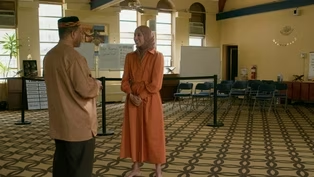
Preview: Ep1 | 30s | A 1819 portrait of a formerly enslaved man reveals the presence of Muslims at the nation’s founding. (30s)
Providing Support for PBS.org
Learn Moreabout PBS online sponsorship












Support for PBS provided by: