
Chicago's Budget Director on Where Negotiations Stand
Clip: 12/1/2025 | 11mVideo has Closed Captions
Annette Guzman, Chicago's budget director, on the latest proposal for next year's city budget.
The City Council’s Finance Committee rejected Mayor Brandon Johnson’s budget revenue package two weeks ago. As alderpeople reignite negotiations over the budget after a Thanksgiving break, we take a look at where things stand.
Problems playing video? | Closed Captioning Feedback
Problems playing video? | Closed Captioning Feedback
Chicago Tonight is a local public television program presented by WTTW
WTTW video streaming support provided by members and sponsors.
Chicago's Budget Director on Where Negotiations Stand
Clip: 12/1/2025 | 11mVideo has Closed Captions
The City Council’s Finance Committee rejected Mayor Brandon Johnson’s budget revenue package two weeks ago. As alderpeople reignite negotiations over the budget after a Thanksgiving break, we take a look at where things stand.
Problems playing video? | Closed Captioning Feedback
How to Watch Chicago Tonight
Chicago Tonight is available to stream on pbs.org and the free PBS App, available on iPhone, Apple TV, Android TV, Android smartphones, Amazon Fire TV, Amazon Fire Tablet, Roku, Samsung Smart TV, and Vizio.

WTTW News Explains
In this Emmy Award-winning series, WTTW News tackles your questions — big and small — about life in the Chicago area. Our video animations guide you through local government, city history, public utilities and everything in between.Providing Support for PBS.org
Learn Moreabout PBS online sponsorship10 to 20 degrees below 0.
Up next, there is a showdown brewing at City Hall over the budget city budget director and at Guzman is here to talk about it right after this.
>> Chicago tonight is made possible in part why the Alexandra and John Nichols family.
The Pope Brothers Foundation.
And the support of these donors.
>> The clock is ticking as Chicago City Council has just a month to pass a budget for 2026. last month, the City Council's finance committee refused to advance Mayor Brandon Johnson's proposed spending plan.
A major sticking point centers around a plan to impose a so-called head tax, a large companies with the Thanksgiving holiday over the pressure is on to reach a deal before the end of the year deadline.
So joining us now is and that Guzman, budget director for the City of Chicago.
Welcome back.
Thank you for joining us.
Thank you for having So second year in a row, it's coming down to the wire.
Remember talking to you about this just a year ago.
>> What did you see is the main sticking point here?
>> You know, I think there's a lot of discussions around.
How do we appropriately fund government.
How do we make sure that services that are critical to the day-to-day lives of residents of the city of Chicago businesses in the city of Chicago as well as people who come to visit our city every single day.
How do we ensure that were properly providing for those while also ensuring that our city stay safe, that we provide ample opportunities for those who want to move live and work here.
And so those are really important conversations that are happening and that we need to happen.
And unfortunately, the city of Chicago because municipality have very limited options around what it is that we can produce as it relates to revenue to support those services.
So before the Thanksgiving holiday, you in the mayor, you charged older people who oppose the mayor's budget to present to come up with one of their own.
>> Have you heard or reviewed any of those proposals?
Alleged proposals?
>> So you know, what we have heard are sort reactions to what the mayor has proposed rate.
So we've had alders who've asked us to look at things slightly Just things.
Could we do it this way instead of that way?
All right.
There, you know, tell us more about the work that we did over the last several 7 months to 8 months, looking at operations.
How do we make efficiencies?
Tell us why we can't get more of those savings into next year's budget as opposed to future your budget.
So those are the conversations that are happening.
As I said before, you we welcome those conversations.
We've been having those conversations, frankly, all year.
Obviously a little bit more pronounced in acute now that we're sort of down to the wire.
But that's really what we've heard from.
This isn't the first time we've asked Alders for their idea is this isn't the first survey that we've put out holders this year.
But I think the urgency of the moment upon us.
Given that we do have a statutory deadline.
So then does it feel like from older people who oppose the budget, you're only getting criticism and no ideas.
No suggestions?
Well, I well, I will say that, you know, I I'm a lawyer by trade.
So I a person that likes to solve problems.
Right?
Eye looks to sort of sit down and see, you know, where is their movement?
Where is there room for for us to come to a compromise rather than just identifying the problem.
Right.
And so for me, we have had really good conversations, helping people understand how we got to where we were in the budget that we did present.
And we have seen some movement once know some of that understanding.
Was there something sort of groundwork was laid?
a little bit of an understanding of like, okay.
Now I understand why this is the option that you put before us and city council.
We still had others who is continually pushed back.
And again, I always how would you like us to resolve that issue?
If you don't like what's before you, how would you like to see?
You know, we keep hearing efficiencies.
We keep hearing cuts.
But what we don't hear are specific cuts.
We don't hear.
What are you willing to, you know, go back to your residents and say we're going to do a little bit less of that next year.
>> So one of those older people, Alderman Bill Conway who voted no on the mayor's revenue package.
He argued 2 weeks ago for implementing more cuts that were outlined in that report from the accounting firm, Ernst and Young.
Let's take a look.
>> And that's why we have to be official with taxpayer dollars.
And the report adds some clear place to do that.
For example, Fleet optimization the average car.
The owned by the city is driven 7,000 Miles a year, 7,000 miles a year.
And Ernst and Young said we get 29.6 million inefficiency in year one.
There's 3 million of that in the budget procurement.
Only 51% of the stuff that we buy goes through the procurement.
department.
They identified 55 211 million dollars of savings.
We can get through that.
Only 10 million dollars in this budget.
>> you've said that the some of the cuts that are recommended in that report will take years to see some of those savings.
>> Say more, please And you know, I've I've sat across Vice Chair.
>> Conway and have always said if you have questions, if you want to dig deep, my door is always open.
My phone is always add on.
Turned on.
I'd be happy to walk you through what that report actually says in that report.
It never says what year one pages it all.
It says in the first year of full recruitment, this is what you could expect.
There's a lot groundwork that we have to lay to get to your one and a lot of those recommendations because they're a new way of operating for the city of Chicago.
They're absolutely right you know, if we had fleet optimization and we had a lot of the groundwork in place right now for 12 months of the year, we would be able to recoup potentially 20 million dollars in savings.
But there is a ton of ground work in how we shift, how we operate to get there.
And those are the conversations that we have with our departments.
We sat down after every single option was put on the table.
said, do you have the things in place to actually get to that level of savings?
Is our year one for this 2026.
Or is year one 2027 2028.
What are the technology that we need to have in place people to track our fleet to be able to understand what the actual utilization is year-over-year.
What is the performance that our departments are having?
As I said to the altar during the budget hearing about procurement departments don't have the same procurement authority as the procurement department.
It's not as if they're all out there buying the same things.
City Council or the last 30 to 40 years has given very specific and limited authority to other departments under city ordinance to pick your specific and limited items within their departments that have nothing to do with what procurement services has.
And as I said to City Council, we can we can delve into why this body gave those departments specific Cuban authorities.
But that's going to take time.
And it's also going to take time to shift our operations and our systems to be able to get more towards what we think is best practice.
So another point of discussion was the mayor has said that he would veto any budget that cuts the Chicago Police Department at 2 billion dollars that we is there.
No way that budget could be trimmed without reducing officers because he's expressed, obviously that that is important that that does not happen.
>> Yeah.
So I think it's important to note that, you know, CPD is about.
>> 1,1500 less officers today than it 4 years ago.
And, you know, in this budget, what we have done is worked really claw, particularly with the superintendent and his senior staff to understand what are your hiring goals based on the coverage that you need today, too.
Both staff the district, the fact that we do have a lot of people who are on medical leave, the fact that we do have a lot of protests that happened in our city right now.
The fact that we do have a lot of special events that require police presence and we're working towards making sure that we're recovering more of those dollars.
But we don't have that system in place today.
And so with all of that forgot, we all signed a consent degree, right?
it ended going get that right.
And the consent decree isn't just about civilian positions is about how the police department and the officers themselves their operations.
And so with all of that conflict, worked really closely with superintendents telling in his senior staff to understand what is a reasonable amount of hiring that you're going to do to keep up with that level of attrition that you have and make making sure that where we are today, we're not going below that.
We froze all of the other positions.
So we've already implemented cost savings on budget in 2026. below what their actual position vacancy count is.
So we've taken all of that into account and we've put in front of city council, a management ordinance where we're sharing responsibility that says we're going to be up front with you where we've told you how much over time that we're going to limit them to.
And we're going to force them to come back to you if they need to go over that we put in front of quarterly and monthly budget monitoring reports that CPD has to get used to city council on a monthly and quarterly basis.
And we also have asked in that ordinance that they also update you on the implementation of the medical audit so we can get officers back in 2 into their their work that we hired them to do.
They have a transition report on civilians Ation that's do next year so that we can get more officers away from doing administrative tasks.
And they also have to report out on a quarterly basis on an early warning system which ultimately helps us actually reduce the number of settlements and judgments, which is another big sticking point in this budget as well.
So we're putting all of these things in front so we can start to shift how CBD operates shift, how we budget for then.
But it won't be done overnight.
It because it didn't come.
didn't get like You didn't write that this problem.
The shortage overnight, OK, that's what we'll have to leave it.
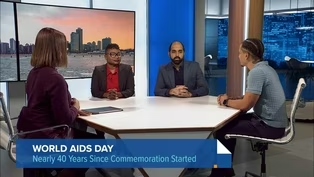
How Chicago Advocates Are Marking World AIDS Day
Video has Closed Captions
Clip: 12/1/2025 | 10m 12s | Chicago advocates are commemorating World AIDS Day. (10m 12s)
Providing Support for PBS.org
Learn Moreabout PBS online sponsorship
- News and Public Affairs

Top journalists deliver compelling original analysis of the hour's headlines.

- News and Public Affairs

FRONTLINE is investigative journalism that questions, explains and changes our world.











Support for PBS provided by:
Chicago Tonight is a local public television program presented by WTTW
WTTW video streaming support provided by members and sponsors.