
Dec. 15, 2025 - Full Show
12/15/2025 | 26m 47sVideo has Closed Captions
Watch the Dec. 15, 2025, full episode of "Chicago Tonight."
Advocates on both sides of the political aisle push for immigration reform. And the impact of “Operation Midway Blitz” across the city.
Problems playing video? | Closed Captioning Feedback
Problems playing video? | Closed Captioning Feedback
Chicago Tonight is a local public television program presented by WTTW
WTTW video streaming support provided by members and sponsors.
Dec. 15, 2025 - Full Show
12/15/2025 | 26m 47sVideo has Closed Captions
Advocates on both sides of the political aisle push for immigration reform. And the impact of “Operation Midway Blitz” across the city.
Problems playing video? | Closed Captioning Feedback
How to Watch Chicago Tonight
Chicago Tonight is available to stream on pbs.org and the free PBS App, available on iPhone, Apple TV, Android TV, Android smartphones, Amazon Fire TV, Amazon Fire Tablet, Roku, Samsung Smart TV, and Vizio.

WTTW News Explains
In this Emmy Award-winning series, WTTW News tackles your questions — big and small — about life in the Chicago area. Our video animations guide you through local government, city history, public utilities and everything in between.Providing Support for PBS.org
Learn Moreabout PBS online sponsorship>> Hello and thanks for joining us for this W T Tw News special looking at the divisive issue of immigration and the federal government's enforcement operations.
Brandis Friedman, here's a looking at.
Both sides of the political aisle say the immigration system needs changing.
But >> lawmakers have been able to agree on a solution.
scared.
And kid this happened his fear.
>> It came true.
>> Family members in limbo as relatives have been detained.
>> We've rescued over 3,000 criminal aliens with Operation Midway Blitz.
>> And from the financial impact to the spiritual, a look at per the effect Operation Midway Blitz is having on local residents.
We'll kick things off.
Right after this.
>> Chicago tonight is made possible in part why the Alexander and John Nichols family.
The Pope Brothers Foundation.
And the support of these donors.
>> As the city deals with the aftermath of aggressive immigration enforcement.
Some advocates say reform is needed now more than ever.
Both Republicans and Democrats say the immigration system needs change.
But for decades there's been no agreement about how to fix it.
While some say there are enough legal pathways for people to become citizens, others argue for tougher restrictions to discourage illegal immigration.
Joining us to talk more about this, our Matthew saw runs vice president of policy and advocacy at World Relief, a Christian humanitarian organization and on zoom states.
Senator Andrew Chesney, a Republican whose district includes Freeport in Western Illinois.
Thanks to both of you for joining us.
First, I want to get your reaction from both of you.
How do you think we got to this point with, you know, aggressive immigration raids in the city.
Lawmakers, though, still unable to pass any policy changes after decades.
Matthews, Torrance, first to you.
Yeah.
I mean, I think there's there's many without the critical of what some of the Trump administration is doing with enforcement.
But I do think actually the root problem here is the lack of action by the Congress under both Republican and Democratic administrations.
>> For decades to address a system that has been dysfunctional for decades has not provided adequate legal immigration pathways to meet the needs of our nation's labor markets that has come, family separated and I think we're seeing some of the impacts of that now with enforcement strategy that unfortunately has gone well beyond just going after those.
I think most of us would like to see detained or deported people been convicted of violent crimes who are public safety threat and going far beyond that, it's only about 5% of people nationally who are detained right now who've been convicted of a violent crime.
Senators has the same question.
You have think we got here.
>> President Biden open up the borders and allowed 20 million illegal immigrants to enter into our communities.
That is created total chaos and Republicans have correctly said for many years that this was going to create dysfunction in our communities and the cleanup of the Biden administration's open border policies has has created has created a little bit of controversy, but Republicans have correctly argued for a long time that we needed to have a secure border.
We are a nation of laws and they need to be enforced when those are not enforced.
You are now asking the new administration to enter into communities and correctly evict those that are in this country illegally.
And so if if people are scratching their head, how we got there, they shouldn't be because Republicans have been saying for multiple years under the Biden administration that this was going to happen and and create the challenges that we're presently seen President Trump has also as of late added some new restrictions on refugees lowering the annual limit map down to 7500, which is the lowest in history.
>> What's been the impact that you're seeing in your work?
Yeah, I mean, we're devastated world relief.
You know, we have worked here in Chicago and across the country to resettle refugees in partnership with many local church is more than 200 local churches here in Chicago and alone.
>> And lots of volunteers.
And this is clear, a lawful immigration process.
It's goes back to a law passed with unanimous support U.S.
Senate in 1980, we've had years since that law was passed in 18, 80 when we've had the refugee ceiling set by presidents like President Carter or President Reagan, President George HW Bush at 140,000 or higher.
And so to go down to 7,500 and what we're seeing now is sole focus on particular group from South Africa who I think the argument that they meet legal definition of refugee, some of those flood well-founded fear of persecution is is strained and you're looking white afrikaner.
there's folks we'd be happy to welcome for illegal immigration.
But it's not they don't meet the definition of refugee and whose excluded by that.
Our people persecuted for their faith, the Christian faith rather than just minority groups.
People who've been allies of the U.S.
military and are at risk as a result of people fleeing the war in Ukraine and Sudan and other countries.
And so we would really like to see this, you know, legal form of migration increased.
And also it's opportunity to meet the needs of the labor market challenges in state at a time when food prices are going up in part because of challenges agricultural labor sector senator chose me.
You and some of your Republican colleagues you all been pushing for repeal of the Illinois Trust Act.
This is the one that prevents local law enforcement from.
>> Collaborating with federal immigration agents in Illinois.
How do you think that will address the immigration challenges the state faces?
>> Well, Governor Pritzker rolled out the red carpet for legal immigrants and it's driving down U.S.
citizens wages and those legal immigrants are living in entry level housing or low-income apartments, which is creating the shortages that were seen today.
And so you want to increase supply before court, the illegal immigrants that have.
Have entered into this country legally.
And so we're we've seen the challenges on the trust act is when it comes to the coordination to removing those those criminal aliens from our communities, which is become much of a challenge and Governor Pritzker is putting up put up significant roadblocks or seen primarily in liberal areas like Cook County that refused to cooperate with even the worst offenders be on the offense of being an illegal immigrant.
>> Senator, are you saying, you know, deportation, wholesale of people who've entered the country illegally who are undocumented?
Maybe some who've been here who knows how Long, 10, 20 years or just you know what the department Homeland Security saying, you know, the the worst, those who have significant criminal backgrounds.
>> What we're saying is is that regardless of how long you've and you've been in this country a legal illegally, you're an illegal immigrant.
And if you're committing crimes above and beyond your immigration status, we still have challenges of of that coordination.
And we are unable in many cases to court date with their local authorities to remove these people from our country.
And so the trust act exacerbated that that problem and made it even more difficult than it already is to remove these people from our country.
And so I don't see much of a distinction that if you're here for 5 years, 8 years or one month, if you entered into this country legally, we have a responsibility as a nation to remove you from this country because there are millions of people that are waiting in line trying to do this the correct way to enter into this country and that that process is being litigated.
>> In many cases by those that don't want to follow rules and just want to sneak into our country.
>> That's where and when say to that, yeah, I mean, I think it's important to know that there are a lot of people, but a million and half people at least who were here lawfully a year ago who've had their legal protections taken away and have gone into that category of being unlawfully present.
These are people who were sponsors in places like Ukraine or Venezuela or Cuba.
Haiti fleeing really humanitarian crises.
you know, those people then lose their status looser, work, authorization, employers, you're out of luck.
Their churches are struggling because people are free to go to church.
Now for those who come unlawful into the country, we think it's appropriate.
There's a penalty for that.
And there have been bipartisan proposal Congress that would say there should be a penalty for overstaying.
A visa are crossing the border unlawfully.
There's a bill from Congress.
Juan Salazar, Republican of Miami and the House right now that we do that the Dignity Act.
It's similar to what George W Bush proposed 20 years ago of Barack Obama Post back in 2013.
We think that's an appropriate consequence.
And I if you look at the polling, the vast majority Americans and both evangelical Christians, which is base.
That was relief.
think that that's a good solution to the situation because it would keep families together say about the violation of laws, a problem.
There's a penalty but to separate families on a huge scale.
I mean, there 45 million U.S.
citizen, minor children in this country who have at least one parent who is vulnerable to deportation.
And we're starting see the effects of and that's where we'll have to leave it.
Certainly a conversation that would like to keep having for now.
>> Thanks to the both of you for joining a state Senator Andrew Chesney in Matthews.
Lawrence, thank you both.
Thank you.
Thanks for coming Up next, our Joint Hernandez introduces us to 2 people who've been impacted by Operation Midway Blitz.
The impact of the immigration enforcement search here has been wide and varied.
Most dramatic, perhaps the human toll are Joanna Hernandez is in Broadview tonight with a look at what some detainees say they've experienced Joanna.
>> And Brian is that's right.
We're going to hear 2 stories of 2 different individuals who pastor this facility, the broader view detention processing facility has been a flash point for protest during the peak of Operation Midway Blitz.
Now, this is a facility where people are detained across the Chicago area and are brought before being transferred to a different facility.
Advocates have said that conditions inside the facility are inhumane and the people that we spoke to tell us more about it.
>> They've been targeting a lot of that.
Stand for a while.
Then, you know, they really a lot of landscapers go there.
>> It's been more than a month since Alexander Gonzalez says federal immigration agents took her stepfather while he was working as a landscaper in Evanston.
I'll cause me He's like Yo.
just got here and, you know, the first thing I will show I don't know how to react.
This video footage captures an ICE officer pursuing Adriana Leon Gonzales before his son says he threw himself to the ground and surrendered.
I felt so many emotions all at once.
I was on the you know, obviously crying.
>> Those are very hard moment.
I couldn't believe Now the step siblings are fighting to bring him home.
>> He's currently detained in Michigan compared to broaden you.
It's it's it's a way better.
How would you describe what he said and he would sleep in their own floor.
you know, just what 30 around him.
>> The family says Adrian Little Gonzalez came from a cubicle more than 25 years ago and built his life here, raising his children in the United States.
>> He closed his eyes and I can say but a passion and his son like I know he's always been there for no matter what.
>> Their case is just one of hundreds still unresolved since the start of Operation Midway Blitz.
It's reported by the Department of Homeland Security that more than 3,000 people have been detained in Chicago and nearby communities.
Among them is Johnny Okay.
on Monday.
>> In the mean whether he's a communicator, believe it.
>> The NATO MS A says he fled to Chicago because of political danger in the Dominican Republic 2 years ago.
>> I mean, that's the only an opponent of an agent with the native can you can get up was enough for some of that.
And I think thing that I knew.
You somebody that I knew he shows us a paper trail of his case.
>> His immigration check and slip reads No, wants no warrants.
He says he would hear about arrests happening around immigration court but never thought it would happen to him.
Then came his second check in in October.
>> No one can it.
to it be.
Maybe a. Both that died at the also fit.
There you go.
Okay.
Kath.
that doesn't open Selena got any of the pie.
>> Now he's speaking out about what he says was inhumane treatment conditions when he was detained.
He holds back tears as he describes how he pleaded with an officer to allow him to use the bathroom.
But he was granted permission.
>> A could put an end.
>> He says the weeks that followed were in experience, he'll never forget.
As a team.
We but okay.
>> Do you have the 8 of us going a different?
>> them?
Issa says he was first sent to broad view where he described being placed in a room with more than 200 men and having nowhere to sleep.
After 3 days, he was transferred to a detention facility in St.
Louis, Missouri, where he spent nearly 2 weeks from there.
He was shuffle to Texas.
Then back to St.
Louis.
And finally to Indiana.
>> Yeah, you know that I don't.
But I like it indicative mean it?
And big area need pull.
fitting that, though.
>> He's talking about his experiences from in the detention facility in Michigan with the help of a lawyer.
He's now back home in Chicago while his case remains open.
>> I wasn't going to getting a lot of open so that you know, in the >> As they wait to hear from their attorney, the Gonzales is visits and phone calls are their only connection to him.
>> He might tell me that he's you know, he's up and a bit better.
Maybe to not concern me.
Concern us so long.
But a video called him a bit of called him that I've spoken to him a lot of times.
You know, he gets more minutes on the phone.
I just would like everyone to know.
Like I said, did not keys are working and does everything right and has no history of anything.
>> And we have an update from the attorney representing the Gonzalez family.
A court order for habeas corpus has been granting meaning authorities must either present.
And before a judge or release him on bond within 6 days, the family will know more this week reporting live from by view.
I'm joined on this.
Joanna, thank you.
>> And as Joanna mentioned, since the announcement of Operation Midway Blitz in September, thousands of people living in the Chicago area have been arrested by Immigration and Customs Enforcement for many Latino families and business owners.
Everyday routines came with the added fear of masked agents patrolling neighborhoods, streets often in unmarked vehicles as Illinois Governor JB Pritzker, put it, quote, Operation Midway blitz turned ordinary life into a risk for thousands of Illinois residents.
Joining us to talk about the impact, a Chicago communities are Strada marketing communications manager for the Illinois Hispanic Chamber of Commerce, Lindsey Joyce, Co president of the Board of directors at one North Side, community organization that serves neighborhoods like Rogers Park Uptown and Ravenswood.
And Reverend At Grace Church of Logan Square.
So value and a teacher at Nash Elementary School of Fine and Performing Arts.
And Reverend Juan Vargas priest at our Lady of the Rosary Parish on Chicago's northwest Side.
Thanks to all of you for joining us again.
Edgar starting with you for so Crain's.
Chicago Business reported in September that businesses in Little Village were experiencing year over year.
Revenue drops ranging from 20 to 50% as a result of the ice enforcement efforts as an organization that supports those businesses.
How has operation Midway Blitz impacted the livelihood of the businesses that you work with?
>> It's it's been terrible.
you know, we hear so many horror stories of just not seen the same liveliness that see in typically in that neighborhood because, you know, obviously a lot of Latinos are there.
You know, there's always been a community that that culture, you feel it.
There you go.
There.
You know, we had a, you know, some bread.
You can go get some Abe goods.
you going year?
You know, your favorite hair stylist?
It could be everything, right?
Because there's a little bit of everything And you feel that you like going there and you feel comfortable walking around being around your people.
And it's definitely like a lower ditched.
The foot traffic has been immense We're seen and and hearing people talk about how they're not seen that same live in anymore.
They're not feeling like they can be themselves.
They're they're not feeling like they could just go out on a walk on a Sunday, right on the weekends.
That was something that you would see ally, right?
You would go out early in the morning and you know me not being that far away out in the borough and area.
That was some place that I remember going to in my life.
And I always like getting a lot but it.
But right.
And you're not seeing those trees so have a back to all that used to attacked a definitely feel damper on that.
>> A father want father wind, the Our Lady of the rosary.
You have English mask.
You have Spanish mass and you've noticed that the attendance for the Spanish mass dropping significantly since the beginning of operation Midway Blitz.
How's the threat been impacting you as a pastor and your parishioners?
>> I mean, it increases a little bit of the work that we do it just because it involves a little bit more one-on-one.
So going to different homes and encouraging people to visit to call to check in on others.
The numbers I think you mentioned have been, you know, just lower but still strong.
It's not.
You know, we would see like 50 or 70, depending on, you know, any activity around the area, which is what cause a little bit of extra fear.
And also just kind of seen people from the Spanish mass going to the English masses, just kind of to to them.
They feel a bit more comfortable thinking that there's a less of a respected.
just because there's been times where that I call, we signed it.
checking the Jewels are walking around the church, the ground.
So just kind of so people will communicate that with one another and just try to support each other see you all come.
The whole company come together.
I would imagine it's a bit conflicting, right, because in a time of fear, people might, you know, seek God, right, go to the place where they can.
>> You know, commune with with fellow parishioners.
But at the same time, they're freed doing And so big push has been reach out, you know, like us that, you know, feel comfortable and so forth, like how are we reaching out to those that we missed that we haven't seen in a while and also if you have not heard of is someone to reach out to your are not for something to make sure that they're doing well as Check on your Lindsay Rapid Response work.
Is new for one northside?
Not the kind of work that we typically see you do but still seems in line >> described how the organization started to carry out your rapid response What led you to get involved in that?
>> Yeah.
What led us to get involved in it is these are people and what we're seeing over and over and over again is that Chicagoans at, you know, if you come from one Chicago and you come for us all, that's what that to Chicago is.
And so what's that?
Look what that looked like for us is that we built out this.
We call it the the the North Side.
Lakefront rapid response and this is.
So many different community organizer organizations, faith communities, local schools, elected officials and hundreds and hundreds of neighbors and the approach for us with three-pronged.
The first education.
Educating people on the rights, educating people on how to document safely.
The second prong was community defense.
And this is kind of what you think of when you hear about rapid responses, the whistle patrols, the school patrols, the bike patrols being out in the neighborhood tracking where ice is and alerting our vulnerable neighbors so that they can take precautions.
And then the 3rd piece that we're really, really proud of is our neighbor to neighbor network.
And we had over 500 neighbors sign up for this and the neighbor to neighbor Network is a network of trusted allies who are doing everything they can to reduce the risk to the most vulnerable people.
And this could look like.
Picking up groceries for folks that can look like taking kids to and from school.
It can look like helping to fill out paperwork showing up to immigration and doctors appointments or just anything that we can do to help protect and defend Chicagoans.
Because Chicago's an immigrant town, it always has always will be.
And and and these are the folks who have been working to make our city better.
so we we have a moral duty and a moral obligation to make the city better for them.
Governor Pritzker's office last week cited This is reporting from Chalk beat that 38 of Chicago's 77 neighborhoods saw student attendance dropped more than the district-wide freeze since the start of the operation.
About 40% of those that saw the declines.
>> Are home to the largest immigrant or Latino populations.
So value.
What have you seen at Nash Elementary?
We have seen some of our students not come to school because of this.
>> Because we have 30% of population is it populate should now and some of them they have talked about being afraid to come to school, not knowing, but the worst part is we have those students that parents are late picking him up.
could be many reasons.
And you see despair in the >> child's face when you're trying to tell like it's OK, they're on their way.
You're trying to reassure them well, all the time you pray and to yourself like pleas, don't let.
I hope that have been right to be picked up.
So there has been a decline in and then not only that we've had we've lost some students because families have started to move because of the fear of coming in contact with ICE as well.
You said that one of the hardest things to adjust to is is waiting for those for those students after school.
>> How have you have you manage that and how if have, have you talked to young people about that?
Just holding their conversation.
Check in on them.
Are you okay?
Do you want to talk?
How are you feeling?
Just let be in that moment and let them express to you what it is.
And then once once they hear at that, we've got in contact the parent.
That they're on their You can see the relief.
On on their faces and then not only win.
especially when they're at the door and I say hears mom, you could see there running they are running to go get to their parent.
is the supposed to be picking Ice is largely left.
Chicago, though, you smaller presence still remains.
>> You know, having come out on the on the, you know, the other side of this main portion of Operation Midway Blitz, there is talk that they will be back in the spring.
Think a lot of folks suspected it could not take Chicago's a a ger.
There's talk of have any confirmation of that.
But Edgar, like, you know, what are you looking where you see when you look into the future?
What are what are your thoughts about what could be happening next, right.
I mean, one thing that we always think about is we never really know what can happen, right?
We always have to be prepared for the ways and just continue to put in the work read lean on each other.
>> I think building the community up continuing to educate the community, continuing to provide resources.
That's something that we need yearlong right at the ICC.
People need help with their businesses all the time.
So we do business advising we do resource that we do workshops, webinars, we vents for people to come to.
And that's important, right?
Because people need to feel like there's an organization companies that care about them and whether there's going to be more ICE agents on the ground.
We're here for for the community regardless, right?
We've got to continue to B the organization that can support them all year.
Round father couple seconds left.
Same question to you.
What you see when you look into the future as far as supporting parishioners.
>> With the possible return of ice yet been able to see the people that have stood up to them.
You know, my colleague, a graph walking to New York from the different people that have been given the testimony after walking with one another.
>> And encouraging people one bringing that hope again.
But at the same time, knowing that it's still kind of keep the guard, let's continue to prepare ourselves to continue to working together to ensure that when happens again that we we can stand.
Our ground ready for it, OK?
That's where we'll have to leave We may or may not have to have you all back in here to talk about this again in the future.
But for now, our thanks to Edgar Strata.
>> Lindsey Joyce, so value Pittman and Reverend Juan Vargas.
And that is our show for this Monday night.
Join us tomorrow night at 5, 30 10 now for all of us here in Chicago Brandis Friedman, thank you for watching.
Stay healthy and safe and have a good thing.
>> Closed captioning is made possible by Clifford and law
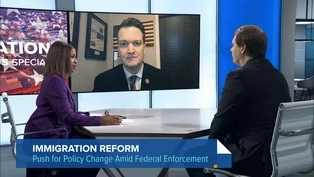
The Debate Over US Immigration Reform
Video has Closed Captions
Clip: 12/15/2025 | 7m 53s | Some say there should be more pathways to citizenship. Others call for tougher restrictions. (7m 53s)
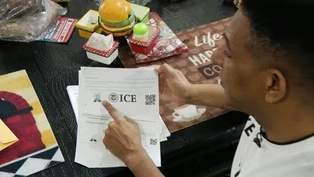
Families in Limbo as Thousands Detained in Chicago Area
Video has Closed Captions
Clip: 12/15/2025 | 5m 33s | HHS said more than 3,000 people were detained by immigration agents in "Operation Midway Blitz." (5m 33s)
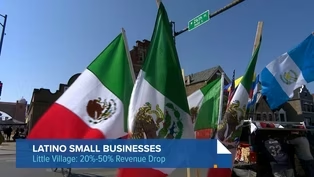
How 'Operation Midway Blitz' Has Affected Chicagoans
Video has Closed Captions
Clip: 12/15/2025 | 10m 16s | From the financial impact to the spiritual, WTTW News explores the lasting effects. (10m 16s)
Providing Support for PBS.org
Learn Moreabout PBS online sponsorship
- News and Public Affairs

Top journalists deliver compelling original analysis of the hour's headlines.

- News and Public Affairs

FRONTLINE is investigative journalism that questions, explains and changes our world.











Support for PBS provided by:
Chicago Tonight is a local public television program presented by WTTW
WTTW video streaming support provided by members and sponsors.