
Dec. 17, 2025 - Full Show
12/17/2025 | 26m 47sVideo has Closed Captions
Watch the Dec. 17, 2025, full episode of "Chicago Tonight."
The clock is ticking as Chicago alderpeople work to pass a budget before the end-of-year deadline. And the Trump administration unveils an aid package for farmers — but is it enough?
Problems playing video? | Closed Captioning Feedback
Problems playing video? | Closed Captioning Feedback
Chicago Tonight is a local public television program presented by WTTW
WTTW video streaming support provided by members and sponsors.
Dec. 17, 2025 - Full Show
12/17/2025 | 26m 47sVideo has Closed Captions
The clock is ticking as Chicago alderpeople work to pass a budget before the end-of-year deadline. And the Trump administration unveils an aid package for farmers — but is it enough?
Problems playing video? | Closed Captioning Feedback
How to Watch Chicago Tonight
Chicago Tonight is available to stream on pbs.org and the free PBS App, available on iPhone, Apple TV, Android TV, Android smartphones, Amazon Fire TV, Amazon Fire Tablet, Roku, Samsung Smart TV, and Vizio.

WTTW News Explains
In this Emmy Award-winning series, WTTW News tackles your questions — big and small — about life in the Chicago area. Our video animations guide you through local government, city history, public utilities and everything in between.Providing Support for PBS.org
Learn Moreabout PBS online sponsorship>> Hello and thanks for joining us on Chicago tonight.
I'm Nick Blumberg.
Brandis Friedman is on assignment.
Here's what we're looking at.
Where contentious budget negotiations stand as a possible government shutdown creeps closer.
Heather Sharon joins us with the latest.
A controversial bill allowing terminally ill patients to end their lives just became law.
A look at the potential impact.
And the Trump administration announces billions of dollars in aid for farmers hit by the country's trade war.
But the state's top agriculture official says it's not enough.
>> First off tonight, residents and local officials confront Border Patrol Chief Greg Bovino on his second day back in the Chicago area.
Masked federal immigration agents were reported and recorded in Rogers Park in Evanston earlier today.
The vino spoke with residents at a gas station just a day after taunting onlookers that it will be a quote, Merry Christmas in Chicago, Evanston mayor and congressional candidate Daniel Biss spoke briefly at the scene with the Vino telling us that agents would make the city safe before walking away.
The Department of Homeland Security has not responded to Wt Tw news regarding how many arrests agents have made but said that immigration efforts in the area are ongoing.
>> Eager voters excited about March's primary election can get a jump on the process with applications to vote by mail.
Opening today.
Voters can choose a political party's ballot or a non partisan ballot with only referenda.
And you can also sign up to be on the permanent roster for mail-in ballots.
The Chicago Board of elections is tentatively planning to start mailing ballots on February.
5th.
The deadline to apply is March 12th and the primary is March 17th.
Get your party hats and noisemakers ready because the city is out with details for Chicago's official New Year's Eve celebrations.
Performances are set to start at 09:00PM, et Wacker Drive.
And Franklin Street in front of the merchandise Mart.
It's part of the city's first time.
Joining the broadcast of Clark's New Year's Rockin Eve with Chance the rapper has local host and performer.
The city will launch fireworks on the Chicago River at midnight as well as at Navy Pier Street closures in the area will begin at 10:00AM on Monday.
The 29th with everything scheduled to reopen by 03:00PM on New Year's Day.
Got all the details on our website.
Up next, the latest on the heated Chicago budget battle.
Heather Sharon joins us to explain where things stand right after this.
>> Chicago tonight is made possible in part why the Alexander and John Nichols family.
The Pope Brothers Foundation.
And the support of these donors.
>> A plan to bridge Chicago's billion dollar budget gap without hiking taxes on large firms would leave the city with a deficit of more than 163 million dollars.
That's according to Mayor Brandon Johnson's office.
The mayor is calling the plan, which is headed to a final vote, speculative infeasible and immoral.
Our Heather Sharon joins us now with the latest as 13 are as all the people rather have just 13 days left to pass a budget.
So Heather, the City Council's finance committee voted 22 to 13 yesterday to send that budget crafted by a group of older people opposing the mayor to the full city council.
Is that budget balanced?
It depends on who you ask.
If you ask the mayor, he will tell you.
Absolutely not.
And budget director and that Kuzma and Chief Financial Officer Kei spent most of this afternoon explaining in painstaking detail.
>> To use older people why their budget plan was not based in reality.
They did not get a receptive audience.
And that is essentially the crux of why it is just 13 days until the deadline.
No one believes anyone else.
Nobody agrees with the facts of the city's financial condition are, although they do agree, it's not well, I think most of us agree but pretty tough otherwise to come to a consensus, you know, this plan, it eliminates the mayor's proposal to levy a $33 month per employee tax on companies with 500 or more employees.
It would pay 140 million dollars more toward cities, pensions.
How to its supporters make up that difference.
So it's really a complicated plan.
The biggest line item would be an expectation that that Kid City could collect nearly 90 million dollars more in debt from Chicagoans.
Now, the mayor's team says we share that goal.
The people who have violated the city's laws should pay what they owe.
They just don't agree that collecting an additional 90 million dollars next year as possible, especially because the mayor's budget already expects to collect 100 million dollars more next year than they did last year.
Thanks to enhanced enforcement efforts.
Now the mayor says he's worried that that means that Chicago's poor assist the poor Chicagoans will face hectoring from third-party debt collection firms.
He says that's not the right way to bring the city.
You know, we heard some strong words from the mayor in the opening.
There could vocab words to out Mayor Johnson says if the city council passes the spending plan, the city's immediately going to find itself just mired in red ink.
>> Do we expect he'll veto it?
Well, he hasn't said one way or the other.
He canceled a press conference this afternoon where he certainly would have been asked that question.
>> Perhaps there are things going on behind the scenes that we are not privy to, but it's not clear how to balance the budget without raising significant taxes on Chicagoans, either individuals or corporations.
And nobody agrees what that package should look like.
All right, that the clock is ticking here.
So what happens next?
revenue side of the plan, the taxes and everything could head to the city council as soon as tomorrow.
We don't expect substantive votes.
But the actual legislation that spends that money, no idea when that will make to city Council.
All right.
We know you'll be watching out for us.
We hope it doesn't go crashing right into Christmas.
Heather Charron, thanks so much.
Thanks, Nick.
>> And you can read Heather's full story on our website.
It's all A W t tw dot com slash news.
>> Terminally >> ill patients in Illinois will soon be able to end their lives with medical treatment.
Governor JB Pritzker just signed the medical aid in dying bill into law.
It allows patients with with less than 6 months to live the choice to take life ending treatment with a doctor's approval.
Supporters of the measure say it gives those who are already dying a peaceful way to go.
While opponents worry it could worsen health care disparities.
Joining us to discuss the new law are state representative Bill How'd or a Republican whose district includes Morton in Central Illinois and state Senator Linda Holmes, a Democrat whose district includes parts of Naperville, Aurora and Boulder Hill.
Thank you both for joining us.
We appreciate it.
Senator Homes, I like to start with you.
Please.
I know you have a personal connection to this legislation.
Can can you tell us why it was something that you are interested in sponsoring?
>> Yes.
The reason I decided to sponsor this, it's a bill I always wanted to sponsor in the General Assembly wasn't sure we never be plugged point where we can do it.
However, my father died when I was 15 lung cancer.
My mother in 2016 died of pancreatic cancer.
And I will say when you watch people you love it's horrible to lose somebody.
love when the guy with a terminal illness.
But watching them soccer is even worse.
>> And Senator homes that, you know, this bill is only applicable to certain patients.
Can you tell us what the restrictions are regarding who's eligible for medical aid in dying?
>> Yes, there's very many because we wanted a lot of guardrails in place.
You have to be 18 or older.
You have to have a diagnosis of a terminal illness that gives 6 months or less to live.
You also have to have both 2 doctors agree on that diagnosis and either those factors questions your mental capacity to make such a decision to make an informed decision, you then to have a licensed mental health care professional.
We in also.
>> And Representative Howard you're opposed to allowing patients access to this kind of aid.
Why is that?
>> Well, I thank first.
Thanks for having me on that.
You know, we are very sensitive as physicians.
I'm a physician.
And, you know, we are the ones who take care of these patients.
So we we take care of compassion.
We try to relieve suffering.
We fight for their dignity and worth life and in death.
And so, you know, we have and medicine.
We have a medical aid in dying.
That was what this bill was called.
And it's it's palliative care.
hospice care are ready.
>> So to you, it's it's unnecessary.
And, you know, representative in in your work as a physician, have you ever had terminally ill patients interested in something like this in in medication to end their lives?
>> A lot about sort of and the city all just and I'm also board certified in emergency medicine.
I dealt with that patients all the time.
And I've dealt with families of dying patients.
And so, you know, in the in the Illinois State Medical Society, we've debated this and multiple years and we stand opposed to it.
The largest representation of doctors in Illinois stands opposed to it and why?
Why is that neck?
And that's because really violate their oath are ancient and sacred oath that we have that we've taken.
And that is first do no harm.
And so this is incompatible with that we've taken.
And so there's so many reasons that we oppose it as physicians, not only medical out the and not only do we have medical aid in dying already with hospice care with palliative care.
We've devoted great resources that's helping are suffering and dying patients to help them well as they as they go through the dying process, but also were opposed because of the expansion that we see everywhere that it's been tried.
And I can give you examples excuse me out its been expanded all from Canada.
The euro to states and the and the United States like Oregon and Washington.
And then finally and you kind of alluded to it at the beginning of the program.
We see equity so we see 2 tiered system developing everywhere.
It's been tried.
And so those with means and those with abilities to pay for expensive treatments, like cancer treatments are able to do so.
And those who can't or have disabilities or chronic illnesses are made to feel like they almost have duty to made to feel like a they have been a burden on society or their caregivers and they almost have a duty to die.
>> And yeah, you know, Senator Holmes, that's one of the groups that we've spoken with that up opposes this access living had, you know, sort similar concerns about that saying that, quote, disabled people have faced a long history of the devaluation of our lives by medical professionals, making people more likely to face coercion into suicide, to avoid, quote, being a burden or costly to society.
Do you think that's a risk here at all?
You know, what's your response to those sorts of concerns?
>> I don't.
And the reason I don't is because number one, I actually a member of disability community.
I was diagnosed with MS 35 years ago.
So I know what it's like to live with a disability having a disability doesn't bring you any closer to the opportunity to use this measure.
You have to be diagnosed with a terminal illness that gives you 6 months or less to live and having a disability is irrelevant to that I will also say that anybody goes to a doctor and feels because they have a disability or that their life isn't worth anything needs to strongly change their physician and make sure that they are being treated by somebody who is chilly, compassion.
I will also say that, yes, we have hospice 88% of the people that choose to use medical aid in dying are already in hospice.
And there is palliative care.
I will argue that this is palliative care because 37% of people that end up getting this prescription, get it Don't even use The reason being is nobody chooses to use this right away.
Number one, let's start out understanding that these are not people that want to dine.
These are people that are going to die.
You are in intense pain.
You're going to wait until that final and what it's like.
All of a sudden you cannot take it anymore.
Which is why 37% of the people with the prescription don't use it.
I don't need it today.
I can make it one more day, but its palliative because, you know, you have that comfort of if the pain becomes unbearable.
I can use this.
And I understand we have regular hospice.
I will also tell you from the daughter watching her parents hospice and the drugs they give you.
Do not take care of the breaks, your pain that happens when you something like pancreatic or lung cancer.
>> And senator, before we run out of time, I want to ask is, well, you know, to that point about sort of this being a slippery as some opponents see it, that that this might expand.
Is there any appetite, senator from Illinois lawmakers to try and expand this right now?
>> And as you'll notice, we pass this by a very slim majority in both chambers.
So to be expanding this any time soon, I don't see happening.
it's not just the slippery because you have to understand anything that changes has to come back before our full and >> And, you know, representative, before we run out of time, we've got about a minute left.
But, you know, as as we've discussed, there is a range of palliative care for terminally ill patients.
Is there any version of of medical aid in dying you think could be a part of that anyway, this this measure could be amended or do you just see it as a sort of flat out inappropriate?
>> Well, I mean, it's so difficult because, you know, we see these patients.
We take care like I said before, and we have great compassion and medicine.
We're trying to find the answers.
We just don't believe this is the answer.
And so we as we grow the specialties of of of palliative care and hospice care, we don't want our patients to consider positions who always been healers and fighters for their life and for their care for their healing and for theirs relieving offering to be seen as now those who will help them commit suicide.
It's against it's against picks and it's against really our principles and our practices that we have had for decades.
>> All right.
Well, I know it's a topic that you both feel passionate about and we thank you for joining us to discuss it.
And fortunately, we are out of time State Senator Linda Home State Representative Bill Hauteur, thank you for joining us.
Thank Up next, an Illinois official who thinks a proposed aid package to farmers is not enough.
Struggling farmers across the country, including in Illinois, may be getting some relief.
The Trump administration is announcing 12 billion dollars in one-time payments to farmers who are facing massive uncertainty amid the administration's ongoing trade wars.
The package is set to cover a portion of the model of losses.
Farmer suffered over the 2025 crop here.
But critics say it's not enough.
Joining us now is one of those critics.
Jerry Costello, director of the Illinois Department of Agriculture.
Thank you for being with us.
We appreciate your time.
Yeah, I'd like to start with, you know, Illinois is the nation's leading soybean producer with China as the largest export market.
So what kind of an effect?
You know, have you seen the Trump administration's trade war with China have on Illinois farmers?
>> So the trade war in the tariffs have been absolutely devastating.
We saw no soybean exports from the U.S.
let alone the state of Illinois, the number one producer of soybeans in the United States.
Up until November.
If you track this back to Trump won the first Trump administration.
You look at what occurred there.
>> In 2016 62% of all U.S.
soybeans.
X sported went to China.
>> 2017 President Trump.
Then Putin tariffs in 2018.
That number went from 62% to 18%.
There is no reason to believe this time around will be any better.
It's absolutely ludicrous.
We're in this position.
>> Do you think this aid package adequately offsets the losses that Illinois farmers are facing >> so not not even close again.
Going back to Trump won the first Trump administration.
The losses there in 2018 19 were about 27 billion dollars.
72 1% of that was soybeans.
Specific.
95% of it was China specific.
If you look at that and that time period, we had a 23 billion dollar aid package back then.
Now the losses we're talking about are anywhere from 35 to 45 billion dollars.
And this aid package is less than half of what the one from 2018 s.
>> So what kind of an aid package would you like to see something in that?
35 to 45 range.
>> What so here's what I would tell you what we need far rivers, agriculture.
We need tree not be because this is just a band-aid on a heart attack.
He is trying to slow bleeding.
You know, one year scenario when we have markets deteriorating.
Global trade, it is the answer.
Not So, know, look.
Nobody's going to look a gift horse in the mouth, so to speak a little bit of money is better than nothing.
But this is woefully inadequate.
The end, honestly, the president needs to do in my opinion.
Is changes his tariff tactics, strategic or tactical is one thing this across the board approach has been devastating to agriculture.
>> You know, when the USDA announced the 8 package, it said in a release that this would offset, quote, temporary trade market disruptions and increased production costs still impacting farmers following 4 years of disastrous Biden administration policies that resulted and record high input prices and 0 new trade deals.
Does that kind of an assertion square with what you saw farmers facing during the previous administration?
>> If look these terror policies didn't work the first time.
And here's where we're at this time around.
Literally in the last 10 months, tariffs or taxes on nitrogen up 10% tariffs or taxes on herbicides, pesticides, insecticides up 20% tariffs are taxes on and equipment up 13%.
Tara, for taxes on tractors, up 16%.
This is just during the president's term in the last 10 to 11 months.
what hearing and seeing honestly is smoke and mirrors.
>> So yeah, to to that point that it's not just really the cratering of exports that you're dealing with.
Illinois farmers are also facing challenges, you know, getting the supplies that they need as well.
Is that fair to say?
>> 100%.
So the only farmers are being squeezed.
They're getting less for their product.
They're paying more for inputs.
And I'll give you an example.
So right now, as we sit here, quarter is trading somewhere probably around 4.20, year, just under beans are trading about 10, 50 year just under break.
Even for the average Illinois farmer this year is about 4.60, give or take in about 11, 60 on beans.
So anyway, you look at farmers are under water large part because we don't have a market to sell into.
You started the segment off by saying China the largest importer of U.S.
soybeans are they have been?
What business do you know that goes to their number one customer who buys 62% of their products and punches him square in the face essentially saying we don't need you.
>> Will to that point the Trump administration announced in early November that China would buy 12 million metric tons of U.S.
soybeans during the final 2 months of this year.
Has Illinois seen any benefit from that deal yet?
>> good, very small.
let me tell you.
These are more smoke and mirrors.
At the end of the day, 12 million metric tons.
That's half of what's normally been purchased.
So in recent years, China's purchase.
26 to 30 million metric tons.
So when you talk about wow, that's why they're using numbers.
It sounds like a big number.
It is my new, you know, our half compared to what we normally experience.
The 25 million over the next 3 years.
That's what's been normal.
So not anything that's been brought to the table.
It's trying to go back to a normal trade cycle, which to be blunt with you.
I don't know that that's going to happen because right now.
China has it even how the trade agreement that they signed with the Trump administration in 2020, they were, I believe about 20% light.
According to that trade agreement.
So 20% that they didn't purchase that they said they were going to.
I don't see a reason to believe that they're going hold their word this time.
We've got about 30 seconds left.
But I want to ask, you know, the average age of Illinois farmers is 58.6 >> Do you think these kinds of pressures on agriculture could make it even harder to attract younger folks to the profession?
>> It absolutely is.
I'm glad you brought that up because we have more people in the state farming that are over.
75 under.
35.
And when you look at all of the barriers of entry into agriculture, so when costs are still pretty costs are still pretty high right interest rate in fairly high.
Younger people getting into agriculture.
That's who all of this is affecting the most in when they're in a position that they can't make a profit.
In these last couple of years.
But but really exaggerated by this tariff policy.
It's extremely hard to attract new farmers, certainly and in farming.
>> Certainly a lot of challenges there.
Director Jerry Costello, Illinois Department of Agriculture.
We thank you for your time.
>> Thank you so much.
>> And that's our show for this Wednesday night.
You can stream Chicago tonight on our W T Tw YouTube Channel every evening and catch up on any programs you may have missed.
Join us tomorrow night at 5, 30 10.
The state's New Accountability Commission tasked with documenting potential abuses by federal immigration agents is set to meet for the first time.
Now for all of us here in Chicago tonight.
I'm Nick Blumberg.
Thank you for watching.
Stay healthy and safe and have a good night.
>> A close caption he's made possible by Clifford and

Examining the Impact of Illinois' New 'Medical Aid in Dying' Law
Video has Closed Captions
Clip: 12/17/2025 | 9m 7s | Terminally ill adults in Illinois will soon be able to end their lives with medical assistance. (9m 7s)
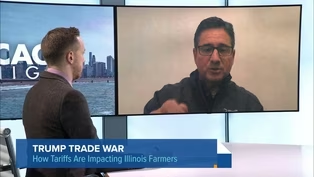
Illinois Agriculture Director on Trump's Farmer Aid Package
Video has Closed Captions
Clip: 12/17/2025 | 8m 20s | Critics say the $12 billion made available isn't enough to meaningfully compensate farmers. (8m 20s)
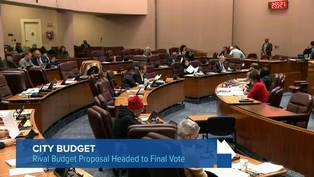
Where Budget Negotiations Stand as Dec. 30 Deadline Nears
Video has Closed Captions
Clip: 12/17/2025 | 3m 22s | A budget must be passed by Dec. 30 to avoid an unprecedented shutdown of city government. (3m 22s)
Providing Support for PBS.org
Learn Moreabout PBS online sponsorship
- News and Public Affairs

Top journalists deliver compelling original analysis of the hour's headlines.

- News and Public Affairs

FRONTLINE is investigative journalism that questions, explains and changes our world.












Support for PBS provided by:
Chicago Tonight is a local public television program presented by WTTW
WTTW video streaming support provided by members and sponsors.