
Instacart’s AI Technology is Hiking Prices as Much as 20%: Report
Clip: 12/16/2025 | 8m 12sVideo has Closed Captions
The report said customers are “unknowingly part of widespread AI-enabled experiments.”
An investigation from Consumer Reports and Groundwork Collaborative revealed that Instacart displayed different prices on the same household staples sold at well-known stores.
Problems playing video? | Closed Captioning Feedback
Problems playing video? | Closed Captioning Feedback
Chicago Tonight is a local public television program presented by WTTW
WTTW video streaming support provided by members and sponsors.
Instacart’s AI Technology is Hiking Prices as Much as 20%: Report
Clip: 12/16/2025 | 8m 12sVideo has Closed Captions
An investigation from Consumer Reports and Groundwork Collaborative revealed that Instacart displayed different prices on the same household staples sold at well-known stores.
Problems playing video? | Closed Captioning Feedback
How to Watch Chicago Tonight
Chicago Tonight is available to stream on pbs.org and the free PBS App, available on iPhone, Apple TV, Android TV, Android smartphones, Amazon Fire TV, Amazon Fire Tablet, Roku, Samsung Smart TV, and Vizio.

WTTW News Explains
In this Emmy Award-winning series, WTTW News tackles your questions — big and small — about life in the Chicago area. Our video animations guide you through local government, city history, public utilities and everything in between.Providing Support for PBS.org
Learn Moreabout PBS online sponsorshipshoppers may want to check their receipts the next time they order from Instacart.
The new study shows the same items bought from the same grocery store using the Instacart app could have several different prices.
The research from Consumer reports, Groundwork, Collective and more perfect Union found that the company made pricing decisions based on third-party information about users, shopping behavior.
On average, a family of 4 that used Instacart for groceries could see yearly expenses increased by nearly $1200 due to so-called surveillance based pricing.
Joining us now to explain our Clare Johnson, assistant professor of law at the University of Illinois, Chicago and Zoom, Eric Gardner, business reporter for More Perfect Union.
That's a nonprofit education advocacy and journalism organization focused on the working class.
Thanks to both for joining us.
So, Erick, you worked with, as we mentioned, Consumer reports and groundwork collective on this study for 6 months.
What did you find out about how companies are charging consumers for groceries?
>> Yeah, that's a great questions.
So what this really story set out to do was try to figure out is insecure, charging people, different prices different items.
And to kind of answer that question, we did, you know, big test of about 400 individuals, 427.
We all got on my same time identified the same 20 items into the same store.
Same location and loaded them up in the basket.
And at the end of because took screenshots of everything and tracked how much everything costs people are charged and with pretty widespread as you described there, especially with the system is puts people into what we're calling pricing groups.
So that means when you look and Instacart for reason you're assigned to different price group and to give people a sense of what that gap is.
Some tests of 7 different price groups, distinct ones where everyone was charged the same amount for the same product and on the low and some folks paid $114 for the 20 items and on the high but $124.
My.
And we reached out to inspect comment and they claim that is all random testing that retailers are doing around, trying to find optimal price points for items.
But as we started this investigation, we realize that they haven't an extensive patent portfolio basically breaks customers down into different buying behaviors, purchasing patterns, kind of more or less.
This whole profile about who you are and then assigns of the different social groups.
>> So, yeah, what you're referring to is the sophisticated customer segmentation technology.
What does that mean for shoppers to be grouped this way?
>> Yeah, I think what it means is that, you know, I think there's this idea with an America that when you go shopping, especially something like groceries, that you're paying a price that the retailer kind identified to kind of get people in the door in.
Unfortunately, as time to be involved in technology is involved.
It's could be further from the truth.
You really kind of encased in COVID mass testing all times to understand what is the maximum amount of profit in a company or perfect price point to extract the maximum loan amount of profit online.
It's done and individual level as you start researching investigating the phone actually in stores as well store level meeting for a team that has 100 teen for 100 stores.
They may be running the different price tests across each individual start a kind of determine the optimal price point.
>> I'm Claire, as Eric says, no.
The report found that Instacart is using third-party information to do this sort of pricing.
This customer segmentation into different groups.
Different price points.
For example, a dozen Lucerne eggs sold for 5 different prices ranging from 3.99 to 4.79 on Instacart all of the same Safeway store in Washington, D.C., that happens revealed that algorithms were being based on would be based on customer shopping behavior to addressed those prices rather than demographic information like race or gender.
How are these different house?
One legal and the other one is not >> well, so they always say that if you don't know what the product is, you are the product.
So we know the is being collected and sold.
Sort of threw out the ways that we use the Internet and that we interact with with various companies.
So we know that the 3rd party companies are selling some of the from a consumer protection standpoint.
We have laws both at the federal and state level to protect consumers from this kind of misrepresentation and this kind of deceptive advertising.
One of the biggest concerns that I saw in the report is that there are sort of false discounts, that it was stating that the original price of something was 5.39, but Instacart was offering it for 3.99 And that's illegal under the Illinois Deceptive Trade Practices Act.
And it also violates the Federal FTC Act which protects consumers against unfairness in the marketplace.
So from a consumer protection standpoint, this Instacart.
And if they're colluding with these retailers, they're engaging deceptive practices that allow them to get a leg up over other vendors who might be being fair in the marketplace and being transparent about their pricing.
So even though it is not that sort of demographic based algorithm which is illegal, right, you can't change prices for someone based on, you know, their gender or or or, you race any of that stuff.
>> Even though it's not that if there's a chance, it sounds like that this is still illegal and violation.
It could certainly violate consumer protection statutes.
However, we also know that there's bias built into algorithms, right?
So even if something is not at an individual level identifying someone by race or gender or age.
Deb, geographic areas can be proxies.
Also, if we know sort of the general credit score of a neighborhood that could be a proxy for race as well.
Some of these data points that are happening at the aggregate level that more perfect union noticed.
And that may still be engaging in discriminatory practices out through the algorithm.
>> Eric customers.
You know, we already pay surveillance or algorithm based pricing for airplane tickets, hotels, large events like concerts.
But researchers surveyed more than 2200 people and found that 72% of people who have used Instacart in the previous year did not want the company to charge different users, different prices for any reason.
What makes it different?
You know, why might people respond differently over groceries versus airline tickets or hotel prices?
>> Yeah, I think there's something visceral around groceries, right?
Like when it comes to airlines or movie tickets for concert tickets, like there's always the option for the argument people make.
We don't need to do that.
You take a train.
You can take a pass.
But when it comes to food bank, there's no other option you have to eat.
And so I think when people find out people are being charged, different amounts for the same products at the same time kind of gets that kind of the core of unfairness kind of practice should be adopted.
>> Claire can state and federal governments could they regulate surveillance pricing?
Is there something they need to be doing in response to this new information?
Monday, Pecan in New York just past an anti anti surveillance pricing and algorithmic Lee place price law.
However, that's a disclosure based law.
And so it doesn't really have any teeth.
You can't sue under it if you're harmed.
It requires the disclosure by retailers.
If they're if they're setting an organized price, however, the or marketplace and fair trade is premised on this idea that consumers should have enough information that they can vote with their feet.
And as pointed out, that's really difficult when it comes to groceries.
And so if the prices themselves or deceptive and misleading then I think we can look at things like the unfair and deceptive acts and practices laws that exist at the state level.
And again, the FTC act at the federal level that prohibits unfair and deceptive marketing or if that's where we'll have to leave it.
This is fascinating.
I'm dying to know what what retailers know about me, but

How a Murder Raises Questions About Roseland Hospital
Video has Closed Captions
Clip: 12/16/2025 | 3m 26s | A WTTW News investigation revealed a troubling pattern of lapses in patient care. (3m 26s)
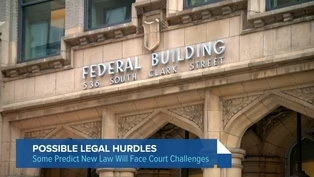
New Law Limits Federal Immigration Enforcement in Illinois
Video has Closed Captions
Clip: 12/16/2025 | 7m 49s | Critics complain the law will be overturned by the courts. (7m 49s)
Providing Support for PBS.org
Learn Moreabout PBS online sponsorship
- News and Public Affairs

Top journalists deliver compelling original analysis of the hour's headlines.

- News and Public Affairs

FRONTLINE is investigative journalism that questions, explains and changes our world.











Support for PBS provided by:
Chicago Tonight is a local public television program presented by WTTW
WTTW video streaming support provided by members and sponsors.