
Listen To Me
Season 18 Episode 1 | 56m 5sVideo has Closed Captions
The road to motherhood takes 3 Black women on a journey from heartbreak to resistance and healing.
Listen to Me is the story of three Black women navigating pregnancy within a system not built to protect them. The film challenges us to shift the narrative from crisis response to reimagine maternal health as a continuum of care, justice, healing and radical listening.
Problems playing video? | Closed Captioning Feedback
Problems playing video? | Closed Captioning Feedback
Funding provided by the Corporation for Public Broadcasting and the John D. and Catherine T. MacArthur Foundation.
Support provided by:

Listen To Me
Season 18 Episode 1 | 56m 5sVideo has Closed Captions
Listen to Me is the story of three Black women navigating pregnancy within a system not built to protect them. The film challenges us to shift the narrative from crisis response to reimagine maternal health as a continuum of care, justice, healing and radical listening.
Problems playing video? | Closed Captioning Feedback
Where to Watch AfroPoP: The Ultimate Cultural Exchange
AfroPoP: The Ultimate Cultural Exchange is available to stream on pbs.org and the PBS app.
Providing Support for PBS.org
Learn Moreabout PBS online sponsorshipDR.
KANIKA HARRIS: Patients are feeling like they're not heard, and they're not being listened to.
BIANCA PRYOR: We put her there and one tear rolled out of Shalon's eye.
WANDA IRVING: I see inequity wherever it exists.
I'm not afraid to call it by name.
WOMAN: When life comes and you claim it, being Black gives you that added advantage.
WOMAN: You have the resources, you have the knowledge, but it still is not enough to save you.
Then what's the answer?
♪ ♪ ♪ ♪ ♪ Hey ♪ ♪ Hey ♪ ♪ ♪ ♪ Hey ♪ ♪ ♪ NARRATOR: "Dear Shalon... "...on your 40th birthday.
"...I wonder what country you would travel to "to bring in the big 4-0.
"I think you would want to be near water, "in a place of peace, "surrounded by beauty.
"With a row of fine brothers in the view.
"I think you would choose a new adventure, "a place that you had never been before.
"I wonder if you would've "invited all of your sister friends "to go with you, or would you want to be in solitude?
As you cast your vision for the future."
WOMAN: ♪ Let her take you with her ♪ ♪ Let her take you with her ♪ ♪ Let her take you with her ♪ ♪ And she'll wash your tears away, sister ♪ ♪ Let her take you with her ♪ ♪ And you'll find that all the troubles you have ♪ ♪ Will no longer arrest you ♪ ♪ ♪ ♪ ♪ KATHRYN HALL-TRUJILLO: I think the Black maternal health movement is very, very old.
And it began on the journey here, when Black women made the decisions to throw their babies overboard rather than have them being born to wherever-- they didn't know they were going, or what was going to happen to them.
But they intuitively knew that it was not a good thing.
♪ ♪ ♪ ♪ KATHERINE GATES: I so badly wanted a girl.
And back in those days, you didn't know until the baby was actually born.
So, it was so special for me to finally have my girl.
Well, she was determined to have her way.
Yeah, she definitely wanted things to go her way.
And I remember one time saying to her, "The world does not revolve around Ebony."
And she said, "Why?"
That was... (chuckles) From four on, I had her in dance school, you know?
So it was not the idea that you were Black, it was your ability, you know?
I had to put that into her.
DR.
EBONY MARCELLE: I loved jazz.
From my freshman year all the way through high school, I was on dance team, and three out of the four years, I was the only Black girl.
Then the white kids.
Remember that time somebody called you something and you were upset?
And we had to talk, and I had to tell her, you know... EBONY MARCELLE: Like, how many times did we have these situations?
GATES: And I used to say to her how beautiful you are, and she was like, "You're my mother," you know?
So.
(laughs) It was hard on me.
It was very hard on me.
I felt like I didn't understand why I was not feeling comfortable, because, maybe 'cause I knew what it was to be in more diverse spaces, coming from Jersey, and, like, the racism in California is not as explicit as it is, like, in the South.
And so just all those subtle overtones just beat you over time, from like, you know, the hair conversation, to, you know, "Does your mom have, like, eight kids?"
Or, "Are you guys on welfare?"
And like, Orange County was very wealthy, and I'll always give the credit that, like, it gave me a pristine education.
Like, I had a really great primary education from them.
But it was stressful.
It was very, very stressful.
♪ ♪ KIDS: ♪ Happy birthday, dear Kanika ♪ ♪ Happy birthday... ♪ Hi Kanika, happy birthday!
HARRIS: I grew up in Washington, D.C.
with my mother, my uncle and my grandmother.
It was me and my mother as an only child.
I have half-brothers and half-sisters that would stay and come in and out of my life, but for the most part, it was me and my mother.
My mother gave this to me!
WOMAN: Who?
YOUNG KANIKA: My mother!
TOWNS: Who?
YOUNG KANIKA: My mother!
WOMAN: Let's have mom stand up.
Yay!
(applause) HARRIS: My mother was my everything.
It always felt like it was me and my mother against the world.
WOMAN: Greatest achievement so far.
Yay, Kanika!
(applause) HARRIS: She wanted to make sure that I thrived as a Black woman in America, that I knew my heritage and my culture, that I had the best education, and that I also had community and I had joy.
♪ ♪ IRVING: You know, my life was put on hold as soon as they were born, and it was whatever they needed and however I could expose them to the most so that they knew this world was larger than just their block or their house or their city.
And this is for Shalon.
HARRIS: Okay.
She was the middle child, and the only girl, and my heart.
And we were best friends after she turned about 25, 26-- those teenage years were a little difficult.
Every year, we'd take two trips abroad, and we'd just enjoy each other's company.
And I remember it was summertime, and I think it was like August.
And I just remember, she was sitting there, and she had this, like, long, fierce, flowy skirt outfit.
Like, she was dressed to the nines.
I said, "Look at sis!"
Like, she was, like, pulled together incredibly.
Like, hair was laid.
And I was like, "Oh, my gosh, I have to know her."
I loved Ms.
Wanda, and the bar is high.
There is just a general expectation of excellence, Black excellence in their family.
And I was always amazed by her.
Like, she never let anything knock her down.
HALL-TRUJILLO: I find myself doing a lot of reassuring, that it feels like it's never the right time to have a baby.
That same piece of coal that either gets ground to dust or shaped into a diamond teaches us something.
About being prepared.
About being courageous, and about having faith and holding onto the light.
♪ ♪ I actually thought I wanted to be an O.B., um, but then I went for a GYN exam, and it was so different than any other experience I'd ever had that I fell in love with midwifery.
And it took me about seven years, I think, total, to, like, take all the pre-reqs to go back to nursing school, and then to work and go to school, but the day I caught my first baby, I cried, and I knew that was what I was supposed to do.
My educational background began at Howard University.
From Howard, I went to Morehouse School of Medicine to get a degree in public health.
From there, I went to the University of Michigan to get a doctoral degree in health behavior and health education.
The University of Michigan was the first time as an adult I was in a predominantly white institution, and I had imposter syndrome.
I didn't feel like I belonged there.
I still grapple with why my mom was so protective and secretive about her illness, but I think... she probably just wanted to protect me, and she knew something like that would, um, break my heart or break me.
Being the caretaker for my mom was the most stressful and taxing thing on my mind, my body, my whole soul, um, because she didn't want people to see her as sick as she was.
I did it alone, and it was a... 24/7, you know, mind on, um, just totally freaked out all the time process.
When you're in hospice at home and they give you that death kit and they tell you what to do with it, it was, um... I don't know, it was just, every day was traumatic.
And then finally, around 8:00 in the morning, when, you know, one of her really close friends came in and was like, "Why don't you lie down?
Just lie down by her bed.
Just lie down."
Soon as I closed my eyes, she left.
And, um, I think she was just waiting for me to... ...she was just waiting for, um, me to let go.
♪ ♪ I decided to finish my degree from a distance.
On top of handling all my mom's affairs and running her business.
Um, so I was doing a lot.
And somehow through it all, I ended up pregnant.
(laughing) Debut announcement.
Everybody listen up.
This is very, very big, big news.
JUA FLUELLEN: Yeah, that's what I said, big news.
(laughing) So what's the news?
We having twins.
Twins!
HARRIS: One, two.
FLUELLEN: Twins!
HARRIS: Not one... FLUELLEN: Double.
HARRIS: ...but two.
FLUELLEN: Bam!
HARRIS: Bam.
FLUELLEN: Bam!
HARRIS: One, two.
FLUELLEN: Bam!
Boy, girl!
HARRIS: Boy, girl.
FLUELLEN: Boy, girl.
HARRIS: You know, I'd never been pregnant before, so being pregnant with twins was... it was tough.
Um... but... ...I didn't know what pregnancy felt like.
I did not have the space to grieve, I think, that I needed.
Um, and I just wouldn't give it to myself, because I thought that if I did... ...um, I wouldn't be able to pick myself up, 'cause it was just that daunting.
So, I just filled my life with goals and expectations, um, that I felt like, helped kept me going, like, you know, Mom, aren't you proud of me, Mom?
Look what I'm doing.
Look how I'm living my life for you.
And I think one day I swear I just heard her say, "I didn't ask you to do this."
♪ ♪ EBONY MARCELLE: Shalon was always at yes.
I think it was, it wasn't even-- there was no question about that, it was a matter of how.
So I actually was planning on being a single mother by choice.
I met my husband right, I think right before I was gonna do my last IUI.
And he had previously been married and really thought it was important for us to kind of get us a little bit more solidified before we added a little person.
Now, when I wasn't getting pregnant, when we started trying, then I was mad, just tiny bit mad.
But the reality of it is, who knows?
I've done everything, and, like, still wasn't able to get pregnant.
I've done everything.
Like acupuncture, Chinese medicine, supplements, like, I've taken so many supplements, I swear to God, the inside of my esophagus is, like, shell casings from supplements.
Like, it's crazy.
And, like, waking up in the middle of-- like, ooh!
"I gotta drink my tea."
Like, all the things.
I just also wouldn't feel right if we didn't try everything to try to have a baby.
I still initially needed a second to accept it, you know?
Um, but I have a really good girlfriend.
She was saying to me, she was like, "Girl, Beyoncé had to get help."
I think it just made me realize that, like, even really strong, self-sufficient women, like, need help.
We went into our first visit with our first R.E.I.
company, reproductive endocrinologist company, and I just had a very poor experience.
He just off the break was just very negative, and wasn't very, um... ...negative in the sense that he was just kind of, like, "Sure, I'll appease you, you know, "with some of the things that you wanna do, "but it's just not gonna work, and, like, and you should just go straight to donor eggs and IVF."
And remember now, like, I am a clinician, so of course I went into that visit with my own labs... (laughs) my own, my own scans, and, like, my carefully charted cycle for the last year.
And I just felt like he wasn't... ...he was like, "Sure, sure, sure, "we can do it, we can do IUIs, I guess, sure.
But, like, it's probably not gonna work."
And I think I struggle with that because I just wanted... ...there was a chance that IUI could work.
There was still a good chance that IUI could work.
I just wanted to still try something less before I got to intervention.
Like, all that comes along with IVF.
I made a list, a list of what happens if it doesn't work, a list of, like, crazy things I'm gonna do if I'm not able to get pregnant.
Like I'm gonna get a tattoo sleeve.
Don't tell my husband yet.
I'm gonna travel to some crazy places.
I just needed to, like... ...make a what-if list, (voice breaking): because that felt comfortable.
(shuddered breath) Everybody has, like... ...their idea about, like, what you should be doing, and not realizing that when you're in this space, my God, that's all you do.
That's all you fixate on, is what could I be doing to get pregnant?
It's like, I'm so tired of, like, the supplements.
I'm so tired of the appointments.
(voice breaking): I'm so tired of, you know, drinking teas, and, like... ...that's one thing that's like at the top of my list.
Like, I can't wait to, like, not pee on sticks.
(sniffles) I can't wait to not chart my period and, like, you know, think, is this an eligible time?
Is this not?
Oh, God, is my period coming?
Like, I can't wait to, like, let go of all of that.
And I go in to an office visit, and, you know, the person's like, "Ah, well, I guess I'm pregnant," or like, "I don't know if I'm gonna keep the baby and I don't know if I want it."
And just still having to be like, (laughs) oh!
This is so painful, and, like, you are so lucky, and I'm struggling.
I don't know, like, I just learned how to, like, tuck it in and, like, keep going.
I had just went to the doctor's... ...maybe two days ago.
Blood pressure was fine, everything looked good, nothing to be concerned about.
Went to sleep, but this headache just would not go away.
Um, so I woke up in the middle of the night and was like, "We've gotta go to the E.R.
now.
I just, I'm not feeling right."
There was a big gush of blood everywhere, and there were so much blood that I passed out.
The next thing I know, I'm looking at firemen around me.
Her knowledge of D.C.
hospitals and where she should be taken came into play.
Because she basically told the E.R.
where to take her, even though it wasn't the closest one to where we live.
And I think that probably also was a factor in why she's still here.
I got to the hospital, and they actually stopped me on the way back and asked me for my insurance card, and I was like, "Are you kidding me?"
I was in so much pain that, at that time, I was just screaming, and I couldn't believe they had stopped me and asked for my insurance card.
A nurse came running down, and she saw the blood and she saw how much pain I was in, and she brushed them off, and I think she called whatever code you call, that we need everybody and their mama here to help this woman, and they rushed me back.
Having preeclampsia and having HELLP Syndrome, we weren't warned in any doctor's visit of the signs or symptoms, which were, you know, extreme back ache, the nausea, the vomiting, the headaches that wouldn't go away.
So I'm just thinking I'm just having a real bad day.
In fact, like, as soon as that was happening, you know, I tried to, you know... ...kind of suck it up through the night, and that was precious time.
FLUELLEN: Hospitals are strange places.
I think for Black men, every time we've gone to the hospital, I'm not assumed to be husband, right?
And... sometimes, people may not even talk to me at all or include me.
So certainly, when the first time we went, even though there was a lot going on, somebody should have been talking to me earlier about what was going on with my wife.
And it wasn't until they saw, like, the hospital saw our community support, we had two doctors in the hospital that kind of knew us, that people started to actually treat me like I mattered, right?
And I think that... ...and I talked to some young fathers about this.
Like, when you go to, you know, doctor's visits, how to be respectfully assertive, right?
How to make sure you're included.
How to make sure people are looking at you without scaring people at the same time, 'cause there's that element of fear sometimes that people will have when they look at me, like, "Oh, "Black man, I'm afraid.
"I don't actually think you're husband, I don't think you're educated," and you gotta navigate all of that.
And so I remember talking to her and saying, "You're not gonna leave me."
Because we made a promise to each other when we were seven years old.
"We are gonna grow old together."
When Kanika, um, began to, I guess, wake up and kind of... ...want to know... ...what happened, all of us were told not to tell her yet.
When I say all of us, me, all family, friends.
And part of the reason was because... ...she was so sick that she could still pass away.
And so the doctors didn't think that it was a good idea to let her know that we already lost one and might lose the second.
And that was... ...hard is not even the right way to describe that, 'cause, like... ...the main thing was trying to focus on her getting well.
There was a person who was, like, transporting things.
I don't know if it was equipment, something, but not like a doctor or a nurse.
And it was-- they came in and kind of said that something bad happened.
And Kanika was awake during this time.
And that's how she became like, "Wait a minute, what?"
♪ ♪ "Patient is resting in bed.
"She states that yesterday she was informed "of the poor prognosis of the living twin, "and the plan today is to withdraw care.
"She is feeling sad, but reports she is coping as best as she can."
Wow.
♪ ♪ This is a text on January 24, 2017, at 12:30 P.M... from Shalon.
"Hey, friend.
At the doctor's again.
"Blood pressure is up, legs are swollen.
"Waiting to have an ultrasound of legs "to make sure it's nothing serious.
I'm so sick of doctors."
IRVING: When she found herself feeling sick, she went to the doctor she's supposed to.
She told them the symptoms.
She expressed them very clearly.
Three, four, five visits, and nothing was done.
She was really grappling with being heard.
She was really grappling with feeling like a broken record, that she was telling them over and over again.
Where else do you go?
Like, who else is out there to listen to your pain and to what you're dealing with and to help you take action?
I truly believe that they thought, they saw, "Black woman, "she's fine, she's good, "she's complaining too much.
What's her problem?
She can handle it."
So I know that it was racism.
♪ ♪ IRVING (on phone): Shalon was rushed to the hospital tonight.
She's in I.C.U.
now.
She's not breathing.
I don't know what to do or what's happening.
She certainly did not look like my friend at all.
I remember a moment when another friend came from out of town, and we were just singing, singing to her, and... ...trying to connect with her, and to see if we could reach her, right?
To see if something would awaken her and to come back to us, really.
And so it was part, I think, accepting the reality, but also still finding that window of hope, that maybe if we praise the Lord loud enough, if we sing hard enough, if we petition hard enough, if we bring Soleil into the I.C.U., maybe it'll just do something.
And it didn't.
I was worried, what's gonna happen to Mom when I leave?
You know, how is she gonna... put all the pieces together and move forward with this three-week-old little baby girl who needs her mom?
We all decided we needed to get Soleil to her mom for one last snuggle, one last moment of closeness, and... ...we knew children couldn't be in the adult I.C.U., and that was their policy, and we said, "Who cares?
Shalon would want this.
Who cares?"
And we... ...put Soleil in this adorable pink little outfit and dressed her up and got her in her baby carriage.
And as soon as we walked through those automatic doors, the nurse says, "You cannot have this child in here."
And I said... (voice breaking): "This is my best friend's daughter."
I said, "This is my best friend's daughter, "and she's dead, "and this baby needs to be with her mother.
One last moment, please."
And we took her out, and we put her right by Shalon, in her arms.
And we all stood there, and we all looked at each other, and we just knew that this moment... ...what it meant and what it was, and how vulnerable we all felt in that space, but that one day, Soleil would... ...have that moment with her mom.
And... we put her there, (voice breaking): and one tear rolled out of Shalon's eye.
One tear... one tear.
♪ ♪ ♪ ♪ ♪ ♪ HALL-TRUJILLO: Now we have more help than we've ever had.
More people involved than we've ever had.
More Black people involved than we ever had.
More money being spent than we've ever had.
I'm confused-- why are maternal mortality rates for Black women going up?
And why is the infant mortality rate not going down?
I, as a maternal and child specialist, do not understand that.
EBONY MARCELLE: If you ask me from a, like, non-scientific, medical place, I completely blame my infertility on years of night call, years of chronic stress, in predominantly white institutions.
Like, code-switching requires a lot of energy on top of the fact that, like, I'm always a manager in some sort, like, a leader in some sort.
So that's another layer of exhausted energy.
People say, "Oh, if you just relax.
"You're just too stressed.
You know, try to decrease the stress in your life."
What does that mean for somebody like me?
Like, I can't.
Number one, I'm a practice director.
I can't quit my job.
You know, this is my calling, this is my, like, life commitment.
Or, you know, as a Black woman, I function through life chronically stressed.
And I always tell my students, like, as I'm teaching them about, like, what it's like, you know, I give this example of being a manager, and when I have to give feedback to somebody who is not of color, and how I have to make sure there's a certain amount of space and, like, make sure I give a certain type of eye contact, make sure my voice is a certain level.
Um, that's a lot of emotional labor, and I'm the manager giving the feedback.
(chuckles) HARRIS: One of the professors I studied with at Michigan was Arline Geronimus, who is known for her weathering hypothesis.
And she studied racism and health, specifically... ...how that plays out in maternal health.
She talked about the Jenga metaphor in connection to racism and health and Black people in the United States.
You think about a nicely stacked group of blocks.
They look strong, they're together.
And when I think about that metaphor, I think about Black women.
I think about it with my own life.
I think about being at the University of Michigan during a time when I got pregnant with the twins, and what blocks were knocked out from under me.
I think about, um... ...surviving in predominantly white environments, working to prove myself, the stress and the grief of losing my mom too young.
And I think those were some of the situations that I walked into my first pregnancy and my twins with, and my structure just wasn't all the way strong.
It takes a lot to admit that, but, um, so many Black women are faced with that.
So when we're walking into hospitals sicker, um, it's not because of anything we're doing wrong, not by anything we're eating, how we're behaving, it's really the life stressors of being Black and living in America.
SHALON (archival): Ah!
Lady says, "Hurry up and get here, Auntie.
"Hurry up, Auntie!
Tia Bibi, where are you?
Come save mama!"
PRYOR: Here you are with this brilliant, you know, human being, you know, pursuing her PhD, also caregiving for her brother, and I had so much respect for her.
Shalon had a hard life.
I believe Shalon was four years old when she lost her baby brother.
And she carried that.
I imagine she also shouldered some of Wanda's pain.
Then you watch your brother, your older brother, Sam... ...suffering multiple sclerosis.
And she was only a teenager at the time as well.
So, Shalon carried a lot.
But this expectation to rise and be resilient and to get your PhD, do the thing, be a professor, be a mom, you know, all the expectations, and... she... ...rose up, she did.
♪ ♪ The money piece, that was difficult also.
It just, like, added on extra stress on top of it.
EBONY MARCELLE: IVF is a whole 'nother ball game, so.
STEFAN MARCELLE: We ended up having to do the GoFundMe.
EBONY MARCELLE: We had a GoFundMe.
STEFAN MARCELLE: Which we talked about that for a long time.
I didn't wanna do it 'cause I felt some kind of shame about having to ask folks for money, but it got so dire.
And people loved us so much, a lot of people donated.
EBONY MARCELLE: They gave us money.
STEFAN MARCELLE: People donated.
EBONY MARCELLE: And that was money that we used to buy the drugs.
The drugs are very, very expensive.
Thousands of dollars outside of the insurance.
And then the cost of the IVF is, like, $13,500 with a provider discount.
So, we knew we were only gonna have, like, one good shot.
STEFAN MARCELLE: It was a very tough part in our relationship.
EBONY MARCELLE: Mm-hmm.
♪ ♪ HARRIS: Everyone that's near and dear to me... ...is right here, and there's so many memories.
Um, so I really picked through some of my mom's favorite clothes and what I remember my mom and my grandmom wearing most.
THERAPIST (on speakerphone): I'm wondering, what would your grandmother say?
What, like, consolation or advice would she give you?
HARRIS: I think I hear her saying, like, "There's nothing a little pound cake won't solve."
(both laughing) I guess the metaphor for that is just like... ...sit down and be sweet to yourself for a minute.
(sniffle) Um, because she knew that with me, I was her unconditional support, and I knew with her, it was the same.
And so I think with that, that was the last... ...um... ...time I felt like I had that kind of support.
I feel like I'm always holding my breath.
THERAPIST (over phone): Yeah.
HARRIS: Mm-hmm.
THERAPIST: Let's take a couple of deep breaths.
HARRIS (softly): Okay.
♪ ♪ HALL-TRUJILLO: And women in the United States are still searching for home.
Even though we don't actually know what it is, we know what it is not.
And it's not just about being in labor and birthing a baby, but I think the hardest thing that a woman actually does is getting to that point where you are now, baby girl, of feeling like you're pregnant with yourself, and you're looking for that space where you can be home and nesting to birth yourself.
Birth work brings you joy.
You know, even... when it doesn't turn out the way you want it to be, there's a certain amount of a feeling that you were involved in something.
Like, there was something wonderful going on, and you were a part of it.
And that sense of being a part of it... ...brings great joy, which doesn't mean that you don't have great sadness, but it's the capacity to have both.
IRVING: Soleil, you're not shy.
HARRIS (chuckles): It's okay.
IRVING: Go show Mommy.
Go point out Mommy.
HARRIS: Where's Mommy?
(gasps) Is that Mommy?
Is that Mommy?
She loves you very much.
Yes.
She loves you so much.
That's Mommy.
IRVING: It's been really, really difficult, because all I wanted to do was be the indulgent grandma, just come take her, spoil her, and bring her home.
And be able to say, "See, I told you so.
That's how it's gonna go."
But no, now it's everything for her, so it's bittersweet.
Um, there's so many things that she's learning and doing, and I just wish her mom could see, um.
And nights are really hard, because it's the loneliest time for me.
I really miss my daughter.
'Cause we used to talk every single day.
Trying to raise her, um, while grieving, it's just a difficult situation.
HARRIS: Yes.
TOY: Hurray, let's have some fun!
(toy music playing) EBONY MARCELLE: I wake up at like 4:00 in the morning and I pee, I pee in a cup, and I was like, "All right, I'm supposed to test today."
I was like, "Whatever, I know it's gonna be negative."
So I dipped the stick, and you know, I'm waiting for something to come across, and I'm like, "I don't really see much."
And I went to pick the stick back up and I was like, "Wait a minute, there's a faint line."
So I was, like, you know, stretching my eyes, 'cause I'm like, "Wait, huh?"
All these plans to, like, make this beautiful announcement for my husband to tell him that we're finally having a baby all went out the window.
I, like, I ran to the room, woke Stef up.
Stef's thinking, like, somebody trying to break in the house, I'm like, "Stef, wake up."
I'm like, "Listen, I need you to look at this."
He was like, "Did you pee on a stick?"
I was like, "I did, and I think there's another line."
He was like, "Hold on, hold on."
So he's scratching his eyes, he's like, "I see the line."
So I'm like, "Oh, my God."
I'm like, "Maybe I'm pregnant."
I was like, "But maybe I'm a little pregnant," because the line is still kind of faint.
So he was, like, super, super excited.
Oh, look at you!
Look at you, moving around!
♪ ♪ (groans) DOCTOR: She's here, she's beautiful!
(baby crying) (inaudible) ♪ ♪ GATES: I prayed with her that day in the car, and we talked about, I talked about a story in the Bible.
It was the story about Hannah, and Hannah couldn't get pregnant.
She went before God and said, "If you... give me this-- "when this child is born, I will give them back to you."
In other words, give them in service to you.
And so that's what I was praying.
I had my friends, um, praying for Ebony to get pregnant, and one of them, especially, she looks at Dru and she said, "Oh, we prayed her.
We prayed her here."
(laughs) EBONY MARCELLE: When I just look at her, I'm like, "This is my baby.
This is my baby."
And I just remember feeling, like, this overwhelming relief, and just, like, I can't believe you're, like, out, and you're here.
STEFAN MARCELLE: It was one of the best feelings I've had.
Like, I caught Dru, and I tell every father, I'm like, "Get in there and catch a baby."
It was like an experience I'd never felt before.
It was beautiful, beautiful birth, um.
Everything for the most part went down smooth.
All that anxiety and, you know, nervousness, was over real quick, and once it was over, I told her, I'm like, "You did it."
And I was just super proud of her.
♪ ♪ JUA: (chuckles) There are no words to describe that, uh.
So for one, we didn't know if we were going to ever even try again initially, right?
Like, you go through... ...both of us, you go through an experience like that and it's like, all right, so are we even gonna do this, right?
So his birth was, like, a celebration.
And actually, his name, Tezi, means one who is committed or one who stays, and part of the reason why his first name is that is because we wanted him to stay.
♪ ♪ HARRIS: It's great to see you.
DR.
NILDA MORENA-RUIZ: So great to see you.
HARRIS: Look at you.
MORENA-RUIZ: You're beautiful.
HARRIS: Thank you.
So are you.
MORENA-RUIZ: Just like I remember you.
HARRIS: Thank you so much for coming.
MORENA-RUIZ: Thank you for reaching out and finding me.
HARRIS: Yes.
HARRIS: Come in.
So, I knew about the memorial service.
And your partner at the time was telling the story, and I recognized the story.
And I was like, "She's my patient.
This is the family that I took care of."
And it destroyed me, I... was extremely emotional, um.
(voice breaking): It was really hard to see that other part.
But at the same time, I realized that I had to do some healing, because it affected me, too.
It's one of the things in your life that touches you and... and stays with you.
So, I'm so grateful that I was actually there.
HARRIS: You were... the doctor in the E.R.
that night that just happened to come in on a really, really bad situation.
There could have been some major misunderstandings.
It could have been like, this hospital took horrible care of us.
Um, they strapped me down, they cut me open, they took my babies, and that's all I know.
And to see you and to see your face and to see how moved you were, I was just like, "Oh, my God, "this was, like, you know, a loss for all of us that night."
It humanized the moment for me, because I feel like I would've thought you were some kind of monster had I had never met you.
And I realized because there wasn't any time.
Um, but it took me a while to come to that understanding of, you know... ...the difficult decisions you had to make in... yeah.
MORENA-RUIZ: I'm sorry that you felt like that, um, because I know that's very important, um.
So that's something that I have taken from that moment to this day.
Even just like three words to say it, because I know it's important.
HARRIS: Once I knew who you were, and we had that initial connection, to me, there were so many lessons in that, that the world needed to see in this crisis, And doctors are very defensive and they feel like they're being attacked, and patients are feeling like they're not heard and their needs aren't being met and they're not being listened to.
MORENA-RUIZ: I did a lot of reflection, thinking through how my life as a... ...OBGYN has been since that moment.
It's just pushed me to another level, but also pushed me to be human, in the sense I show my humanity to my patients, to have conversations, and if we have to cry together, we cry together.
And almost, like, gave me a permission to... ...to open that and be vulnerable.
Because I remember, I don't remember who, what I remember in that memorial, someone said, "Oh, I've never seen a doctor cry."
And I was like, wow, like, why?
Why not?
We're humans.
(voice breaking): That's the thing that I... ...I always wished that I could save everyone.
Mom and baby, right?
And I guess that's why I was so emotional, because I couldn't get you there.
So I felt like a failure to you and to your husband.
HARRIS: If we can have these conversations, if there is opportunity for closure, if there is opportunity to see the human side, that we can get so much farther.
You know, my husband and I did not know if we would try again.
We did, a year later, we had a beautiful baby boy, Tezi, who is now 12, so, two years later, we were able to have a successful birth.
And then seven years later, we got pregnant with boy-girl twins again.
Yes.
MORENA-RUIZ: Oh, my God!
Spontaneously?
HARRIS: Yes, yes.
MORENA-RUIZ: Oh, my God.
HARRIS: Yes.
So, it's like they came back.
MORENA-RUIZ: Thank you, universe, for making that happen for you guys.
Wow.
Isn't that amazing?
HARRIS: Yeah.
MORENA-RUIZ: Wow, that is... ...yeah.
The two angels came back.
HARRIS: They came back.
♪ ♪ IRVING: The nonprofit was founded by myself and Shalon's best friend, Bianca Pryor, to carry on her philosophy, which was, I see inequity wherever it exists.
I'm not afraid to call it by name, and I work hard to eliminate it.
I vow to create a better Earth.
That was the philosophy, the motto, the mantra that Shalon lived by every single day.
So our nonprofit actually is set up to build awareness, to help enable policy to change health equity for Black women, to improve the health outcomes for Black women.
And I do it out of respect for my daughter, out of love for my daughter, and the fact that I want to ensure that no other mother has to go through the same kind of unending pain and grief that comes with losing a daughter, especially to a preventable death.
Life right now, that Soleil is five, is difficult on days.
Um, Soleil is a wonderful, wonderful little girl.
She's a gift to me, because without her, I'm not sure I could continue on.
It's just very difficult at my age to be raising a young child.
She is so incredibly active and bright and just curious and always into things.
And she's fearless.
I am, I am praying that I'm here long enough just to get her to a point where she can maneuver on her own.
I think Shalon, more than anything, wanted me to be happy and not to cry.
The only way I can be happy, I think, is knowing that I'm doing something to keep my daughter's memory alive, to keep the work that she did alive, and to make sure that Soleil knows who her mother was, and to make sure that I instill in Soleil the same types of strengths and just her talents, her skills, her abilities, her vision, her love, her respect.
And so as she grew and as her knowledge about her mom grew, she became the kind of kid that said, "Well, what would Mom do in this instance?"
Or, "What would my Mommy say?"
And she'd do it or say it, and it would bring, you know, laughter.
Because it's like, okay, okay, Shalon.
All right, I hear you.
And now she asks, you know, "Why did my Mommy have to die?"
But now she has her own answers, and says, "Because they didn't listen to her, right?"
And it's like, "Yes, Soleil, they didn't listen to her."
"Well, I'm gonna be a doctor, so they listen to me."
♪ ♪ HALL-TRUJILLO: The hardest thing for mothers to do is to mother themselves.
But before your mothering is birthing yourself, and then letting that be okay.
If we're used to birthing other people, birthing other people's ideas, birthing other people's visions and plans and whatever, we're there.
But when it comes to birthing us, we're scared to be pregnant with ourselves, take care of ourselves the way we would take care of ourselves when we're pregnant with the baby, actually holding ourselves in our own arms and hands and saying, "Well, what do you want?
What do you like?
What would make you feel good?"
And then cheering for ourselves as we take the little baby steps toward being independent and could do it by ourselves.
(cheers and applause) CHILD: Happy birthday!
HALL-TRUJILLO: But now one thing I do for young women is I say, "Precious, it's gonna be okay.
"And I'm here to comfort you.
"But one day, I won't be here, "and you're gonna have to learn to comfort yourself.
"And that's okay.
That's a gift."
♪ ♪ ♪ I'm right here, I'm right now ♪ ♪ I'm just waiting for you to be with me ♪ ♪ It's right here, it's right now ♪ ♪ And I need you to join me ♪ ♪ And sing for freedom, freedom ♪ ♪ Freedom, come on and sing with me, yes ♪ ♪ Freedom, freedom, freedom ♪ ♪ Hey ♪ ♪ Freedom, freedom, freedom.
♪ ♪ ♪

Invisible Man: A Dad’s Perspective
Video has Closed Captions
Clip: S18 Ep1 | 1m 21s | A dad shares his experience of feeling invisible as he supports his pregnant wife and unborn child. (1m 21s)
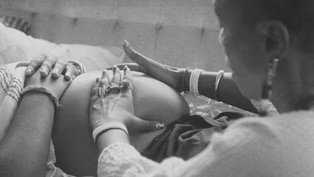
Video has Closed Captions
Clip: S18 Ep1 | 32s | A clinician describes the gratification she experiences from working in the birthing profession. (32s)
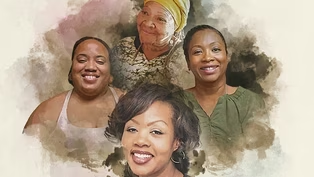
Video has Closed Captions
Preview: S18 Ep1 | 30s | The road to motherhood takes 3 Black women on a journey from heartbreak to resistance and healing. (30s)
Societal Contributors to Black Infertility
Video has Closed Captions
Clip: S18 Ep1 | 1m 29s | A woman struggling with infertility highlights the emotional labor of navigating constant stress. (1m 29s)
Providing Support for PBS.org
Learn Moreabout PBS online sponsorship













Support for PBS provided by:
Funding provided by the Corporation for Public Broadcasting and the John D. and Catherine T. MacArthur Foundation.