
New Law Limits Federal Immigration Enforcement in Illinois
Clip: 12/16/2025 | 7m 49sVideo has Closed Captions
Critics complain the law will be overturned by the courts.
Immigrants living in Illinois, among the states hit hardest by the Trump administration’s immigration crackdown, are now shielded from federal enforcement near courthouses, hospitals, university campuses and day cares under a law signed by Democratic Gov. JB Pritzker.
Problems playing video? | Closed Captioning Feedback
Problems playing video? | Closed Captioning Feedback
Chicago Tonight is a local public television program presented by WTTW
WTTW video streaming support provided by members and sponsors.
New Law Limits Federal Immigration Enforcement in Illinois
Clip: 12/16/2025 | 7m 49sVideo has Closed Captions
Immigrants living in Illinois, among the states hit hardest by the Trump administration’s immigration crackdown, are now shielded from federal enforcement near courthouses, hospitals, university campuses and day cares under a law signed by Democratic Gov. JB Pritzker.
Problems playing video? | Closed Captioning Feedback
How to Watch Chicago Tonight
Chicago Tonight is available to stream on pbs.org and the free PBS App, available on iPhone, Apple TV, Android TV, Android smartphones, Amazon Fire TV, Amazon Fire Tablet, Roku, Samsung Smart TV, and Vizio.

WTTW News Explains
In this Emmy Award-winning series, WTTW News tackles your questions — big and small — about life in the Chicago area. Our video animations guide you through local government, city history, public utilities and everything in between.Providing Support for PBS.org
Learn Moreabout PBS online sponsorship>> A new Illinois law is barring federal immigration officials for making civil arrests in or around court houses, hospitals, college campuses in daycares.
It also provides legal steps for people who believe their constitutional rights were violated during an immigration arrest to sue federal agents.
Well, it's already in effect.
Some are certain that the law itself will be headed to court.
Joining us now via zoom for more on the legal questions around this measure, is Chicago Kids, College of Law professor Harold Krantz.
Harold, Welcome back.
Thank you for joining us.
My pleasure.
So what is the likelihood that federal agents will actually he this Illinois law?
They actually won't arrest people outside or around or in court houses.
>> Well, they can arrest individuals around courthouse, but they have to be a traditional work But obviously what the legislature trying to do is head office collision a classroom scenes ICE agents are Border Patrol agents coming into the court disrupting court nations and grabbing individuals who were there to testify.
This obviously undermining the sanctity of Illinois's justice system and under our system settles in this country, Illinois has a right to make sure that locus of power, the court system, state government is free to function and therefore, Illinois isn't excellent argument that the Illinois was indeed constitutional because the federal government can not just roll for functions of state government such as judicial system.
>> Ok, so let's say more about that as you said, federal government officials under the Trump administration, they argue that this law violates the supremacy Clause of the Constitution.
Even Illinois Democrats acknowledge that this law is probably going to be challenged in court.
Will this hold up when that happens?
>> I think this part of the long.
Well, I think other parts may not think is balance here between the supremacy Clause which says it's lot.
is superior to state But the same time the 10th Amendment of our Constitution cruisers to the state's ability to have the essential functions of government ones operate and to sure while FOX.
So Mister is judicial warrant.
Ice officials cannot go around and grab people away from the courthouse.
>> Republican state Senator John Curran went as far as to say that this is going to get set aside by the U.S.
Supreme Court.
Do you think it'll get that high?
>> Was there some other states to have some So there are a couple of cases that are now percolating.
So I'm not surprised that this will judicial challenge the surprising that didn't see judicial challenge.
And I think the federal courts will have difficult job accommodate supremacy clause with the right of the states to to govern themselves.
In this particular instance, I think there's such a tradition of preserving the integrity viability of the state judicial system that it goes too far forward.
Federal agents without a warrant to come and grab somebody disrupting the federal the state judicial system itself.
So I think it will be challenging for the record.
I think ultimately what he's a very good chance of prevailing as to the other states with similar laws.
So the other states with similar laws, California and New York, they also have laws that restrict civil immigration arrests at courthouses.
>> What we know about what happened when when those laws were challenged.
>> There's been one additional decisions so far in the order, all but settled district courts that court held the state was with within its rights to preserve integrity of judicial system.
Of course, that's going to be appealed to the court of appeals.
So it's early stage of the litigation.
sure that this will follow suit.
>> Now, this law, because you also you mentioned, you know, there are other parts that may or may not hold up in court.
also opens the door to litigation against federal officers are federal officials who, quote, knowingly violated constitutional rights during civil immigration enforcement operations.
One critique is that this could have unintended consequences for local law enforcement.
What could that look like?
>> Well, much of the consequences for local law enforcement per se.
But I do think the consequences several lawns and and our pretty great.
And I think that this part of this part of law will be more difficult to Basically, Congress has created system for individuals to sue, multiply that the Constitution watched by state officials, but they haven't done so But on the other Congress has given way of the subcommittee of the Senate government.
you, federal officials make the kind of comprehensive study of weird to a while.
So those were not to allow federal And so I think they're going argue that means the federal government argues that Congress already considered issue and he's not permitted in this particular instance so that the state effort to give a remedy to individuals who have been injured previously by actions of these federal will be preempted by federal That's my prediction.
I think it may be another close but as a results will, there may be no kind of damages liability for people who are injured by unconstitutional conduct by these federal officers.
We've seen that with detentions seen that with people getting knocked over in the streets by Border Patrol is used stations.
And again, it seems unclear that they're going to have a that that federal government he this state cause of action to go forward.
I think the recourse will be to file actions before federal court against the federal officials.
But that remains to be seen.
And that's going to be teed off for the occasion as well.
Okay.
So additionally, this law requires public colleges and universities, hospitals, childcare facilities to set up policies.
>> For dealing with immigration enforcement and it mostly prohibits some of them from disclosing the immigration status students, patients, parents and children.
What policies restricting federal immigration enforcement are already in place for these areas.
These places >> it's tough to lines.
Me of the sanctuary litigation that Chicago was well done a number of years ago.
first Trump administration because the wind to be forward there is that local law cannot be to do cannot be forced to cooperate with federal immigration but they can't impeach So these policies and structures as long as they don't say, you can't ignore request from the federal government.
I awful.
And they're saying basically you can't knowingly disclose this information came to public register of this information.
if there is a judicial subpoena for the information's, then the hospitals in the educational systems would have apply.
So within that light, I think that this is similar to the sanctuary city litigation, Chicago And so the line to be drawn again is that the hospitals and the educational institutions don't have to go out of the way to help federal immigration authorities.
But they can't block a legitimate judicial subpoena.
At the same time.
>> Okay.
That's that's what we'll have to leave.
But obviously we will keep an eye on this one and C how it plays out in court if and when that day comes, we'll have you back
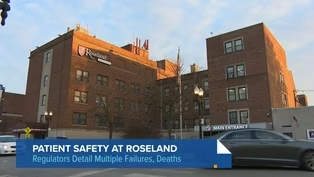
How a Murder Raises Questions About Roseland Hospital
Video has Closed Captions
Clip: 12/16/2025 | 3m 26s | A WTTW News investigation revealed a troubling pattern of lapses in patient care. (3m 26s)
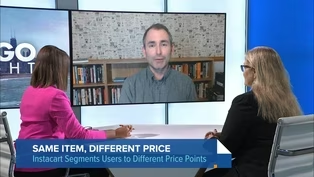
Instacart’s AI Technology is Hiking Prices as Much as 20%: Report
Video has Closed Captions
Clip: 12/16/2025 | 8m 12s | The report said customers are “unknowingly part of widespread AI-enabled experiments.” (8m 12s)
Providing Support for PBS.org
Learn Moreabout PBS online sponsorship
- News and Public Affairs

Top journalists deliver compelling original analysis of the hour's headlines.

- News and Public Affairs

FRONTLINE is investigative journalism that questions, explains and changes our world.












Support for PBS provided by:
Chicago Tonight is a local public television program presented by WTTW
WTTW video streaming support provided by members and sponsors.