
Nov. 20, 2025 - Full Show
11/20/2025 | 26m 49sVideo has Closed Captions
Watch the Nov. 20, 2025, full episode of "Chicago Tonight."
Meet Patty Garcia, who’s running for Congress in a political move sparking controversy. And the Trump administration moves to dismantle the Department of Education.
Problems playing video? | Closed Captioning Feedback
Problems playing video? | Closed Captioning Feedback
Chicago Tonight is a local public television program presented by WTTW
WTTW video streaming support provided by members and sponsors.
Nov. 20, 2025 - Full Show
11/20/2025 | 26m 49sVideo has Closed Captions
Meet Patty Garcia, who’s running for Congress in a political move sparking controversy. And the Trump administration moves to dismantle the Department of Education.
Problems playing video? | Closed Captioning Feedback
How to Watch Chicago Tonight
Chicago Tonight is available to stream on pbs.org and the free PBS App, available on iPhone, Apple TV, Android TV, Android smartphones, Amazon Fire TV, Amazon Fire Tablet, Roku, Samsung Smart TV, and Vizio.

WTTW News Explains
In this Emmy Award-winning series, WTTW News tackles your questions — big and small — about life in the Chicago area. Our video animations guide you through local government, city history, public utilities and everything in between.Providing Support for PBS.org
Learn Moreabout PBS online sponsorship>> Hello and thanks for joining us on Chicago tonight.
I'm Nick Blumberg.
Brandis Friedman is on assignment.
Here's what we're looking at.
If we dare to struggle, we dare to win.
In one of her first sit-down interviews.
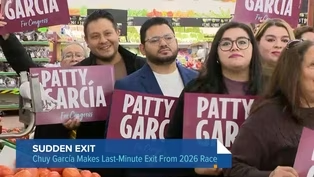
We talked with congressional candidate Patty Garcia and her vision for the office and how she hopes to win over voters.
>> Its UK shun is local.
It should be overseeing locally.
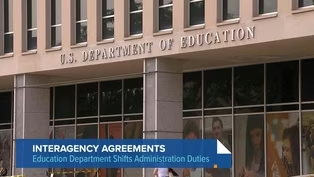
The Trump administration is dismantling the Department of Education.
What the restructuring plan could mean.
In a letter.
The farms is coming now.
I feel like I had to prove myself.
The pressure was there.
And meet a local pharmacist working to bridge gaps in his community.
>> First off tonight, the release of hundreds of Operation Midway Blitz.
Detainees is on hold for the time being as many as 615 people were in line for release after a federal judge found federal immigration agents repeatedly violated a consent decree restricting warrantless arrests in Illinois.
Court records show fewer than 3% of those detainees have a criminal record.
But earlier today, the 7th Circuit Court of Appeals put their release on hold.
Hearing on the issue is scheduled on December 2nd.
Federal prosecutors are dropping charges against a woman shot by a Border Patrol agent.
My my Martinez had faced claims she assaulted federal agents in Brighton Park last month.
Prosecutors had claimed that Martinez and a second defendant Anthony Ian Santos Ruiz rammed a Border Patrol vehicle as neighbors were tracking immigration enforcement efforts and that she was shot after boxing agents in.
But subsequent tests showed the agent bragging about shooting Martinez saying he'd, quote, fired 5 rounds and she had 7 holes.
Put that in your book, boys.
In a brief motion today, prosecutors moved to dismiss the indictment against Martinez and Ruiz at an afternoon hearing, attorneys confirmed the dismissal with prejudice, meaning charges can't be refiled but provided no explanation.
As Chicago City Council continues its heated budget debate.
Cook County commissioners unanimously sign off on a 2026 spending plan board.
President Toni Preckwinkle says the 10 billion-dollar county budget is aimed at making up for federal cuts in funding on health, public safety and other issues.
The budget doesn't include any tax hikes or service cuts and it makes permanent a pilot program.
A pilot guaranteed income program, rather that was initially funded by federal COVID relief money.
The group, Economic Security, Illinois says that makes Cook County the first government body in the U.S.
with a permanent income program.
Up next, one on one with candidate for Congress, Patty Garcia.
She joins us in studio right after this.
>> Chicago tonight is made possible in part why the Alexandra and John Nichols family.
The Pope Brothers Foundation.
And the support of these don't.
>> Congressman Chewy Garcia.
Surprised constituents and political watchers earlier this month with the last-minute announcement he wouldn't seek re-election.
That announcement came paired with the revelation that just one other candidate had gathered signatures to get on the Democratic primary ballot.
His chief of staff, Patty Garcia, no relation to Garcia's move was blasted as Chicago machine politics earning him a rebuke from his colleagues in the House of Representatives.
But in launching her campaign last week, Petty Garcia said there were no electoral shenanigans and vow to protect protect immigrant and working class communities.
And joining us now is the congressional candidate herself, Petty Garcia.
Thanks for being on the program.
Thank you for the night.
So you've worked in in politics and policy for quite some time, but you're not necessarily a widely known quantity.
Tell us a bit about yourself.
3 So I was born and raised Chicago in Little Village.
Both of my parents are immigrants from Mexico.
>> I grew up in a union home and I I'm a proud graduate of Chicago, Public schools and also from the U of I hired my education policy doctorate degree from the U of I and education for me has always been a passion.
It's what's led me to civic education, voter engagement building, the next generation of leaders, including training people for office as well as then training elected officials to be effective in the roles.
And so most recently doing government work.
And this is where I've learned great deal working with Congressman Garcia for the last 7 years.
First district director for 4 years in the last 3 years as chief of staff.
And so everything from, you know, how to advance a progressive agenda.
sure that we're delivering for our communities to have a secure grants, right from flood mitigation to use centers to hospitals as well as case work right?
And especially right now we're seeing the Trump attacks and that this man, Steven federal agencies, we need to ensure that we're protecting constituents, that we're getting them out of detention centers that we're giving them the resources that they need to ensure that they've have a safe home to communities.
So as we mentioned, the congressman announced he was leaving the race shortly before the filing deadline >> should he have said publicly what he told you privately that he couldn't make another run so other candidates could have had at least a few days to gather signatures.
>> Now there's a lot going on.
I'm sure you all know that little village has been an area in the 4th district has been the target by the Trump administration for enforcement.
And so from that Friday to that Monday, it was just I keep using the world word world wind.
It was a world when it was a roller coaster emotions, but also now we need to get on the ballot, right?
And so that was a priority to ensure that we get get on the ballot.
We had less than 2 days essentially to be able to collect the minimum, which and now the 4th district is about 700. proud to say that we were able to over twice that amount that is required.
And we had over.
75 volunteers helping us ensure that we've got on the ballot.
So it was a lot to do in a short amount of time.
I'm happy that I had to support of community members and of the voters from across the district to get on the But I mean, how do you respond to to folks who say it's sort of a classic machine politics play here that might tarnish the congressman's legacy.
>> anyone could have filed at any point.
And we've said that consistently have said that consistently that we didn't stop anyone from gathering their petitions wouldn't stop anyone from filing the Board of elections are open as it is anybody else.
The process is open to anybody else.
Anyone who's interested can file at any point and there are 2 other candidates on the ballot.
This isn't a done deal.
Friday.
I I'm gonna I'm taking this seriously and I'm going out to every voter to the municipality, to neighborhood award.
There are still election to run.
There are still 2 other candidates who also filed to run.
And as I've said, it was an opportunity for anyone else to to run and it make sure that I added that every single I've been with the Congress in 2019 and every single election people have filed to run.
So we assumed other people would be filing to run as well.
>> Sure it is fairly safe.
Democratic had folks, you know, had more of a heads up teammate.
There may have been, you know, a wave of people, as we've seen in some of the districts where folks are retiring.
>> Yeah, they going have a primary last cycle.
And you know, we have to and just for that and make sure that we had to voters knew about the congressman to why he was a better choice.
And so, you know, now for me, I'm focused my race and ensuring that people know who I am that get back to to the issues and ensure that people know why I'm the better option and why I've been doing this work.
while the right person to to continue that work, as you said, it was it was sort of a whirlwind for me.
I mean, when did the congressman tell you his decision and become the first signature on your petition?
>> It wasn't until Friday where kind of decision there we didn't start circulating till Saturday.
But yes, it was literally less than 24 hours from one.
A final decision was made.
And when we had to get in work on a petition and get out to the doors and recruit people to come So as we mentioned earlier this week, the House did vote to censure Congressman Garcia, that included 23 Democrats, 2 of whom are from the Illinois delegation.
Are you confident you can repair those relationships?
Should you be elected, especially within, you know, your own potential caucus?
But the reality is that right now, Democrats need to be united.
There are other more important issues that matter.
I've been hearing from as I was knocking on doors, collecting signatures as I've been working with people across the district, people care about, can I get put on the table?
Can it pay the rent?
K put my child to child care, right?
Like those are the real issues that matter to voters.
Not that inside are kind drama between one member, another member or the political targeting that might happen or the personal kind of attacks one another.
Those are the things that actually people don't want.
Voters don't want to see that disconnected kind of work.
They want members there court delivering for them.
And so I'm confident that with the relationships that you have already built with some of these members as a chief of staff that I can earn their support well into some of those issues.
talked a lot, you know, about protecting immigrant communities, many of whom called the 4th district home.
What would your priorities be in in that arena?
Should you be elected?
>> But it's been over 40 years since we've had any meaningful immigration reform.
So number one for me is, of course, immigration is a daughter of immigrants.
As someone who's had to go fight ice and go to broad view and go surprise visit detention centers.
>> I've seen the atrocities of this immigration system and it's not just one president has been a system that has completely vilified criminalized immigrants and and separated families.
And I think that it's important to prioritize a path way to citizenship.
It's unfair that people have been here 2030, years contributing to our economy, helping, you raise our doctors, our teachers.
And yet they can't even get protection that they won't be deported, right?
And sold for one number.
Number one, priority immigration.
Ensure that we have a pathway to citizenship, ensuring that we protect our Dhaka recipients.
It's time, right?
They've they've been here and it's time to give them some real protection and long-term protection.
We've got temporary protective status for people that we need to work on as well as some work permits some.
You know, there's people here that at minimum they want protection and work permits.
And so that's my number one priority.
Immigration, especially given the demographics of the district.
There people here that have been waiting 2030, years of because I've said to become citizens and so that's number one with my back education that some of again, passion of mine.
I want to make sure that we have good paying jobs that we have better workforce partnerships with institutions and higher ed.
And that from birth to college kids have a portable in quality education, regardless of where they've grown up you know what your background.
>> But, you know, we just exited the longest federal government shutdown in U.S.
history with a handful of Democrats, including Senator Durbin voting to reopen.
Would you have cast a vote to reopen?
>> I think we should have walked away until we had something to walk away with, right?
We should have waited to ensure that we had at minimum some health care and I would I would have worked with community members and with them with our stakeholders to hear from them directly know that a lot of the organizations said Democrats, we've got your back.
Holder called online a little longer.
We haven't come this long give and walk away with nothing.
>> Well, as you mentioned, been working with the congressman since 2019 and including most recently his chief of staff, one accomplishment from that 10 year.
Are you most proud of?
>> think the most proud of all, all C 2.
All right.
they all seem to help make it quick on the case work side, there's nothing more rewarding than being able to reunite families and get someone out of detention.
And so I've got amazing stories of people that I've been able to help release fathers on Father's Day mother's on Mother's Day and like, you know, I think about my parents, I think about my neighbors, right?
And like I would want someone to fight as hard like that.
Like the way that I have for others.
So I think that that to me has been the most rewarding experience, be able to find a different for others and also bringing back resources to the district.
So the committee project funding being able to identify what you know, youth centers, hospitals, health care centers fled mitigation programs.
All these things that are tangible is not these abstract kind of federal funds that you don't see.
You get to work with the community to identify what would you like to see in your area?
Right?
And so those are some of my favorite kind of a project's.
Alright, 4th district candidate had a Garcia.
Thank you so much for joining us.
Thank you.
>> Up next, the Trump administration moves to dismantle the Education Department.
What that might look like right after this.
>> The Department of Education is shrinking.
Many of the officers that carry out its key functions are set to shift to other federal agencies.
It's the latest step in President Donald Trump's push to make good on his campaign pledge to dismantle the department entirely.
Education Secretary Linda McMahon said this morning the changes will address, quote, our own bureaucratic bloat.
We have link 6 groundbreaking partnerships with other federal agencies.
>> To delegate Education Department programs that are redundant with existing programs at Labor State, Interior and HHS.
These inner agency agreement to cut our own bureaucratic bloat.
Our key step in our efforts to shift educational authority from Washington, D.C., to your state education agency.
>> And that man also called on Congress to make these new changes permanent.
Joining us to discuss everything that's happening is Bo Jackson, a professor of education and social policy at Northwestern University and former appointee to the White House Council of Economic Advisors.
Professor Jackson, thanks for joining us.
Thank you so much for having So this overhaul set to shift funding for schools serving low-income communities to the Department of Labor grants for parents attending colleges will go to health and Human services, foreign language funding over to state and Native American education programs to interior.
Are these other agencies built to effectively administer those programs?
No, no, they're not.
So, you know, that part of education serves a lot of different functions.
And, you know, just want to make clear from a historical perspective, you know, the department education was established in 1979 before then it was health education and welfare.
And there was an acknowledgement that a lot of the things that were happening to serve students in this country should have been house within one central Department that really took care of all those different aspects.
So, you know, when you think about administering the title one program, which really provides funds for low-income children in this country in Chicago.
I think about 90% of schools are title.
One.
Schools heavily depend on that money.
That is not something that Department of Labor is really equipped to do.
So I'm a little concerned about that.
I would also say that I wonder to what extent this represents so shifting of orientation away from education being something that is designed to promote overall human, thriving towards thinking on a much and now review about education is only towards serving to make sure people have skills to serve the labor market right now.
I think obviously that's part of what education is there to But it's not everything you know, in the department announced these new interagency agreements on Tuesday, there's clear timeline of of when they go into place.
I mean, are concerned about the speed at which things are moving?
Could this create delays and funding or other snags?
It absolutely could.
So in principle, would you like to see is that personnel who are currently involved in the part medication.
We're going to take advantage of the institutional knowledge, decades of his to shun knowledge that people have acquired over the course of years working at a department occasion.
I would like to see if they were going to make this move in in a way that was responsible, that those individuals would move over to the other other entities move over to HHS, to move over, to to labor.
But I don't see any indication of that.
What seems to be happening is that what we're going to move over the functions and leave people where they are, which I which I think could absolutely have deleterious effects for the people who depend on these funds.
And it would be clear a lot of the money that the federal government spends an education goes towards the more fragile members of our society, low-income kids, people who need access to money, to go to college.
And these are the end of it is we're going to suffer.
mention CPS about your at 89% of schools qualify for that title.
One funding.
What sort of an effect could this have on kids here in Chicago?
That's a really question.
So it's important to put all this into context.
So overall, in terms of how much money comes from the federal government that goes to public schools nationally, it's about 10% of the budget comes from the federal government in Chicago.
That number's probably little bit higher.
say 20%.
So we're talking about that pocket, that amount of money.
It's not the lion's share.
Most of the control and the money really still is at the local and the state level.
But losing a fit for your budget?
Absolutely can have deleterious effects.
So to put that into into perspective, you talk about losing maybe 2, 2, and a half $1000 per kid estimates show that would reduce college-going rates by about 6 or 7%.
So that's a really meaningful impact.
We could see if we were to sort of have that money go away.
So we mentioned that of the accusations of glow at the top of the segments Trump administration says the Education Department is too big.
4200 employees, 17 offices, nearly 200 billion dollar budget in 2025, what do you make of that argument?
It is there too much bureaucracy there at at is it loaded?
I wouldn't say that is going to just be clear.
You know, whether something is believe it or not, really has to be a comparison of size relative to function.
The department occasion does a lot of things that has a lot of different functions of meant to mention a few already administering.
See the Pell Grant program to make sure people have access to financial aid, making sure the student loan programs are properly administered, making sure the Office of Civil Rights is there to enforce laws that require that students are not being discriminated against the do a lot of actions that are happening within department education.
Some of it is also research collecting data, making sure we understand where things are sitting rules and standards for schools in of right of domain.
So that requires a lot of different moving parts and requires a reasonable sized rockacy.
So to say that just because there are a lot of people employed by the department, those blow to don't think is quite with a look at.
You have to look at the size.
department relative to all the functions that is actually being carried out by the department.
You know, the administration says breaking up the Education Department will put more power in the hands of states of school districts parents.
What do you make of that argument?
So I don't think that makes any sense.
So right now, what what is being proposed or what is being fought up to spoke about right now is essentially moving control or moving some of some of the functions from one federal part of the brat rest the government to another within the federal government.
So we talk about moving from education, 2 labor or to a These are all still within the federal government.
So nothing that is being discussed here is moving any power down towards the states or to local entities.
So that doesn't make any sense.
I would also just want to say very clearly that a lot of this conversation is predicated on this idea that somehow the federal government is controlling what is happening in schools.
That is just not the case.
Most of the day-to-day decisions that are happening within schools are determined by in local level at the state level.
It is that the federal government does provide some resources to help students were in need who are from low-income backgrounds.
But most of the day-to-day decisions are really not happening at the federal level.
So the that entire predicate of this argument, it doesn't really hold water.
And do you think that's part of why, you know, President Trump, some some politicians, some voters want to see the department dismantled this idea that it's somehow, you know, complete federal control of what happens in in classrooms each day.
So I think there 2 things potentially going on.
I think one is I think there's somewhat of a misconception in among the public that somehow the federal government is responsible for the curriculum that is being taught.
Some people have called it will If you want to use that terminology has been used to describe what's happening in schools and people associate that with things that are happening from the federal government.
That is not but the federal government really is involved in the federal government has guidelines say to enforce civil rights.
So, for example, we have laws that say that you cannot have have exclusionary, discipline policies that disproportionately impact African-American boys, for example, those are the kinds of things that would be enforced by the civil rights arm of the department education.
That's not what prevent hating laws.
But I think there's been a confounding of those ideas and the thinking is, well, if the federal government isn't is enforcing laws and making sure that, you know, certain rules are followed some of that control.
But most of the day today, like I said, is really happening at the local level.
some of that I think is just the idea that we don't want people.
We don't want the federal government involved at I would argue that part of the role of the from federal government is to protect those that are most vulnerable.
And that's when most of those programs are there to do.
All right.
Well, much more to watch for in the days ahead.
But that's all the time that we have for right now.
Curable Jackson, thank you for joining us.
Thank you.
And up next, how a first generation college student graduated from being a sales associate to a pharmacist.
Stay with us.
>> What began as a high school job?
Let a first generation college student on the path to becoming a pharmacist reporter Joanna Hernandez recently visited the city's Belmont Cragin neighborhood to share his journey.
Here's another look.
At just 26 years old.
Hey, guys, what >> Freddie Gomez is a pharmacy manager at his local Walgreens.
On the northwest side.
>> you go to the pharmacy typically you don't expect the key in the white coat.
>> With a light hearted smile, Gomez works at a pharmacy in Belmont Craigan that serves a large Latino population.
Love giving back.
>> And the thing is those pharmacists were the most accessible health care provider in the committee.
So, for example, in this neighborhood, a lot of uninsured under-insured patients.
So if they have anything going on, they're going first just to avoid the cost.
Are the troubles of going to hospital without having insurance that's care for them.
>> Born and raised in Chicago, Gomez began working at his local Walgreens as a customer sales associate during high school.
After graduating, he began exploring potential path for his future career.
My memory got sugar like Brady from where you are a little boy and you went to the pharmacy with your mom and you had a chance.
They because >> the pharmacist didn't know Spanish.
So you know what can do this through a tuition assistance program from Walgreens.
Students can receive financial aid to pursue a career in pharmacy.
>> Gomez says he benefited from scholarships that helped him achieve his doctorate from Roosevelt University.
>> I got to Asian.
They call your name.
You cross the stage.
Dr.
Freddy going called the thought.
I'm not.
Like a part of yourself.
I But I sometimes I'm still in disbelief, especially now Gomez says he hopes to inspire other young Latinos to pursue careers as pharmacists, ino.
And the pharmacy profession is not a lot of us.
Hispanic pharmacist Mexican Pharma but it's important for us to be here it's not just because we speak the same language.
We still the same values.
We understand the struggles, same culture and that connection makes the trust more The son of immigrant parents.
>> Gomez says he probably gives back to the community that shaped using his bilingual skills to serve others and stand as a bridge between cultures through gun.
You're lucky.
You know, you're not like everyone else.
We're going to have to put yourself and I'm like just natural.
Just do what you gotta do.
And all I did was take care of my patients to care the community for Chicago tonight.
Join on right.
And Gomez now mentors, other aspiring pharmacists through Roosevelt's pharmacy program.
>> We're back to wrap things up right after this.
>> Reflecting the people perspectives that make can This story is part of Chicago tonight.
Not the >> And that's our show for this Thursday night.
Stay connected with our reporters and what they're working on by following us on Instagram at W T Tw Chicago, you can also follow us on Blue Sky at W T Tw.
Join us tomorrow night at 5, 30 11.
34 the week in review.
Now for all of us here in Chicago tonight, I'm Nick Bromberg.
Thank you for watching.
Stay healthy and safe and have a good night.
>> Closed caption News made cost why Robert a cliff.
she combo personal injury and wrongful death.
It gives back
Congressional Candidate Patty Garcia on Her Vision for the Office
Video has Closed Captions
Clip: 11/20/2025 | 9m 30s | U.S. Rep. Jesús "Chuy" García made a surprise announcement this month that he won't seek reelection. (9m 30s)
Trump Administration Moves to Dismantle US Department of Education
Video has Closed Captions
Clip: 11/20/2025 | 8m 13s | Many of the offices that carry out key functions will shift to other agencies. (8m 13s)
Providing Support for PBS.org
Learn Moreabout PBS online sponsorship
- News and Public Affairs

Top journalists deliver compelling original analysis of the hour's headlines.

- News and Public Affairs

FRONTLINE is investigative journalism that questions, explains and changes our world.











Support for PBS provided by:
Chicago Tonight is a local public television program presented by WTTW
WTTW video streaming support provided by members and sponsors.