
Nov. 6, 2025 - Full Show
11/6/2025 | 26m 47sVideo has Closed Captions
Watch the Nov. 6, 2025, full episode of "Chicago Tonight."
A judge imposes further restrictions on immigration agents’ use of force. And the mayor’s plan for a corporate head tax faces pushback.
Problems playing video? | Closed Captioning Feedback
Problems playing video? | Closed Captioning Feedback
Chicago Tonight is a local public television program presented by WTTW
WTTW video streaming support provided by members and sponsors.
Nov. 6, 2025 - Full Show
11/6/2025 | 26m 47sVideo has Closed Captions
A judge imposes further restrictions on immigration agents’ use of force. And the mayor’s plan for a corporate head tax faces pushback.
Problems playing video? | Closed Captioning Feedback
How to Watch Chicago Tonight
Chicago Tonight is available to stream on pbs.org and the free PBS App, available on iPhone, Apple TV, Android TV, Android smartphones, Amazon Fire TV, Amazon Fire Tablet, Roku, Samsung Smart TV, and Vizio.

WTTW News Explains
In this Emmy Award-winning series, WTTW News tackles your questions — big and small — about life in the Chicago area. Our video animations guide you through local government, city history, public utilities and everything in between.Providing Support for PBS.org
Learn Moreabout PBS online sponsorship>> Hello and thanks for joining us on Chicago tonight.
I'm Brandis Friedman.
Here's what we're looking at.
>> Uses of force.
And then more than exemplary.
>> But a federal judge disagrees and imposes tighter restrictions on federal immigration agents use of force against protesters.
>> Well, that it's tough on One more time.
>> Some Chicago businesses are feeling the effects of Operation Midway Blitz.
A look at how their communities are rallying around them.
>> We're not going to continue to balance budgets off the backs of working people.
Is it and the debate over the city budget heats up as Mayor Johnson pushes for corporate head tax on large companies.
>> First off tonight, a federal delivers a stinging rebuke over the actions of federal immigration agents in Chicago.
Us District Court Judge Sarah Ellis says the conduct of agents executing the Trump administration's operation Midway Blitz, quote, shocks the conscience as a result.
Judge Ellis today issued a sweeping injunction designed to permanently rain in agents use of tear gas, pepper and other crowd control measures or Haddock.
And Heather Sharon joins us now with more.
Heather, take us inside Judge Ellis, his courtroom that was at the Dirksen Federal Courthouse when she delivered this brought order.
She spoke from the bench for nearly 90 minutes.
Painstakingly detailing all of the instances she said where federal agents.
>> Indiscriminately used crowd control measures like tear gas, pepper and other uses of force against the people of Chicago for doing nothing more than exercising their First Amendment rights and that includes 2 speech assembly and to the practice of religion.
Now she said that the government had been completely incredible in what they told hers.
And she said, quote, the government would have people believe instead that the Chicago land area is ice hold of violence ransacked by rioters and attacked by.
tater that simply is untrue.
And the government's own evidence in this case, lies that assertion.
Okay.
Judge Ellis, she also had some particularly sharp words for Border Patrol Chief Greg Bovino, who has >> become the face of the president's mass deportation effort saying that he lied.
What about she singled out 2 instances when he directly used force against the people of Chicago.
The first was on October 23rd when he fired tear gas at a crowd that it's had assembled in Little Village, which is, of course, the heart of Chicago's Mexican American community.
>> He said that he had been struck in the head with a rock before he fired tear gas at the crowd.
Well, you know, it did during his sworn deposition that he was not struck with a rock and he said during that deposition, but he acknowledged he had lied in the second instance during that deposition, he watched a video of himself tackling a protester outside the Broadview ice facility even after watching that video during the deposition, he said that he had not used force against that protester.
A claim that Judge Ellis clearly found simply incredible, incredible.
And of course, to be clear, when we say incredible, we're That's amazing.
was in.
The judge did not believe it down to to not be credible.
>> She's not the only judge, though, to have found federal agents testimony, not credible.
Remind us of these other cases, Judge U.S.
Jet District Court Judge April Perry, who's overseeing the case challenging the Trump administration's deployment of National Guard troops into Chicago said that the testimony she has heard from federal agents was simply unreliable.
And in a 3rd case just this week, Judge Robert Gettleman dismissed federal agents testimony that the people being held at that Broadview ICE facility were being well taken care of.
Instead, he said it had turned into a prison with unspeakably cruel condition, slot of cases to keep up with for here.
What happens next, Now the Trump administration told me they will immediately appeal.
Judge Ellis is order calling her an act.
That judge would put the safety of law enforcement agents at risk.
Judge Ellis, no doubt anticipated that appeal.
She said all she is asking the Trump administration to do simply follow the Constitution and allow the people Chicago to exercise their First Amendment rights.
thank you so much.
Thanks.
Brandis.
And you can full story on our website.
It's all at W T Tw Dot com Slash news.
>> Chicago tonight is made possible in part why the Alexandra and John Nichols family.
The Pope Brothers Foundation.
And the support of these don't.
>> Also tonight, a federal judge orders the Trump administration to fully fund the Supplemental Nutrition Assistance Program or SNAP benefits this month.
The full amount of SNAP benefits have been withheld since the start of November because of the government shutdown with the administration releasing only partial funding number of cities and nonprofits sued the government in order to force full payment of benefits.
Now the federal judge has ordered the Trump administration to find the money for full benefits by tomorrow.
Some 42 million Americans receive snap assistance credit analysts are sounding the alarm about Chicago's finances.
But Mayor Brandon Johnson is defending his latest budget proposal despite SNP global ratings revising its outlook on the city's credit rating from stable to negative.
>> I know that there been questions around pensions and, you know, when the executive order was put into under previous administration, it was set up to provide an additional advance payment based upon an assigned balance.
There will be no longer have that.
However, we still were able to even in these very difficult to was times still put forth an advance payment while not cutting service is I think it's a remarkable text testament to the innovation and ingenuity that has been put forth in this particular budget.
>> In a statement, the company says, quote, We believe social capital risks weaken or overall analysis of the city's credit fundamentals given access inequities to quality health care, public education and housing that in our view, could contribute to population loss and economic underperformance over time.
Meanwhile, air travel is about to get a lot bumpier as some of the nation's busiest airports began cutting flights tomorrow.
The Federal Aviation Administration says it will reduce air traffic by 10% across high-volume markets, including both Chicago airports due to the ongoing government shutdown.
The agency says the move is to maintain travel.
Safety as air traffic controllers approach a second missed paycheck and are increasingly calling off work.
Passengers should have begun to receive notice of flight cancellations today, United Delta and American are offering refunds to passengers who opt not to fly even if their tickets are non-refundable.
Up next, how operation Midway Blitz is affecting many neighborhood businesses.
Joanna Hernandez joins us from Belmont Cragin with a live report.
Since the federal government began operation Midway Blitz in Chicago.
Many establishments have been experiencing a decline in sales and foot traffic due to concerns over immigration enforcement.
Some local businesses are reporting that sales are just as low as during the pandemic restaurants, particularly those in Latino communities may be the hardest hit are Joanna Hernandez is out in the Belmont creating community and tells us more.
>> Brian is that's right.
Neighborhoods like Belmont Craigan have had to get creative in host these restaurant crawls to support family owned businesses in the area.
Owner selling doesn't even have to adjust operations to keep their businesses afloat.
>> We're talking areas like I after COVID like that, we're in the clear we don't have to think of anything spontaneous or something.
surviving him are a couple years later.
Here we are again.
>> On any given weekday and lunchtime and a little stuff.
Pizza in Archer Heights would be packed with customers but its 03:00PM and it's quiet owner.
Adrian somewhat deal says following the escalation of operation Midway Blitz in Chicago, there has been a noticeable decline in business.
>> He doesn't have kids coming in after school.
We have parents to know that come before picking up their lunch for the kids afterwards.
>> says slow sales have forced him to close shop on Mondays.
This highlights the challenges many local businesses are currently confronting.
In Belmont, Craig, in the local restaurant, Henry's is also facing a decline in sales and dining.
>> I feel that it's the pandemic one more time.
And again, difference it's that make them like they support from the government OK, you want that you're not able stay home.
And there's a monthly check or whatever.
But now it's just so difficult for everybody.
>> Illinois is home to thousands of Latino owned businesses, contributing millions in tax revenue.
Take little Village, a neighborhood with a predominately Latino population.
It generates nearly 900 million dollars a year in business.
According to the Little Village Chamber of Commerce.
However, business owners are not reporting losses of between 50 and 70% in sales since the start of ice operations.
>> We stimulate the economy.
>> our own way, we keep it going.
Not based only by spending also by working by producing by.
Helping out.
>> Victor Guy out of is one of the owners of Hungary's.
It hurts.
>> That think of where were legal but also tour also are ultimately even People were work.
>> Suffering the consequences.
>> Hyman follow president of the Illinois Hispanic Chamber of Commerce says that the fear of ICE raids is devastating not only to restaurants but 2 businesses in general.
>> That's just for is a restaurant is losing 40% all the suppliers and they're not at the males.
Then some of the culture that usually creek and tie whenever they are, but they're losing 40%.
Also.
So 7 setting for the whole ecosystem.
The Pollo says there's currently a lack of grants to assist struggling businesses.
>> But the organization has been mobilizing to provide people with resources.
We've got team of people walking and this is going assist.
>> Giving people hoping people so they improvise.
I had to do business better.
How to use the Internet.
>> In the midst of ongoing financial uncertainty, businesses are stepping up to support their communities.
Angelo Stuff.
Pizza says it's donating 40% of their sales to the street Vendor Association now offering free delivery on November.
11th and 12th.
>> Helping community, especially like and hard times like this.
We know that's gonna come back around one way or another.
>> recently hosted a fundraiser donating 100% of their sales to organizations that support families impacted by ICE.
>> From the business point view, but with the book to help out.
Why not do again?
That's maybe won't.
Impact as many people as we want, but also.
And little bit helps.
I think.
>> And these are just 2 businesses that are facing financial difficulties and they're still giving back now from that fundraiser that was hosted by Hungary's.
We're told that they raised $12,000 that will be donated to 2 local organizations and then they will distribute those funds to people who've been impacted by ICE in those are not the only ones we were just approached by this business behind me.
Call it a The owner tells us they are hosting a fundraiser tonight and they're asking people to come support.
The restaurant is open till 09:00PM and those sales will also some of those sales will also be going to families who need help reporting from Belmont, Craig.
And I'm joined on this.
I send it back to you.
>> Best of luck to them.
Joanna, thank you.
Up next, debating the mayor's controversial head tax proposal.
>> Reflecting the people perspectives that make up This story is part of Chicago tonight.
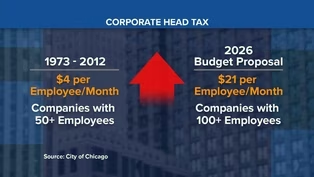
Not the >> Mayor Brandon Johnson wants large companies in Chicago to pay up Johnson's most recent budget proposal calls for a $21 per employee monthly head tax for businesses with more than 100 workers.
He says that would generate 100 million dollars to fund violence.
Prevention efforts.
But it sparked a heated debate as critics say the tax would hurt the local economy.
Johnson defended the plan earlier today.
>> I don't think it's an unreasonable service.
For 3%.
Of our largest corporations that have 100 or more employees that are full time.
To pay their fair share.
Look, I made a commitment to the people of Chicago that we're going to invest in them and that we're going to challenge those with means to put more skin in the game.
>> Joining us to talk about the issue Sean Deiah, co-director of the Institute for Public.
Good, a nonpartisan policy and advocacy group and Pat Door director of the Hospitality Business Association of Chicago.
Thanks to both of you for joining I'm going to ask both of you about your positions on this tax issue.
And I are first to you.
You supported.
Tell us why.
>> Yeah, so I'm coming with this perspective of a neighbor that came from a working class family, but also coming with the perspective of someone that started and scaled a 300 person business here in the city of Chicago.
Wright decided to actually headquarter the city and in the city of Chicago.
And the reason that we did that was because we know that the top 3 reasons for people starting businesses and the city are for primarily quality of life.
Why did people start businesses in the city?
It's because this city is the most affordable city.
The most healthy, large city in this country.
And we want to make sure that we're continuing to do that.
So as we think about this had tax, I want to be clear that this had tax is actually a different head tax than what was around in the Daley administration and You know, we're going to talk about them The reason it's different is because that had tax targeted.
>> Businesses that were 50 or more employees.
This as we're actually not going to target the beloved virtue.
That's on the South side.
We're not going to target the Beagle.
Miller and Lincoln Square that just recently actually closed its in-store sales.
You're saying is this one is narrower, it started companies right.
So these are and however, comma Pat, not a fan.
>> CFO went astray.
This was disingenuous to the point.
It.
>> She said it only applies to full-time workers.
Then you've actually read the ordinance applies to any worker making $2500 a month 3 times in a quarter.
That's a good bartender server working part-time.
You get roped in the whole ordinance incorporates the same trap we have with Rahm, where combined independent businesses make sure an owner.
So a pizza or a bar that night on 2 locations and combines them to get you to the 100 and you're stuck being liable because you've doubled or tripled down on Chicago for 3 locations.
And now you're going be paying this much higher.
$21 play Pat Pat, OK?
So and going back to your Pat supporters of this tax they say in the mayor has said it himself that the city needs this money.
>> To fund the community violence intervention and prevention work that the city has seen success with along with other services.
So if big companies rely on the city to provide that public safety as well as educating the future workforce, should those do you think those big companies should also pitch in to support the community safety efforts?
As the mayor says it would?
>> Well, W t Tw scare.
A lot of those companies donated generously to City Hall programs for youth Employment and crime prevention headed by the Crown family.
But above and beyond that, what a property taxes for what are the 10 to 12% sales taxes are paying for the good of the city of Chicago.
What are the fees for are creating a whole new tax?
And honestly, the mayor does have one good point.
Jobs are a great way to stabilize communities to promote community safety.
Now we're taxing job creation.
If it easy to create jobs here, we wouldn't have a pharmacy and grocery drought and a 3rd of the city and we have to focus job creation, not squeezing existing jobs, more revenue that should be coming from other existing sources.
>> Asian, could this not discourage companies from from setting up shop here?
Yeah, I mean, the data shows that there is actually no relationship between local taxation and job rate.
Congressional Research Services issued at the survey looking at 50 years of tax policy in this country.
>> And show that there's no relationship there.
But what I will say is that of the top 3 reasons why people decide to start businesses and grow businesses here.
The number one thing that people say is how do we make sure that the city's affordable so this head tax is not operating in a vacuum, right?
This head taxes operating as an alternative to the other options that are on the table and the alternatives that we're talking about are taxing working families that are seeing an 80% increase in their ACA health care plans and they are not going to be able to afford the increase in grocery taxes, the increase in liquor taxes, which will affect small businesses, the increase in property taxes.
We need to ensure that we are not balancing this budget on the backs of working people and the choice is clear.
Do we do that or do we tax the corporations that have seen actually ballooning profits over the last 8 years and asking them to contribute just a little bit more alongside working families to fund things that make this affordable city and a safe city.
If I may, we have a definitional problem here in that.
>> We were promised by the CFO 2 weeks get a list of the companies.
This tax would apply to cause as Alderman Bill Conway and other journalists and pointed out the math does not work to get to the revenue number with 3% of employers.
It's got to be a broader net that will impact job in hiring across the city.
But we don't need a congressional research report to explain why this is a bad idea if we're worried about creating jobs when we did one fair wage.
I was here.
We talk with it matter or not.
And what has happened is hiring slowed down and hospitality in this industry.
When we started eliminating the tipped wage.
And that's because we're in low-margin industries that will be caught up in this head tax and why it's not a good idea is because it will disincentivize the smallest companies, especially border awards from investing in Chicago.
When you can go right across the city limits would lower property taxes, lower wages, lower sales taxes and no head tax.
It brutally hard tax on those board awards Chicago.
>> What drives businesses?
And I say this is someone that has created more than 300 cars in the city.
What drives in the hospitality industry at What drives businesses in the city is demand right and demand exists in the city when we make sure that we are not taxing our working families into oblivion, every dollar less tax on working families, a dollar more in pocket that they can go to their nearby restaurants and they're nearby bagel shops.
This is an argument respectfully that is not reflected by the data.
The mayor touted again today how we had record tourism.
>> Record visitors, the airports.
We do not have record employment in these industries.
We're doing more with less because the margins are so tight before this tax.
So OK, so when asked about that because the city had ahead tax in the past, as we've mentioned, 1973 to 2014, excuse me 2012, it was $4 per employee per month for companies with 50 or more employees.
Now that was scrapped by Mayor Rahm Emanuel in 2014 called it job killer at the time.
>> The mayor is proposing quite a big increase currently.
21 bucks per employee per month for businesses with more than 100 employees.
That is a steep price.
That's $2100 a month.
If you've got 100 employees, for example, pat to you first, can for All can all the companies because some companies are operating with different margins.
>> So lower margin companies to grocery stores, to pharmacies a small businesses that every community, all the 70 neighborhoods want, it cannot or if they can do to it with fewer employees because you've got your property tax bills which were finally going to get next week going into the slow winter season and you're not going to hire with answer any of this tax heading over you into the holidays because you cut somebody loose in January because their of tax, so it will hurt hiring near term and short term, especially in our border awards.
>> As looking at these businesses that 100 or more employees, what we're talking about, the average 100 person company has a 10 million dollar payroll.
And what we're talking about here is a $24,000 tax on an average on the year on that 10 million dollar peril.
That's less than half a cent per payroll dollar.
Right.
This is a thing that large companies can afford.
And it is a thing that benefits not just large companies.
It benefits the small and medium-sized businesses because we know that when we invest in community interventions that work like violence prevention like free public mental health centers that is increasing the ability for people to have safe streets and actually go to their neighborhoods.
Could those small and medium-sized businesses, though, that have smaller margins?
Could they not get squeezed on Those small and medium-sized businesses have deliberately been cut out of this head tax to make sure that we're focusing on 100 plus businesses.
This is not the same.
Had 50 plus people that was operating pack in 1973 to 2014 a veteran of the 2012 phase out.
>> This has the exact same tools that the comptroller back then used a rope and small bars, restaurants and retail stores across the city.
Exactly.
Copied it.
>> Well, into that point, there's been some criticism of the city's analysis over who would pay this tax based on who paid it before the repeal repeal repeal.
I get paid to talk back in 2014.
Pat, what are your thoughts on that?
This is going to catch a wide net.
It was brutal back then because the city decided that individual businesses with some common owners had to pay this thing.
>> At the end of the day, the money that the city should be making offseason, places them coming into Chicago for these jobs spending in their communities.
We're going to have a 12 per cent sales summer.
As soon as the RTA tax goes in those employees spend locally when they come in, even if we're just talking about Amazon and those warehouse jobs, if they go across the city border, they're not doing that.
jewelry spending in the city, but even Texan, the largest employers were not making money.
And we're not keeping those shuffle is that it is easy for a corporation to just sort of up and leave.
Maybe they're scooting to the outskirts of Chicago outskirts of Chicago.
But maybe there's going to Milwaukee or Indianapolis making clear.
I don't speak for Amazon.
We have a warehouse surplus and building boom post pandemic.
>> All over Chicago land.
It is not J logistical challenge to move more of our logistical work which lost a record amount of credit challenger, and Christmas this morning out of the city or to set up a new jobs out of the city.
And those are good entry level job for any Chicago.
>> I will say it is as someone who has built in scale the business, it is challenging to move a business across borders because everything is based on your talent.
But the thing I want to be clear on is that this tax is not existing in a vacuum.
This tax is a set of options that we have to tax large corporations that have actually got more profit during stagnant wages to the Trump administration or do we tax working families into oblivion, pushing them out of the city or to be cut the city services that people rely on to survive.
Protect Chicagoans, protect corporate profits or cut services.
And we got to protect Chicago past 30 seconds left.
What other way should the city be using to raise revenue if not the corporate tax?
>> We're not raising revenues.
Ron conversation were up 50% for the city payroll.
>> Since the pandemic lake, no private business could exist at this point in this economy.
If you are up that much, we're not going to be able fill that hole, going to have to leave it there.
Conversation to continue another time.
I'm sure each and I and Patt door.
Thanks you both for joining us.
Thank you, sir.
Appreciate it.
And that is our show for this Thursday night.
Stay connected with our reporters and what they're working on by following us on Instagram at W T Tw Chicago.
>> And join us tomorrow night at 5.37, for the week in review.
Now for all of us here Chicago tonight, Brandis Friedman, thanks for watching.
Stay healthy and safe.
>> Wu's caption News pass why Robert, a Chicago personal injury and wrongful death that
Budget Debate Heats Up as Johnson Pushes for Head Tax
Video has Closed Captions
Clip: 11/6/2025 | 11m 49s | The mayor's proposal calls for a $21 per employee monthly head tax for businesses with 100+ workers. (11m 49s)

Judge Imposes Strict Restrictions on Immigration Agents’ Use of Force
Video has Closed Captions
Clip: 11/6/2025 | 3m 51s | “The use of force shocks the conscience,” U.S. District Court Judge Sara Ellis said. (3m 51s)

Some Chicago Businesses Are Feeling the Impact of Immigration Raids
Video has Closed Captions
Clip: 11/6/2025 | 5m 13s | Some local entrepreneurs said sales are as bad as they were during the COVID-19 pandemic. (5m 13s)
Providing Support for PBS.org
Learn Moreabout PBS online sponsorship
- News and Public Affairs

Top journalists deliver compelling original analysis of the hour's headlines.

- News and Public Affairs

FRONTLINE is investigative journalism that questions, explains and changes our world.












Support for PBS provided by:
Chicago Tonight is a local public television program presented by WTTW
WTTW video streaming support provided by members and sponsors.