Living St. Louis
Living St. Louis Special: Tornado Recovery | May 11, 2026
Season 2026 Episode 9 | 28m 46sVideo has Closed Captions
Living St. Louis profiles the aftermath and recovery of the May 2025 EF3 tornado.
In recognition of the one-year anniversary of the May 2025 EF3 tornado, Living St. Louis profiles the aftermath and recovery efforts that have unfolded since that day.
Problems playing video? | Closed Captioning Feedback
Problems playing video? | Closed Captioning Feedback
Living St. Louis is a local public television program presented by Nine PBS
Support for Living St. Louis is provided by the Betsy & Thomas Patterson Foundation.
Living St. Louis
Living St. Louis Special: Tornado Recovery | May 11, 2026
Season 2026 Episode 9 | 28m 46sVideo has Closed Captions
In recognition of the one-year anniversary of the May 2025 EF3 tornado, Living St. Louis profiles the aftermath and recovery efforts that have unfolded since that day.
Problems playing video? | Closed Captioning Feedback
Where to Watch Living St. Louis
Living St. Louis is available to stream on pbs.org and the PBS app.
Providing Support for PBS.org
Learn Moreabout PBS online sponsorshipAfter a natural disaster, the damage is immediate.
The recovery, of course, is not.
One year after the May 16th tornado, you can drive through most of our city without seeing damage at all, while some neighborhoods are still waiting to feel seen.
Our stories today are about how St.
Louis is continuing to learn what recovery takes, and how community continues to be the support our neighbors need now more than ever.
If you don't live in, or drive through, or visit North City, it's easy not to know it's there.
The boarded up windows, the debris filled lots, the generations of families who have shaped and backed our city feeling unseen and unheard.
Many residents say that gap between what's visible and what's actually happening is part of what's been hardest.
Welcome to City Hall.
St.
Louis, our neighbors, city workers, community partners, and protesters.
And protesters.
Welcome to City Hall tonight.
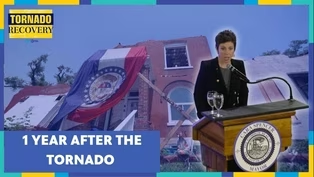
That frustration boiled into public view earlier this year during the mayor's State of the City address when community members interrupted Mayor Spencer's speech, demanding urgency and visibility for neighborhoods still waiting to recover.
It is clear to me and it's clear to everyone in this space that our city is coming from a place of hurt, that our city is in pain.
It includes lifetimes of disinvestment and a lifetime of work ahead of us.
- City leaders claim delays weren't due to inaction, but to months of back and forth with FEMA and the Missouri State Emergency Management Agency, particularly over who was responsible for removing debris.
Requests reportedly went unanswered for weeks at a time.
Plans were rewritten and the city hesitated to move forward without clarity on which costs would actually be reimbursed.
In the meantime, residents stayed surrounded by reminders of loss.
Now, city officials claim St.
Louis is entering a new phase of cleanup.
Plans are in place to demolish roughly 300 unsafe tornado-damaged buildings over the next several months, a sharp increase from the roughly 40 demolished in the year immediately after the storm.
More funding is also reported to become available.
A $100 million state relief package is aimed at homeowners who don't qualify for FEMA assistance.
And the mayor continues pushing to use a portion of the RAM settlement funds for North City recovery, reigniting longstanding and deeply divided debates over how those dollars should be spent.
But for many families, rebuilding isn't just about demolition timelines or funding streams.
It's about stability and staying connected to their community.
The tornado damaged 12 St.
Louis public school buildings, forcing seven schools to close and displacing about 2000 students.
Three schools have since reopened, but four remain closed, with some students not expected to return until 2027, if they return at all.
In that gap, community groups have carried much of the load, providing meals, housing support and day-to-day help, doing much of the heaviest lifting since day one.
Still, residents tell us recovery can't be measured only in cleared lots or signed contracts.
It's about whether people feel seen, whether they feel prioritized, and whether North City's future feels like a shared responsibility or an afterthought.
One year later, St.
Louis may no longer consider itself in crisis, but for many in North City, healing is still very much unfinished.
Recovery efforts in North St.
Louis are experiencing pre-tornado inequities.
For decades, they've experienced private disinvestment and discriminatory housing policies.
This next segment is from "Tale of Two River Cities, "Lessons from Katrina," where the past is alive and well in North St.
Louis.
♪♪ - When the tornado hit, you can see where it's pushed that wall out all along here.
- In present day North St.
Louis, residents are experiencing similar effects from pre-tornado inequities.
North St.
Louis has faced decades of private disinvestment and discriminatory housing policies.
- There were no laws like they were in the Deep South, but St.
Louis was just as segregated as any city in the Deep South.
Banks gave the loans, but the government would back those loans and would guarantee them, but they would not guarantee loans in those areas that were rated red.
In the mid-1930s, the Homeowners Loan Corporation deemed black-owned homes in a neighborhood hazardous and labeled them red.
Redlining was one of several housing practices and policies which limited mortgage access to black families, depreciated property values, and created patterns of residential segregation that exist today.
Many economists, many sociologists trace the wealth gap to this particular problem because blacks were not able to buy houses because that's the number one way people build wealth.
And if you do not have a house, it makes it very hard to build wealth because you can't pass that on.
Black families who could often bought homes directly from sellers on high interest, high risk, no equity contracts.
We're in the 5200 block of Enright.
Started with my grandmother and grandfather in 1952, I think it was, that they moved from Clarksdale, Mississippi, to St.
Louis, to this house.
Yvonne Meeks and her niece, Keisha Glover, both grew up in this house in the Academy neighborhood.
The Academy is similar to New Orleans' Lower Ninth Ward in that it's a black middle-class community with many owner-occupied residences.
It's nestled between Union Avenue to the west, Kings Highway to the east, Martin Luther King to the north, and Delmar Boulevard to the south.
All of us can come together, you know, to support one another.
Their neighbor, Larry Powell, is a retired St.
Louis firefighter and Vietnam vet.
He's lived in Academy for 16 years.
This neighborhood was on the upswing.
We're on Enright.
Just about all of these houses were rehabbed.
Take Kensington.
We were all rehabbing our houses there.
It was a very quiet, pleasant neighborhood.
At the time of the storm, Keisha Glover was living here with her family and her mother.
The tornado did not spare their home.
Phew, quite a bit.
It was a lot.
It was a lot of damage, bricks.
We had no, we still don't have a roof yet, but it was no roof.
We lost the whole back end from the back end on the left-hand side all the way around to the right-hand side.
I mean, bricks was everywhere.
Just lost everything.
- What's your plan?
- To rebuild.
- How come?
- Because, I mean, my, I don't wanna, mm-mm.
♪♪ - This is more than a home to Keisha and Ivan.
It's their family's story, their history, their legacy.
It's generational wealth that began with Keisha's great-grandparents.
Like Katrina, this tornado tore through homes of the rich and the poor, through white and black neighborhoods.
And the recovery?
It's just as uneven.
Residential segregation here isn't separated by a canal.
It's separated by Delmar Boulevard, the Delmar Divide.
And no matter which side you live on, the need to rebuild your home, the desire to reclaim your neighborhood, is equally as great.
This street divides whose homes have financial value, and whose do not.
And I love these old fireplaces.
It's a bad situation.
Now we have houses here that have been destroyed, devastated, and simply put, most people here do not have the means to remove all the debris, as you can see around you, nor the means to repair their homes.
Larry's house sustained a tremendous amount of damage from the storm.
And as you can see here where that wall was pushed out, you know, compromising the structural integrity of the house.
Fortunately, Larry has insurance.
But the effect of those residential segregation policies from almost 100 years ago still linger.
Property values north of Delmar are lower than those south of Delmar.
What does that mean for Larry?
The value of his house isn't worth the cost of repair.
Did you think this wasn't repairable?
Were you told by your insurance company it wasn't?
Yes, yes, it was total.
And you were ready to go.
Yes.
We see what New Orleans' Lower Ninth Ward looks like 20 years after Katrina, when restricted resources prevented black residents from coming home.
Limited resources in North St.
Louis could force residents like Larry and Keisha's family to walk away from their home, their neighborhood, leaving entire blocks vacant and a population decline of a community this city can't afford to lose.
In the days following the tornado, a North City handyman began helping his neighbors.
And viral TikToks turned that effort into STL Rebuilds.
Veronica Mohesky checked in one year later on the organization and how it's moving beyond emergency repairs.
On May 16th, 2025, neighborhoods across the North side of St.
Louis were devastated by an EF3 tornado.
One of those neighborhoods was Penrose.
- I was numb.
When I first saw the destruction of the neighborhood, I was numb.
I saw people whose roofs, just like the whole roof was sitting in the street, or parts of their roof were sitting in the street, or parts of their houses had collapsed, and trees had fallen down onto cars, onto houses.
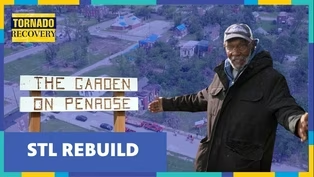
Last summer, we spoke with handyman Calvin Motley.
Immediately after the storm, he used his skills to help his neighbors repair and rebuild their homes.
He also helped create the organization STL Rebuild, along with his friend, Mark Timmerman.
Yes.
So at the beginning, it wasn't even an organization.
It felt like a movement that was starting on TikTok.
Mark is an attorney and also a co-director and secretary of STL Rebuild.
The organization initially started with a GoFundMe, but a few months ago, it officially became a non-profit.
Calvin is a co-director and president of the new non-profit.
Over the last year, he says he's repaired at least five homes and cleaned up dozens of vacant lots in the area.
Well, we did a lot of work fixing up houses, patching roofs, cutting trees, cutting the grass.
I think last year I cut like 30 lots, including these 10 here that we're standing on.
And this year I'll pick up a couple more lots.
The GoFundMe, as well as volunteers, helped sustain the organization's work over the last year.
Calvin says he's hopeful about the neighborhood.
After May 16th, it's a great improvement.
And I still see there's some people that are just starting to work on their houses and the buildings.
So I'm I'm encouraged by it.
STL Rebuild took a break over the winter, but their work is continuing in new ways in 2026.
This is the garden.
And it's 370 feet by 100 feet.
So it's almost an acre.
Right now, it may not look like much, but Calvin says the garden will take about three to five years to complete.
He plans to grow everything from vegetables to fruit to fungi.
He's also planning to use his construction skills to build a greenhouse, an aquaponics building, a pond and more.
This is what we're calling a permaculture garden.
And that's where we're not going to create any waste here.
We're going to use everything we possibly can and just keep recycling it and producing the soil, composting.
There's going to be bees.
There's going to be birds.
There's butterflies, everything.
We want everything that can be here to help the plants grow and improve the quality of the neighborhood.
Calvin has already built a free little library on the lot.
'Cause I think that a lot of the things that we can help with in this neighborhood is getting a higher educational attainment and keeping like the STEM to STEM things like science, technology, engineering.
While Calvin works on the garden, Mark is focusing on the future of businesses in the area.
Last year, I was going to Penrose often enough that I, it felt like a second home, the neighborhood, and I just fell in love with the people that I was meeting.
And I could see the future of Penrose being really bright if it just had people come and invest.
He says he was inspired by the reactions of local business professionals to the STL Rebuild TikTok account.
Everyone, every kind of profession was responding to Calvin and responding to Penrose and responding to the dream to rebuild and see something new develop.
That got me thinking about working there and moving my firm there.
Timmerman Law is currently located in Soulard.
The new firm will be on North Newstead and Lee in Penrose.
And then the law firm idea turned into much more.
We were thinking about having a law firm for criminal defense, for civil rights, for personal injury, and also just a resource for the community if they need to advocate for anything from the city or if they just need to learn about the legal methods to achieve their own dreams.
And so a part of the corner, the dream became to build out more of the corner to have a small business incubator, to have a coffee shop, to have a barber shop, to have a place where we can sell the fruits and vegetables and provide them to the community.
It's all part of the basic plan.
We have several other initiatives that we'd like to do too.
We'd like to increase the home ownership.
We wanted to actually do some rebuilding, some rehabbing of properties and getting, creating a path to home ownership for people that may not have otherwise been available to.
Mark says STL Rebuild's mission has expanded from tornado recovery into a wide range of services that reflect the needs of the neighborhood.
And while many changes will take time, the first step is beautifying the area.
I think once the green spaces started to be cleared and mowed and trees that were overgrown even before the tornado or bushes, once that became cleared out, you could see the beauty of the land.
I think it naturally became, let's just make the spaces around these houses and these structures, let's make it as beautiful as possible.
So I think that's what it naturally pivoted to the garden.
- And though there's a lot of work ahead, Calvin says he wouldn't wanna be doing anything else.
- Another thing people ask me about is, aren't you ready to retire?
Really, this is not that much different than what I had envisioned my retirement would be.
I had always thought I would do a homestead in the rural area, but an urban homestead is just as good.
In the days following the tornado, organizations shifted their focus and even joined forces to help their neighbors.
One grassroots organization continues to grow and recently opened up a brand new headquarters.
Chelsea Haynes has the story.
I think government from a local state to federal level has completely abandoned North City.
The government has failed North City.
And part of the reason we responded so quickly the same day the tornado happened was because we anticipated that the government would fail North City.
We thought it would be an immediate failure, but that they would get it together and come along.
And now we're nine months out and it's still failing our people.
But failure was never an option for the North Side.
And there has been a lack of response.
It's been too slow.
It's been too many hiccups, too many reasons and excuses on why resources aren't making it to the people.
And since the people needed help, the people responded.
What has happened in the nine months since the tornado is failure from our governments, but powerful solidarity from everyday people.
A brainchild of two nonprofits in St.
Louis.
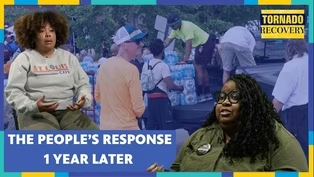
And that was the people's response.
The people's response was birthed out of the same thing that birthed Action St.
Louis.
We knew that we had to do something.
We had to get active.
We decided to put out a call for volunteers to go canvas neighborhoods to help clean up.
And it ended up creating this infrastructure out of the YMCA parking lot, where we held over 10,000 volunteers, gave out over 20,000 meals, supported over 6,000 families in a six-week time period.
-We distributed $400,000 in direct cash assistance to residents with partners like InvestSTL.
It really stood up one of the larger recovery efforts.
And we're not a recovery organization.
We're an organizing organization.
So we just used the tools that we had to build the apparatus to stand in the footprint.
And it really morphed into a movement.
Filling the gap where civic leaders could not.
A movement that is still boots on the ground, but now with a permanent home.
This is the Northside Movement Center.
This gym is the Mill Creek Gymnasium.
So every room in the Northside Movement Center is named after a current or former neighborhood in North City.
And the building is 36,000 square feet.
We actually purchased it in 2023.
And so very quietly, while the people's response was happening, the recovery is happening, this building was under construction in the North Point neighborhood.
- This is what community looks like.
- This is what community looks like.
- I am so excited for the opening of the Northside Movement Center, and movement is in the title on purpose, because it is for us.
- It's a space for community to have access to, so they can have access to this gym, conference rooms, a co-working suite, operating hours, and evening and weekend hours.
And it really is the culmination of what I believe Action St.
Louis is.
Action St.
Louis, to me, is a love letter to Black people in St.
Louis.
It is about making love actionable, and that's the work that we do every day in this building.
It's about bringing that love to a physical place and creating what we call a home for our movement.
- Taking action where it counts.
- We've sort of lifted up a phrase that means a lot to me, that North City is the North Star.
And what that truly means to me is that our eyes have to be on the prize of North City being whole.
St.
Louis reaches the next place.
It reaches being a better place, a more transformed place if North City is our North Star.
When I think about what it means to be from St.
Louis, it is to take action against injustice.
That is the spirit of this city.
It always has been.
There's a legacy of being there for the people who need it and fighting against the systems that harm us.
And that's the true spirit of St.
Louis.
And I hope we continue to honor that spirit in action.
After the tornado, the city paused alley recycling to focus on debris pickup, but the services never returned.
As residents made adjustments, one St.
Louis man decided to fill the gap himself.
Recycling day for many neighborhoods in the city of St.
Louis doesn't look like it used to.
The blue dumpsters are still there, but no longer full of carefully sorted materials.
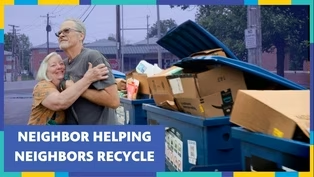
For Erik Kozlowski, recycling hasn't ended.
It's just become personal.
I'll have to do a little recycling, man.
I'll have to do a little recycling.
I always was a big recycler in the city.
Stopped recycling, I noticed the alleys were just filling up with stuff that should be recycled.
And they were telling everybody to take it to their local destination.
And a lot of people, I noticed, just don't have the time.
I decided there was a service needed.
And that's why I decided to come out of retirement and and create recycles with me.
It's pretty simple.
Erik drives around neighborhoods a couple of times a week, picks up what people leave out, dumps it at the proper drop-off site, but unlike official city service workers, he's home in time to still enjoy his retirement.
Simple as that.
Off to do the recycling again.
I can't say there's really a hard part.
I mean, I like doing it.
I like moving and grooving, you know.
Just doing a little bit to help out and doing the right thing, you know.
-Last year, the city of St.
Louis made the major change of ending alley recycling pickup across most neighborhoods in the city, claiming staffing shortages, financial and practical reasons.
More than half of what was collected was contaminated with food, trash, or non-recyclables mixed in, causing entire loads to be rejected by recycling facilities.
When that happens, the city still pays recycling rates, nearly five times more per ton than trash.
In 2025, St.
Louis spent about $1.7 million on recycling disposal fees, with roughly half of what was collected ending up in the landfill anyway.
While residents with roll carts are still able to have their recycling picked up from their homes, for alley recycling, the city shifted toward more than two dozen drop-off locations.
And data shows this approach is working better so far, with contamination dropping by 83% and overall recycling increasing by 8%.
Still, this shift asks a lot of city residents.
-Do you hope that one day the services will continue from the city?
-Yes, I really do.
It would be great if they took this away from me.
I don't mind it.
I love the city of St.
Louis.
I'm a lifelong city resident.
It's tough.
It's a lot tougher than people probably know.
People just think you can change something overnight.
It's tough.
When you're dealing with the big city, you're trying to do the best for everybody and you're not going to make everybody happy.
But I'm just telling you, my experience with the city of St.
Louis forever has been very, very nice.
I've had some really, really good emails of people just thanking me for doing it, even if they're not using my service.
People that are recycling themselves have sent me some emails saying thanks for what you're doing.
Because that little bit, it's just a little bit, makes a difference.
And that's Living St.
Louis.
You can find more of our tornado-related stories on Nine PBS' YouTube channel.
And if you have any suggestions on tornado recovery stories, let us know at Nine PBS.org/LSL.
I'm Brooke Butler.
Thanks for joining us.
♪♪ - Living St.
Louis is funded in part by the Betsy and Thomas Patterson Foundation and the members of Nine PBS.
♪♪
Meet the Man Rebuilding North City After the May 16th Tornado
Video has Closed Captions
Clip: S2026 Ep9 | 7m 46s | North City handyman Calvin Motley began helping his neighbors with tornado damage. (7m 46s)
Meet the STL Resident Who's Taking Recycling Pickup Into His Own Hands
Video has Closed Captions
Clip: S2026 Ep9 | 3m 28s | A city resident is now offering his own recycling service to ensure items stay out of the landfill. (3m 28s)
What is St. Louis City's Plan for Tornado Recovery?
Video has Closed Captions
Clip: S2026 Ep9 | 3m 50s | Many residents have expressed frustration over the lack of response from the City of St. Louis. (3m 50s)
What's Next for The People's Response? | One Year After the May 16th Tornado
Video has Closed Captions
Clip: S2026 Ep9 | 4m 9s | The People’s Response to help fill the gaps for resident services after the May 16th tornado. (4m 9s)
Providing Support for PBS.org
Learn Moreabout PBS online sponsorship











Support for PBS provided by:
Living St. Louis is a local public television program presented by Nine PBS
Support for Living St. Louis is provided by the Betsy & Thomas Patterson Foundation.