
November 10, 2026
11/10/2026 | 55m 46sVideo has Closed Captions
Christiana Figueres; Johan Rockström; Faten Abu Mousa; Bob Kitchen; Chris Miller
Former U.N. climate chief Christiana Figueres and climate scientist Johan Rockström discuss the stakes at COP31. International Rescue Committee officials Faten Abu Mousa and Bob Kitchen discuss the dire conditions and worsening humanitarian crisis in Gaza. “Chip War” author Chris Miller examines the Nvidia scandal and its implications for U.S. national security and the AI race with China.
Problems playing video? | Closed Captioning Feedback
Problems playing video? | Closed Captioning Feedback
November 10, 2026
11/10/2026 | 55m 46sVideo has Closed Captions
Former U.N. climate chief Christiana Figueres and climate scientist Johan Rockström discuss the stakes at COP31. International Rescue Committee officials Faten Abu Mousa and Bob Kitchen discuss the dire conditions and worsening humanitarian crisis in Gaza. “Chip War” author Chris Miller examines the Nvidia scandal and its implications for U.S. national security and the AI race with China.
Problems playing video? | Closed Captioning Feedback
Where to Watch Amanpour and Company
Amanpour and Company is available to stream on pbs.org and the PBS app.
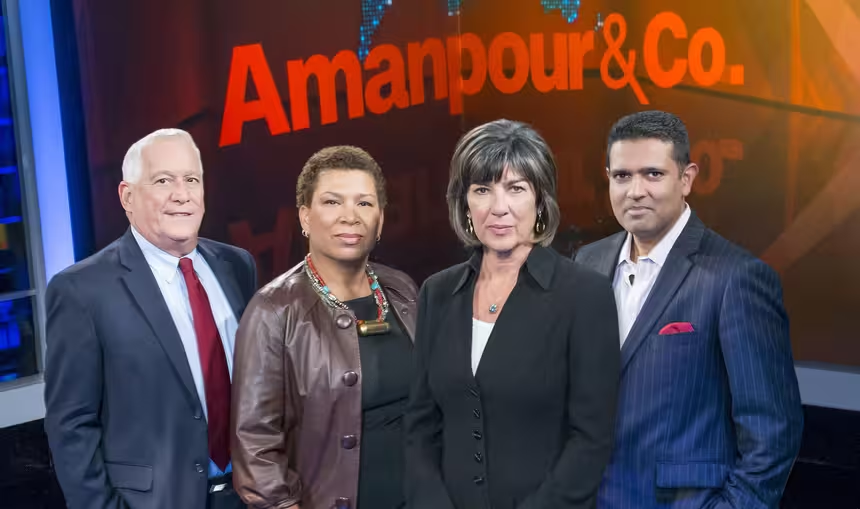
Watch Amanpour and Company on PBS
PBS and WNET, in collaboration with CNN, launched Amanpour and Company in September 2018. The series features wide-ranging, in-depth conversations with global thought leaders and cultural influencers on issues impacting the world each day, from politics, business, technology and arts, to science and sports.Providing Support for PBS.org
Learn Moreabout PBS online sponsorshipHello everyone and welcome to Amanpour & Co.
Here's what's coming up.
What is being decided and talked about in these rooms could be a life or death sentence for countless people.
World leaders are gathering in Turkey for COP 31, with the planet hurtling towards one of the hottest years on record.
Will they take decisive action?
We ask former UN climate chief Kristjana Fuggeris and climate scientist Johan Rockström.
Then... What should we do?
All our belongings are soaked.
I don't have blankets for the kids to sleep now.
The UN says children are among the dead in Gaza after heavy floods.
We hear from the International Rescue Committee about the desperate situation on the ground.
Plus... It certainly shows the lengths at which China is willing to go to get access to these ultra-critical semiconductors.
The NVIDIA boss under fire over his affair with a suspected Chinese spy.
As the fallout intensifies, Professor Chris Miller tells Walter Isaacson about the race for advanced chips and its impact on U.S.
national security.
Amanpour & Co.
is made possible by The Anderson Family Endowment, Jim Atwood & Leslie Williams, Candace King Weir, Charles Rosenblum, Norma C. Warner & Paul D. Warner, Monique Schoen Warshaw, the Sylvia A.
& Simon B. Poyta Programming Endowment to Fight Anti-Semitism, The Straus Family Foundation, The Peter G. Peterson & Joan Ganz Cooney Fund, Koo & Patricia Yuen, Committed to Bridging Cultural Differences in Our Communities, Barbara Hope Zuckerberg, and by contributions to your PBS station from viewers like you.
Thank you.
A warm welcome to the program, everyone.
I'm Paula Newton in New York, sitting in for Christiane Amanpour.
World leaders are gathering in Antalya, Turkey, for the annual COP Summit, and the stakes, they could not be higher.
This year has strikingly seen the cost of an overheated planet, from the deadly flash floods caused by glacial collapse in Nepal and China's Tibet region, to the wildfires that raged across continents.
UN Secretary General António Guterres warns, "We have entered a new age of climate extremes."
It is an urgent moment, with El Niño likely to supercharge the climate crisis in the coming months, threatening economies and putting people's lives at risk.
COP 31 is also taking place against the backdrop of the Iran war, highlighting global dependency on fossil fuels amid an energy crisis.
And while the conference has barely begun, U.N.
climate chief Simon Steele appears all ready to be managing expectations.
No cop is a silver bullet.
No single conference can bridge the chasm between the science and reality.
We must deal with the world as it is, not as we might wish it to be.
For our discussion on all this, we want to bring in Christiana Fugueres.
She is a former UN climate chief who played an instrumental role in the 2015 Paris Agreement.
And Johan Rockström.
He is the director of the Potsdam Institute for Climate Impact Research.
I want to welcome you both to the program and glad to have you here as so many around the planet are really confused as to what is being done in the obvious face of a climate crisis.
I do want to start with you, Christiana.
This conference is referred to as the housekeeping cop, where the focus is more on implementation it seems than on moving the agenda forward.
But is this a way of keeping expectations defined and quite frankly a little low?
Well, thank you very much.
First of all, Paula, thank you for the invitation.
There is no way that we can keep expectations low, absolutely not.
And I am thrilled that the COP has actually started with the high ambition countries, setting a pretty high bar for COP 31, because ministers from the Pacific, from Europe, from Africa, from the Caribbean, from the Latin American areas, have signed a statement that they released on Monday, saying this cop will be judged on how well it responds to the overshoot.
That is the last report that has come out from UNEP, and I will defer to Professor Rockstrom to explain that.
But what is very, very clear is that science continues to evolve, continues to mark the urgency, that COPs are the moment and the time in which the evolving science comes together with the not-so-rapidly evolving implementation.
And that is the gap that we have to close.
When we talk about that gap, though, Christiana, what would you consider a successful outcome at the end of these two weeks?
I would consider a successful outcome if the COVR decision, which is the legally binding decision, first, takes not just note, but welcomes, approves and accepts the science that has come out from UNEP about the urgency of facing the overshoot now.
Secondly, that country's put a very clear pathway forward over the next this five years, but then the next decade as well, to increasingly close the gap between where we are.
And we do have to know that we're actually advancing a lot on on emission mitigation, but not as fast as we should.
So closing that gap because we have two races here.
One is the race of science that is telling us about the destruction and the human misery that will come if we do not live up to the expectations of science.
And the other curve is actually the technological advances that we are seeing in many countries.
The problem is that the gap between those two curves is not closing.
And as you said that technological ambition needs to catch up to the science.
You all hand given the science this fall, the UN environment program was Christiana just highlighted announced that exceedance of 1.5 degrees is now widely assessed as unavoidable.
That is their quote.
What does that mean?
And what will it be like living in a post 1.5% climate reality?
Thanks.
Thanks, Paula.
This is absolutely correct.
As Christiana says, science is absolutely clear.
Actually, we've known this for quite some time now that we will be breaching through the 1.5 degrees Celsius limit actually within the next three to five years and moving into what science has as the best to offer as an overshoot period.
But let me first explain that we are following a pathway that actually takes us not to overshoot, but straight into disaster to 2.8 to 3 degrees Celsius of warming by the end of this century.
That's the business as usual pathway.
The best science can offer is today exceeding 1.5 degrees Celsius, peaking at 1.7 or 1.8, and bringing us back down to 1.5 by the end of this century, if we do everything right in terms of implementing phase out of fossil fuels and scaling carbon dioxide removal and investing in nature.
Now, your question of what does it mean to exceed 1.5?
Well, to start with, we know today that we haven't seen a planet that hot for the past 100,000 years.
So we are outside of anything that we know even has the possibility of supporting, you know, in a dignified way, the world as we know it today.
We know that droughts, heat waves, fires, disease patterns, human-reinforced storms will increase.
But not only that, we also know that we will be coming dangerously close to tipping points.
Actually, we cannot exclude that even the Greenland ice sheet and the West Antarctic ice sheet, the two ice sheets that hold 10-meter sea level rise, might be irreversibly melting if we stay too high above 1.5 for too long.
Even the Amazon rainforest is at risk when we exceed 1.5 degrees Celsius.
So fundamental systems that are the basis for billions of people's lives are at risk if we exceed 1.5 and stay above it for too long.
- Johan, what you just described is absolutely chilling, and yet we have heard it before, Christiana, right?
We are coming off a year of cascading climate disasters, and still, there is no U.S.
government delegation even present, and many of the world's richest countries have curtailed international aid that deals specifically with these climate disasters.
What does that tell you about the commitment to the COP process right now?
Well, I don't think we need to discuss that the U.S.
is not there.
I think we all understand that lamentably, the irresponsibility of the current White House.
But beyond that, Paula, what is actually very interesting and almost ironic is that the geopolitics that we're all facing right now, the energy insecurity, the volatility of energy prices, the craziness of transport risks and insurance prices for the transport of fossil fuels from point A, exporting country to point B, importing country, have been so expanded and have gone so through the roof that now energy security, domestic provision of energy, which means largely renewable energy, is actually top of the agenda in most countries.
Not necessarily because they're worried about climate change, but because they're worried about their immediate energy security.
Both of those things actually coincide in the measures that are being taken.
So you could say that geopolitics is killing us, or you could also say that geopolitics might actually be helping us.
It is fascinating, isn't it?
Because, Lissana, many people have discussed the fact that the Iran war, in fact, might make it more clear to many countries that they must mitigate this and get to a low-carbon economy much faster.
You subscribe to that, then?
You think that will happen?
I think there's a good chance that that is going to happen.
Have we seen it go deep enough and fast enough?
No.
But we are beginning to see some of that evidence.
So Africa, for example, is on track to install a record 17 gigawatts of solar this year.
Indonesia is going to build 30 gigawatts.
Germany has committed to phasing out fossil fuels by 2045.
I could go down the list.
The fact is that countries are beginning to see that it is in their, not only in their own interest, but in their own immediate interest to do this transition.
And that is important because one of the major issues that we've had in communicating and acting on climate change is that it is perceived as a long-term problem.
It is no longer a long-term problem.
Either we cut emissions now or we face unprecedented destruction and human misery.
So the fact that the urgency is being put on the table because of the shocking prices and the insecurity of delivery of fossil fuels is actually a very welcome piece.
And it is an urgency which many are feeling firsthand.
And Johan, to that point, this year El Niño is triggering new weather extremes.
Is this a preview of our post 1.5 degree future?
And I am wondering, could El Nino spur action towards mitigating extreme climate events?
Again, as Christiana just said, making it even more stark, what's at stake?
No, definitely.
It's a very dire conclusion, but unfortunately, 2026, which is an unprecedented year in terms of human suffering across the entire world because of human-caused climate change, will be looked back upon as a reasonably harmonious year, because we are moving into a situation where it just will get worse when temperatures rise even further.
So we have a supercharged El Nino this year where temperatures peak, yes, close to 1.5, but you know when we reach 1.6, 1.7, 1.8, it will just, you know, get worse and worse and this is what we're facing.
Now it should be absolutely clear that this means that we are at an urgency point, just like Christiana says.
Actually, one message we have to Antalya, the COP31, is that our only chance of a safe landing, to minimize the overshoot and avoid the disastrous, unmanageable outcome, is to start reducing emissions globally by 6% per year from this year onwards.
And we are actually increasing emissions with between 0 and 1% per year at this point.
But this morning in Antalya, the Global Carbon Project, one large scientific effort gave some good news.
The projection this year is actually that we will, for the first time, reduce emissions by 0.4% over this year, which is exactly related to the point that Christiana pointed out, the acceleration of renewable energy, which is now out-competing, particularly coal-based electricity, and the Hormuz Sound closure.
So paradoxically, for completely the wrong reasons, but paradoxically, President Trump is actually contributing to be a climate champion in terms of enabling energy independence to be really a top priority for security.
You make such a good point there, and the science, given the plateau there of the scientific findings for this year, really bear that out.
Christiana, both you and Johan, in fact, have said that COP is no longer fit for purpose.
Given that you've often described yourself as a stubborn optimist, what do you think can be accomplished in the next few days?
I think we have to understand that COPs were actually designed to bring all countries of the world together to agree to a universal regulatory framework that would be in place for decades to come.
That was achieved with the Paris Agreement.
The COPs are now fortunately already migrating into what they should be doing now, which is not necessarily limiting themselves to multilateral agreements that need everyone to come on board, but rather to have coalitions of the willing, of which there are many sorts that came forward in Brazil and many that will come forward now, and others that already exist, to push the agenda forward, to implement the Paris Agreement, but at the speed that is necessary, at the scale that is demanded by science.
So it's a very interesting development and evolution of the COPs that we're now looking at the COPs as being the moment in time in which these coalitions emerge and then the progress of them is monitored from one COP to another.
Christiana Fugues, Johan Rockström, thank you so much, both of you, for joining the show.
We learned a lot and hope that certainly for all the success at COP 31, as we all have a stake definitely in this.
Appreciate you both.
Thank you, Johan.
Thank you, Paula.
Thanks.
First war, then rubble, then tents, and now floods.
Heavy rain is causing devastating floods in Gaza, where displaced Palestinians are living crammed into camps.
Tens of thousands of tents were flooded over the weekend and a woman and three children were killed after a sand embankment collapsed.
President Trump's Board of Peace chided Israel for its "insufficient response" to the catastrophe.
Nada Bashir brings us a report on the human toll on the ground.
In a note you may find some of the images distressing.
Another desperate rescue operation in Gaza.
This time, survivors are not digging through the rubble of missile-hit homes.
These are boulders of hardened sand from an embankment which collapsed after days of torrential rain, engulfing the tents beneath, along with the families who had been sleeping inside.
Death however seems inescapable in Gaza.
Three children were among the victims of this latest disaster.
Their small, shrouded bodies lay to rest on Monday.
"My wife was martyred in the battle of Qat'an.
My son Salar, my daughter Maryam and my daughter's husband Habib."
Torrential rain has left tens of thousands of displaced families once again without shelter.
Israeli authorities say they are proactively working to improve the humanitarian response across the enclave, delivering additional tents, blankets and winter clothing, though Palestinians on the ground say their reality has not improved.
Any hopes of a post-war rebuild effort have also been crushed by an Israeli government ban on heavy machinery and construction materials entering the Strip.
In a statement, the US-led Board of Peace has warned that the dire conditions across the Strip now constitute an immediate humanitarian emergency, with Israel's response described as "insufficient".
The US President Donald Trump's initiative has also faced its own criticism from the UN and other humanitarian organisations.
Now, after more than a year of what was meant to be a lasting ceasefire, most of Gaza's 2 million Palestinian residents continue to live in these makeshift tent cities.
And this latest catastrophe has served as a deadly reminder that nowhere is truly safe here.
As winter looms over Gaza, conditions are only growing more challenging.
And families who thought they had found some semblance of safety are left facing yet another threat to their lives.
Now, thanks to Nada Bashir for that report.
Now, Fatin Abou Moussa, a senior protection officer for the International Rescue Committee, has seen the dire conditions up close.
She told me some families are losing everything when she joined us earlier from Gaza.
Fatin, thank you so much for being with us.
We heard and saw the torrential rain that flooded tens of thousands of tents.
I mean, the images are so horrifying.
I can only imagine what you're witnessing on the ground, especially families with young children trying to salvage whatever little they could cobble together in those tents.
At least five are now dead.
I mean, please tell us, what are you witnessing and how people are coping just trying to survive in these conditions?
Yeah, thank you and thank you for inviting me to this interview.
And if we have to talk about what we are witnessing, we are witnessing everything flooded here in Gaza, the tents, the children, everything is flooded.
The recent storm has turned an already devastating humanitarian crisis into an even more serious emergency situation.
You know that the majority of the families in Gaza are living in displaced shelters and it is a very difficult situation inside those shelters.
So the displaced families have seen during this last storm, they've seen everything, their tents, their children, their belongings destroyed and they're losing everything.
So these conditions, we are still in the start of the winter season and you saw what is happening in Gaza because you know everything, the system is totally collapsed in Gaza.
The water network, the road is destroyed.
So you can imagine when there is a heavy rain what the flooding can do with the people and how it will affect the people.
So we saw that everything for the displaced people is gone and they lose everything.
The basic things that they use to stay alive in Gaza, they are losing those basic things mainly.
So it will be another humanitarian crisis will be added on the shoulders of the children or the families here in Gaza.
Tell us, you know, what the day-to-day situation is like without clean water, dry clothes, and especially trying to keep children from having to really face so many of those risks when you have things like waterborne diseases.
The problem is not the rainfall itself.
It is years of... we are now around three years living in shelters.
So it is multiple years of destruction and everything is damaged.
Gaza infrastructure is totally damaged.
There is no drainage system, the roads, the water network, the sanitation facility is totally destroyed.
So you can imagine the flooding is mixed with the sewage and this will be linked with more diseases for children and also the women, the elderly, the people with disability.
Yeah, this is the situation.
Before the winter is approaching, the people are suffering to have the basics like the mattresses, the tents, the plastic sheets to protect them from the summer and now they are losing this and there is nothing to protect them from the winter.
I do want to ask you about the tents.
The IRC says some 121,000 tents are needed in Gaza, yet aid organizations say you have only 2,800 inside the territory.
You know, the UN says more than 150,000 tents are there waiting outside, but Israel claims 91,000 tents have been sent inside.
I mean, have you seen these tents?
Are they getting to the people that need them?
You know, the need on the ground is very huge because it is a complex situation and it is a prolonged crisis.
So even if there is some humanitarian or materials come in, it is not enough.
I guess what is reported by IRC and by other INGOs is great.
Now around 121,000 are in need for the tent, but I think it maybe could be more.
Still, what is coming, it's very, very, very limited and cannot cover all the needs on the ground.
And not all the people who are living in a displaced or shelter, they have a tent.
Some, they are using some curtains or some plastic sheet from the local market.
And sometimes the people, they are using their own clothes to make a tent.
So, yeah, not all can, even if there is a tent in the market, not all of the people, they have the ability to buy those tents.
Because, you know, the economic situation also is, you know, collapse and a lot, you know, most of the people, they are losing their income generation here in Gaza.
So it is a complex and it is a different layer, Sarah, of the challenges on the shoulders of the families, especially the displaced families.
So we will see and we will hear a lot of laws, a lot of causalities, a lot of damage, a lot of difficult health situation and diseases spread among children.
And it was before, and we advocate always that the people and we are in need for a very important medical supplies to enter in Gaza because children are facing many skin diseases.
So this will be separate very much during the winter condition because of the mix of the flooding with the sewage.
So yeah, we will get to see a more difficult situation and more suffering, let's say, of the ITPs in Gaza.
And as you point out, it will likely not be the last extreme rainfall for Gaza.
I have to ask you, given everything everyone has been coping with in Gaza, have things gotten better in the last year?
Do you have hope that things will change a few months from now?
Honestly, no.
There is no big change.
We can say after the ceasefire is announced, yeah, we anticipate that something will be changed on the ground, on the situation of the people who are living in the shelters.
But no, there is no big change.
Yeah, there is food coming in and the market is improved because there is availability of the food and some materials.
But not all of the people can, as I said, can have the ability to afford those basic needs to their family.
And also, people still live in shelters, still live in tents, at least just to ensure that the people have a safe space that can protect them, give them the dignity and the privacy.
Let the tents, a lot of tents come in and give the people their needs and just help them to have a safe space.
Nothing else.
Keep them to protect themselves from the winter condition or from the summer condition.
You can imagine how the people, there's a lot of families, they are living on the beach.
So you can imagine during the winter, how the situation on the beach.
So just advocate and ask for action to be taken to protect the people.
Just give them a space to be safe.
- We hear you and it should not be too much to ask.
Fatem, thank you again so much.
Really appreciate it.
Thank you.
As we're listening to Fatemeh, it is so important to have those eyewitness accounts of the suffering in Gaza, especially as Israel continues to block foreign journalists from entering Gaza without military escort.
Now we do want to turn to Bob Kitchin.
He is Vice President of Emergencies for the International Rescue Committee, and I want to welcome you to the program.
You're joining us from Nairobi, Kenya, and I have to ask you right off the bat, with even the U.S.-led Board of Peace, they were established to oversee the ceasefire and reconstruction.
They're saying Israel's response is insufficient.
I mean, this is urgent, right?
Shelter, sanitation, drainage supplies.
How extraordinary is it that the very body tasked with implementing President Trump's peace plan is now having to appeal to Israel just to get it done?
And what explains the impotence there?
It's immensely urgent and desperately sad as a situation for my colleague Fat Anne to be on the ground seeing at least 26,000 families flooding, flooded out of already broken tents.
It's heartbreaking to have as few as 2,800 tents available to try and respond.
It's a situation where we're dealing with conditions that are barely suitable to sustain human life at this stage.
So for the Board of Peace, who themselves have been struggling to make this ceasefire work, to say that the humanitarian response enabled by the government of Israel is insufficient, that's quite something.
And it demands an immediate and proportional reaction to, I mean, to use a word that's ironic now, to flood the humanitarian aid in immediately.
Good point, because those were the promises.
In your estimation, in trying to get work done on the ground, why has this ceasefire, this Board of Peace, not been able to deliver?
Well, it's complicated.
It includes a lot of politics.
But what I can tell you is that the situation on the ground, as Fatan said, hasn't changed.
Barely half of the hospitals and clinics on the ground are even partially working, while the humanitarian community working around the clock has managed to back the population away from famine.
It's only been just.
We've still got widespread hunger across the Gaza Strip.
And as Fatemh said, some food has now gone in through the commercial market, but as she also said, people can't afford much.
So the commercial traders that have bought food in have bought in the cheapest food that they can get their hands on because they know that's what will sell.
So if you and your viewers imagine what you would want to give your children who have only just recovering from famine, I can tell you it's not the Coke and candy that's for sale on the market.
And it has to be noted that this is going into the fourth winter.
Winters are not easy with the best of conditions.
You know, Reuters has reported that Israeli forces still control more than 60% of Gaza and access and restrictions extend roughly across two-thirds of the territory.
I mean, that leaves hundreds of thousands of Palestinians crowded into an ever-shrinking space.
What does that mean for your ability to deliver and sustain humanitarian assistance?
It's a huge task and it's made complex because we're not allowed to bring enough aid in to help this population.
We've got at least 1.7 million people living across 1,600 shelters.
So to say that this area was overcrowded is a massive understatement.
And what I can say now is that it's both overcrowded and now underwater.
So the imperative to get supplies in is increasingly pressing.
And it's pretty straightforward.
I've got four data points that the Government of Israel can open its borders and make a massive difference.
We need 120,000 tents.
We need half a million tarpaulins.
We need 60,000 shelter kits, so basic toolkits so people can rebuild the shelters they're living in.
And we need 1.7 million new mattresses because everyone's mattress is now soaking wet.
As you said, we're at the beginning of winter.
Can you imagine starting a winter with all of your clothes and all of your belongings washed away?
This is going to be a brutal season without more aid immediately.
The challenge is so stark.
There has been or could be, I suppose, a change of leadership in Israel soon.
President Herzog has tasked opposition leader Gady Ezinkot with forming a government.
I don't want to get too much into the politics of this, but do you believe a change of government or just any kind of resolution to the political situation in Israel right now, however it happens, can make a difference to the humanitarian effort you're trying to undertake in Gaza?
I hope it can.
My basic point is that you're discussing politics and I'm discussing basic shared humanity.
We've got under five-year-olds being killed because of landslides in a highly developed corner of the world.
That should never be allowed to happen.
We've got kids freezing now overnight because they're sleeping in wet clothes on wet mattresses.
These are things, challenges that we can fix immensely easily, immensely quickly.
So whoever takes over in Israel, I implore them to open up this border crossing and allow this aid to cross immediately to save lives.
Bob, we don't have a lot of time left, but given the promises from the Trump administration and the President himself, I mean, where are we with that plan?
There have been lots of promises and there must be a plan in place that you can appeal to someone in the Trump administration to say, look, these were the promises that were put on the table.
Yeah, I mean, this is a conversation of accountability for everyone involved, starting with the Board of Peace who introduced the ceasefire plan.
It had various phases and it stalled.
So the Board of Peace should be asking both sides to the conflict what they're going to do to get it going again, to safeguard the lives of more than 2 million people on the ground who are now freezing because they're wet.
It's an accountability issue that all of the sides of the conflict have to come back to the table and make some decisions to safeguard the civilians on the ground.
Bob Kitchen, we certainly hope that people that can affect the situation are listening, especially as we say we are entering a very precarious point in time for Gaza yet again.
Bob Kitchen with the IRC, thanks so much for joining us.
Appreciate it.
Now to an affair that's shaken the tech world.
And now Donald Trump says the FBI is investigating.
NVIDIA CEO Jensen Wang has admitted to having an affair with an alleged Chinese spy.
Now his company designs computer chips, software and AI, earning the favor of the U.S.
president.
With Trump and Chinese President Xi expected to meet next week, professor and author Chris Miller joins Walter Isaacson to discuss the NVIDIA scandal and the implications it might have on U.S.
security amidst the AI boom.
Chris Miller, welcome to the show.
Thank you for having me.
In your book, Chip, you call it the world's most critical technology.
The big news now in the chip world is of course the investigation of Jensen Huang, the head of NVIDIA, the most valuable chip-making company in the world, by his own board for an alleged relationship with somebody who might be a Chinese spy.
What is the significance of that to the chip world and to the U.S.
relationship with China?
Because it's an American-based company that sells chips to China.
Well, it's a shocking allegation.
It certainly shows the lengths at which China is willing to go to get access to these ultra-critical semiconductors.
But I think it's also going to spark a rethinking in the Trump administration as well as at NVIDIA of their approach to China.
For the last couple of years, NVIDIA has been lobbying for more access to the Chinese market, and Trump's been very open to giving the company more access.
And I think the new Congress in particular is going to call that into question and push for tougher rules on the export of chips to other countries, including to China.
And Jensen Huang has been one of those tech leaders that threw himself very close to Donald Trump.
He's been around Donald Trump, donated to things.
To what extent do you think Donald Trump is going to defend Jensen Huang?
Well, we've seen some early defense from the president, but I think we should wait and see how the investigation develops and also how the rest of Washington approaches this case.
It's already been reported that Congress wants the NVIDIA CEO to come testify to it, and I think we should wait and see what new news actually emerges.
Secretary of State Marco Rubio oversaw the drafting of a classified memo about Jensen Huang.
What do you think Rubio's role will be in terms of trying to push Trump on what should be done on the Jensen Huang and NVIDIA, and for that matter, the whole China situation?
There's been an active debate in the White House about whether Trump's China strategy has been too lenient when it comes to artificial intelligence.
There was a lot of disagreement in the White House when Trump began loosening restrictions over AI chips.
And I think this news, combined with the midterm loss, is likely to push Trump in a less lenient direction going forward.
And these sort of tremors are happening right when President Trump is preparing to meet this month with President Xi.
To what extent do you think that summit is going to revolve around issues such as access to microchips and AI, and what would they talk about?
I think this scandal is only going to further limit Trump's ability to offer concessions to Xi on the issue of chips.
Trump has been trying to do so for the last couple of years.
He's offered some concessions.
He's been hemmed in by Congress in offering others.
But now I think Trump's hands will be largely tied on this issue.
And it's worth noting Congress has been advancing several pieces of legislation that would further limit the president's discretion in terms of offering waivers or improved access to advanced semiconductors.
So I expect that across Washington, including in the White House, this will lead to a tougher line when it comes to China and AI.
The Chinese foreign ministry has denied that this was an espionage case.
I don't know how much inside information you have, but to what extent do you think it's clear that this was Chinese espionage?
I don't have any inside information, but media reports suggest that it wasn't only U.S.
intelligence, that Taiwanese and Singaporean intelligence were also tracking her, which suggests that there was a substantial base of evidence that this conclusion was based on.
Well, let me go back to the basics here, because we've been talking about microchips, the most critical technology.
Explain to me exactly what a microchip is and why it's so critical, especially in this era of AI.
Well, a chip is a piece of silicon that has millions or now billions of tiny circuits on it that enable all of the ones and zeros that undergird all digital computing.
And for AI, you need a lot of math, a lot of ones and zeros.
And that's exactly what NVIDIA's chips are perfectly primed to do.
It's already been a decade that NVIDIA has been producing chips specially tuned to AI.
And so the company was perfectly placed when the release of Chachapiti led to a surge of investment in data centers full of the world's most advanced chips.
That's why Nvidia has grown to become a four or five trillion dollar company as all of the world's leading tech firms spend tens of billions of dollars buying the company's chips.
So when we talk about these chips which are really just on off switches transistors etched on a piece of silicon you say which is a semiconducting material meaning it can be doped to be on or off so it undergirds it's like the dynamo of this new revolution the digital revolution but tell me why is it that chips are so hard to make and why aren't they made in the United States more?
Well, these tiny transistors that you reference are today microscopic in size, measured in just a handful of nanometers, that's billionths of a meter in scale, yet they're produced by the trillions and trillions.
There's nothing that comes close to the complexity of manufacturing of these chips and today there's just one company in the world that actually does the manufacturing.
NVIDIA itself, like many chip firms, only actually designs the semiconductors.
And that's a very hard thing to do on its own, but it works closely hand in hand with the Taiwan Semiconductor Manufacturing Corporation, which manufactures almost all of the world's AI semiconductors.
And so we've got a situation in which NVIDIA is the dominant designer of AI chips and TSMC in Taiwan produces almost all of the world's chips based off these designs.
So it's an extraordinarily concentrated supply chain that links up Silicon Valley with Taiwan.
And that of course adds a complexity, meaning the Taiwan question, with China.
The fact that most of these chips are done in Taiwan, to what extent does that play into this meeting President Trump is going to have with Xi to try to figure out how to calm down the issue of whether Taiwan has its autonomy retained from China?
Well, it's a hugely important question that's only gotten more important as the U.S.
becomes more dependent on Taiwan for AI chips.
This year, the United States is on track to spend more money importing goods from Taiwan than it imports from China.
An extraordinary data point.
And it's all about these critical AI semiconductors.
And that's why I think it's so important that President Trump be clear to China's leadership and to Xi Jinping that the security of Taiwan, the defense of Taiwan is critical not just for Taiwan but also for the United States.
Well let me drill down on this question of why we can't build them in the United States.
The Taiwan semiconductor company that you referred to is moving some operations I think to Arizona.
Do you think they will have more production capacity in the United States real soon?
TSMC is certainly building capacity in the United States.
They have one factory up and running in Arizona, producing close to the leading edge of semiconductors, and they're building more as we speak.
By the middle of the 2030s, they might have a quarter of their global production in the United States, and that's a substantial change from just a couple of years ago when we had 0% of advanced ship production in the United States.
But because the manufacturing is so complex, because it requires so many advanced materials and specialized tools, this is an ecosystem that just can't change overnight.
It requires billions of dollars of investment, unique types of talent that just can't be straightforwardly replicated.
And so it's going to be a long time in which the United States and Taiwan are deeply intertwined in producing these advanced semiconductors.
We've just gone through midterm elections where somewhat in a real wave, a resistance to AI, a resistance to data centers, and perhaps even a resistance in Texas now that it went Democrat-Gaddax leaders across the board, to building things like a TeraFab factory.
How do you explain this resistance to things like data centers, and do you think it will affect even the fabrication of chips in the U.S.?
I think data centers and chip plants are in many ways quite different.
There's a large number of data centers being built.
There's a small number of chip plants by comparison.
Chip plants provide jobs over the long run.
They build local ecosystems.
And so you've seen in Arizona, in Texas, and other places, a lot of local support for building more chip plants.
That's not universally the case, but that's been the trend.
The challenge, though, for the chip industry is that they need data center growth to buy all the chips they're producing.
And if local political leaders in Texas or elsewhere slow the rate of data center construction, that will have, inevitably, an impact on the number of chips that can be profitably produced.
We talk about the U.S.
trying to get into the game of building chips, Taiwan dominating it.
Why doesn't China have the ability to build more of these chips?
China wants to.
China's been investing tens of billions of dollars each year for now well over a decade, but it can't figure out the manufacturing of the chips themselves or the ultra-complex tools that are used to make these chips.
And if you go inside of one of TSMC's factories in Taiwan, you'll find that they import equipment from all over the world.
Specialized machines from Japan, from the United States, and most importantly from the Netherlands, where one company called ASML produces almost all of the world's advanced lithography tools, which are critical in making advanced chips.
And China can't make these tools at home, and the U.S.
and the Netherlands won't let them buy these tools either.
And that's why China's chip manufacturing is a tiny fraction of Taiwan's, despite this huge investment.
Just one data point.
This year, best estimates are that China will produce something like 2 or 3% of global AI chips.
Taiwan's going to produce well over 95% of the world's AI chips.
So this difficulty that China is having in terms of fabricating chips, to what extent is that caused by the success of restrictions that the U.S.
has tried to put on advanced technology going to China?
I think that's exactly it.
If China had been able to buy these ultra advanced chipmaking tools when they started to try to in 2018 or 2019, I think we should expect that Chinese firms would be among the best in the world.
And it's worth noting if you separate the processor chips that NVIDIA produces from the memory chips, what you find is that China has made a lot more progress in catching up in memory chips precisely because the leading Chinese producer of memory chips, a firm called CXMT, is allowed to buy many of these advanced tools.
So where the U.S.
has restricted tool sales to China, China has struggled to reach the cutting edge of manufacturing.
The U.S.
has a great advantage in chip design.
That's what NVIDIA and other companies, including Intel, was all about.
Taiwan has this huge advantage in being able to fabricate them, but China has certain advantages too, including the processing of rare earth materials.
To what extent can we really decouple this complicated supply chain that, as you say, goes all the way from the Netherlands to rare earth minerals in China to fat plants in Taiwan to design in the United States?
I think a complete decoupling or separation is not going to happen, but we've now got a decade of active competition where Beijing and Washington and Tokyo and Seoul and Taipei are all trying to improve their competitive positions in these supply chains.
And so you mentioned rare earths.
These are critical materials in making the tools that make chips.
And China's been restricting the flow of these rare earths, especially to Japan, which is a key node in the supply chain for processing these advanced materials.
And so one of the key questions that I think Trump will face as he meets Xi is, can he actually get China to sell more of the rare earths that it's promised to sell?
Right now, China's not following through on the deal that was struck last year whereby it would sell more rare earths.
And if that doesn't change, we might face supply chain difficulties across the manufacturing base as early as next year.
Well, we always talk about rare earth minerals, but help explain it to me, which is what minerals are these, and why can't we be doing them in Colorado and Arizona?
Well, there's an array of different materials that are used for different things.
Gallium and germanium used in manufacturing certain semiconductor devices, but the most important today is called yttrium.
China's the leading producer, almost the sole producer globally, and it's not really because of mining capacity, it's because of processing capacity.
China's decades invested in this processing capacity.
It's subsidized companies to do so in ways that might not have been profitable outside of China.
And today it has a dominant position in this material, which is critical both for chip making, for aviation and also for certain medical devices.
And so there's a race right now in Japan and the United States and other countries to bring online new processing capacity faster than we run out of our existing stockpiles of these materials.
This whole conversation has really revolved around the difficulty of supply chains.
And do you think all of this is going to help push countries to onshore things more, to manufacture more things in their own country, to process more minerals in their own country, instead of relying on global supply chains?
I think to some extent that will be the case, but I think this also shows one has to be very specific about which node in the supply chain you invest in.
You can't do everything domestically.
There's just no chance that's going to work.
Why not?
It's just too expensive.
It's too hard.
The cutting edge of manufacturing requires bringing together the most advanced capabilities from Japan and from Europe and from Taiwan and from the United States.
And so self-sufficiency is a pathway towards technological backwardness.
And we're better off if we're able to work with allies in Europe, in Japan, in Taiwan, and in Korea to manufacture even better products, taking advantage of that R&D.
In a recent Washington Post column, you warned about what's called the Dutch disease when it came to AI.
And the Dutch disease, I think, is when they had a boom in natural gas and they got all excited and they neglected other industries.
Explain to me why you think that's a problem right now with the AI boom.
We've seen this surge of investment into artificial intelligence, building data centers, buying chips, and that's driven up the price of electricians' wages as they work more on data centers as well as chips.
And so if you want to buy an iPhone right now, it's more expensive, largely because of the AI boom driving up the price of components inside of it.
And I think a lot of the backlash against AI is partly explained by the fact that people are paying higher prices for certain types of components and the products that use them without yet really feeling the benefits of this technology.
Do you think there is an existential danger, as some of these tech leaders say, of putting the brakes on data centers, putting some guardrails around AI, and thus allowing us potentially to fall behind China, as President Trump has warned?
Or do you think we really should now be figuring out how to get our own microchip house in order, get our own AI with the right guardrails, and doing this in a more prudent fashion?
I think guardrails are a reasonable thing to pursue.
The question is, what type of guardrails are we looking for?
It seems to me that if you're going to talk about making AI systems that are higher quality, that aren't going to do things you don't want them to do, that's a better AI system, not a worse AI system.
When AI systems go out and hack autonomously when they're not supposed to, that's a system that malfunctions.
And so I don't think it's right to see better controlled systems and progress as dichotomies.
What we want are AI systems that do what they're told and don't do what they're told not to do.
Chris Miller, thank you so much for joining us.
Appreciate it.
And finally for us, it's among Britain's most prestigious literature awards.
M. John Harrison's "The End of Everything" is this year's Booker Prize winner.
Now, he becomes the first sci-fi writer to receive the sought-after award.
And it's a somewhat unexpected triumph, with Harrison beating fierce competition from high-profile writers like Marlon James and Elizabeth Strout.
And at 81, he's achieved another historic first, becoming the oldest-ever winner six decades after he started writing.
And congratulations to him.
And that's it for our program tonight.
If you want to find out what's coming up on the show each night, sign up for our newsletter at pbs.org/amanpour.
Thank you for watching and goodbye from New York.
 New
Nvidia CEO Faces Scrutiny Over Affair with Alleged Chinese Spy
Video has Closed Captions
Professor Chris Miller discusses Nvidia CEO Jensen Huang's scandal, U.S. security and the AI boom. (17m 46s)
Providing Support for PBS.org
Learn Moreabout PBS online sponsorship New Episode
- News and Public Affairs

Top journalists deliver compelling original analysis of the hour's headlines.
 New Episode
- News and Public Affairs

Today's top journalists discuss Washington's current political events and public affairs.
 New Episode
 New Episode
 New Episode
 New Episode


 New Episode



 New Episode
 New Episode
Support for PBS provided by: