
November 13, 2026
11/13/2026 | 55m 49sVideo has Closed Captions
M. Gessen; Elizabeth Strout; Jon Batiste
New York Times columnist M. Gessen discusses the enduring appeal of autocrats and what it takes to defeat them. Clare Sebastian investigates a deadly Russian attack on civilians in Ukraine. Pulitzer Prize-winning author Elizabeth Strout discusses her new novel, “The Things We Never Say.” Grammy-winning musician Jon Batiste explores the American South in his new documentary, “American Amazon.”
Problems playing video? | Closed Captioning Feedback
Problems playing video? | Closed Captioning Feedback
November 13, 2026
11/13/2026 | 55m 49sVideo has Closed Captions
New York Times columnist M. Gessen discusses the enduring appeal of autocrats and what it takes to defeat them. Clare Sebastian investigates a deadly Russian attack on civilians in Ukraine. Pulitzer Prize-winning author Elizabeth Strout discusses her new novel, “The Things We Never Say.” Grammy-winning musician Jon Batiste explores the American South in his new documentary, “American Amazon.”
Problems playing video? | Closed Captioning Feedback
Where to Watch Amanpour and Company
Amanpour and Company is available to stream on pbs.org and the PBS app.
Watch Amanpour and Company on PBS
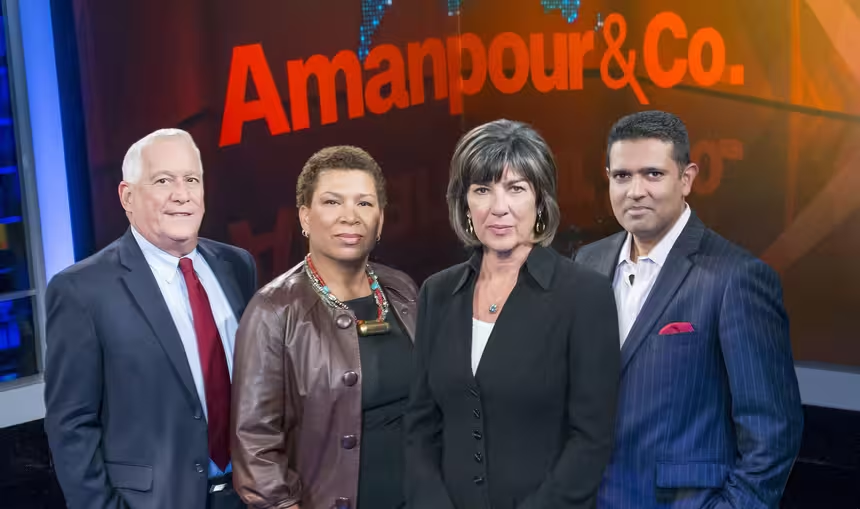
PBS and WNET, in collaboration with CNN, launched Amanpour and Company in September 2018. The series features wide-ranging, in-depth conversations with global thought leaders and cultural influencers on issues impacting the world each day, from politics, business, technology and arts, to science and sports.Providing Support for PBS.org
Learn Moreabout PBS online sponsorshipHello, everyone, and welcome to Amanpour & Company.
Here's what's coming up.
Trump is not a lame duck.
And thinking about him in those conventional American terms is really dangerous.
A setback for Trump, but not necessarily for Trumpism.
How do leaders who undermine democracy keep their appeal?
New York Times columnist M. Gessen on the enduring power of autocrats and what it takes to oust them.
Then... When I meet readers, I think that they are finding something truthful in these characters.
The things we never say.
Pulitzer Prize winning novelist Elizabeth Strout on the personal and political crises shaping America and why she turned to fiction to explore them.
Also ahead... We kind of take it for granted in a sense of how important it is culturally but also ecologically.
It's a divine alignment of nature that's keeping us alive.
The wild side of the American South, Grammy-winning musician Jon Batiste takes us into the region that shaped his music and the extraordinary natural world at its heart.
He speaks to Walter Isaacson about his new documentary, American Amazon.
Amanpour & Co.
is made possible by... committed to bridging cultural differences in our communities.
And by contributions to your PBS station from viewers like you.
Thank you.
- Welcome to the program, everyone.
I'm Christiane Amanpour in London.
From the United States to Israel, a warning about the enduring appeal of autocrats.
Last week's midterm elections delivered a stunning rebuke to President Trump, handing Democrats control of both houses of Congress.
And in the former slave-owning state of Mississippi, Scott Columb made history becoming the state's first black U.S.
senator in more than a century.
But does that really signal the beginning of the end of Trumpism?
In Israel, Benjamin Netanyahu's party won the most votes, despite years of war and security failures, and history shows that autocrats often thrive on the very fear and instability their policies create.
And in Russia, the non-democratic Vladimir Putin has clung to power for decades, despite corruption, war, and economic hardship.
New York Times columnist and longtime Putin critic M. Gessen warns against misreading the midterm results and argues that defeating autocracy around the world requires more than simply opposing the autocrat.
Writing what works is opposing the autocratic worldview itself.
It's asserting that while life really is hard and the world really can be scary, we need not live in fear and isolation rather than conjuring an imaginary past, its promising and achievable future.
I spoke to M. Gessen about what it really takes to defeat autocrats.
M. Gessen, welcome back to the program.
Thank you.
It's great to be here.
So, we turn to you because you are a real autocrat and authoritarian specialist.
You get what it takes.
You grew up in Russia.
You've been around, and you've really lived this stuff.
So, I just first want to ask you, you've written a lot about the midterms, and you said in your latest op-ed that it is a real blow to Trump and the administration and to the Republicans, but you caution it's dangerous to misread the midterm results as a complete failure of Trumpism.
What do you mean by that?
I wouldn't say that it's dangerous to misread it as a complete failure of Trumpism.
It is a complete failure of Trumpism.
But I think it's dangerous to assume that this means that Trumpism is over, because there's a real difference.
And it also has to do with just the strange way that we set up elections in this country, where there's a kind of every four years voters get to vote for president, and every four years, two years after they voted for the president, they get to express their displeasure.
The midterms are always a vote on the performance of the current president, and they're usually a vote of disapproval.
So the question is always the scale of this disapproval.
And the scale of this disapproval is enormous, and I don't want to diminish that by one bit.
But there's a huge difference between how people make decisions in the midterms and how they make decisions in the presidential elections, because presidential elections are not about disapproval.
It is not enough to hate the autocrat to unseat him.
Presidential elections are really about what people want to see in their future.
And that's where a lot of oppositions to autocrats or aspiring autocrats, both in the United States and around the world, have fallen flat on their face.
- And that's what I want to get to with you.
But first, I cannot not ask you about the incredible fact that in Mississippi, a former slave-holding state in the Deep South for the first time in about 150 years, an actual black man has been elected senator, a Democrat.
It is a remarkable thing.
Some 5,000 votes separated him from his, you know, his opponent.
And he did it in an interesting way.
He did it in, you know, also by engaging with Republican voters.
He, we read, went to Trump rallies, asked them about their issues.
I just wonder what you make of that tactic and that victory there.
- It's, you know, it's extraordinary.
It's inspiring.
It really tells us that Americans are not as bad as we sometimes think we are.
It also, the tactic, we've seen this before, right?
We saw it most prominently, maybe not for the first time, maybe this was who invented it, but New York City Mayor Zoran Mondani.
The way that he began his campaign, which is hard to remember now, happened when he was a complete unknown, is he started going around the city talking to people who had voted for Trump and asking them why they voted for Trump.
And I think this is not a gimmick, right?
This is, this begins with the acknowledgement that people didn't vote for Trump because they're stupid or because they're poorly informed, which is what a lot of sort of the elite attitude toward Trump voters sometimes reads as.
People voted for Trump because they're scared, because they're in pain.
And there are other ways to address that fear and that pain, but first you have to understand it and you have to acknowledge it.
And that's what both of these politicians did.
And I would also point out that the senator-elect from Mississippi did this with really no help from the Democratic Party.
- Yeah, yeah, that's really interesting.
I think the establishment was kind of caught off guard in some of these races, and again, the people have basically had their say.
You talk about the rest of the world as well.
You grew up in Russia, and you've seen with your own eyes what happens there.
Now, obviously, Putin's not a Democrat, and we know, you know, that he has done the total, you know, dictator playbook or the authoritarian playbook.
You know, there's no real independent judiciary.
There's no independent press.
We now talk as Novaya Gazeta has finally closed its doors, the last remnant of an attempt at independent press freedom in Russia.
But I'm interested in an illiberal democracy, the one in Hungary.
They call themselves illiberal Democrats.
And yet, Orban was unseated, and you were there.
What were the tactics that Peter Magyar used to oust an authoritarian democratically after 16 years of him being in power?
- And you know, after 16 years of him being in power, and at a point when really nobody believed that he could be unseated, much less unseated in such a decisive way.
Because of course, what autocrats do, and you pointed out rightly that, you know, some really change the landscape to the point where, like in Russia, basically you go to prison or are killed for dissent, but even sort of the illiberal democracy kind of autocrat rigs the system, limiting access to the media, right?
It's very difficult to run a campaign when you can't access the television or the big newspapers, rigging the constitutional system to raise basically the barrier to entry for aspiring opponents.
So what Madjer did is not dissimilar to what we were just talking about, about the sort of the new progressive populist politicians in the United States, which is he went directly to the people.
And he talked to their anxieties.
He talked to their pain.
He embraced some, you know, there's a kind of narrative about Magyar that the trick is that he came from the right, that he came from Orban's own orbit.
I don't think that's the trick.
I think the secret, one of his secrets, is that he didn't come from the discredited opposition.
He didn't come from the old opposition that was seen as having compromised with Orban, as having sort of, as basically having allowed Orban to happen on their watch.
This is a real warning to the Democratic Party in the United States.
They really do risk, especially after the last two years, being seen, the Democratic Party establishment, being seen as Trump enablers.
So, breaking with that enabler image and embracing issues of actual interest of voters, including issues that, and this is another very important point about the Magyar campaign, he took up issues that were seen as untouchable in Hungarian politics.
He took up the rights of the Roma people, which, you know, a lot of Hungarian pundits believed that this was an issue that the Hungarian society had moved so far to the right that she couldn't touch this issue.
The parallels in the United States would be to, you know, trans rights or immigrant rights.
We believe terrible things about our compatriots, sometimes with good reason.
But we have seen in this midterm election that this wasn't a determinant, right, that there were other things that mattered to voters.
But they don't actually care about trans rights as much as you might think.
And they don't believe that -- they don't necessarily believe that immigrants are an existential threat to them.
>> What do you think it takes to go from a protest movement, like the student-led list in Serbia, or the Cockroach Party, or the Nepalese, into a proper governing institution?
>> Well, you know, you and I are both old enough to have reported on the last student revolution in Serbia, which was, what, 26 years ago, 25 years ago?
And yeah, the fact that Serbia needs another student-led revolution a quarter century later is, you know, it's both wonderful that they can have it, but it's also so heartbreaking that they need to do it all over again against the exact same politics and even some of the exact same people, right?
So, so this kind of unseating the autocrat is only the first step.
And then the question is, what are the institutions like?
How much damage has been done to those institutions?
And coming back to the United States, what I think we really have to think about is that one of the reasons that voters chose Trump twice is that the message they've been really trying to send is, "Look, the system doesn't work.
If Donald Trump is the grenade that withrowed the system, so be it.
But the system doesn't work for us."
And so when Democrats have run, as did Joe Biden and Kamala Harris, on a sort of "everything is fine, we just need to go back to normal" kind of campaign, that doesn't work because the normal doesn't work.
And so the mandate for those who unseat an autocrat is not to go back to an imaginary normal, is not to restore the institutions, but to reinvent the institutions.
>> So, just to that point, the wins by the opposition in all of these places we're talking about were so overwhelming that even those disposed to question the results and, you know, say that, you know, it was a steal or whatever, did not -- not in Serbia, not in Hungary, not in the United States this time.
But the president, after a little bit of, you know, sort of chagrin the day after the midterms, has now -- appears to have doubled down.
His appointment of his most intense right-wing hardline ideologue, Steve Miller, as his chief of staff now.
The House has named a, you know, really pro-Trump, intense right-wing representative to be minority leader.
Is that a last gasp, or is that something that can just keep the ball rolling the way it's been rolling?
We need to take this very seriously.
Trump is not a lame duck.
And thinking about him in those conventional American terms is really dangerous.
Trump is a man who realizes on some level that if he loses power, he goes to prison.
And we've seen that around the world, right?
That's what autocrats do.
They abuse power.
They turn their political authority into a mechanism for enrichment.
The way that Trump has done it, the blatant way in which he has enriched himself, his family, some of his cronies, you know, it's mind-boggling.
And he knows perfectly well that he narrowly escaped going to prison before he was elected this time, and that he probably wouldn't be able to escape it if he is voted out of office.
So he is a desperate man who may stop at nothing to hold on to power.
And again, this is not an uncommon story around the world.
And what we have seen is that, yes, as you mentioned, we need a win so decisive in the next presidential election that like Orban and Hungary, he just wouldn't be able to contest it because it's so decisive.
But, you know, it's a really dangerous situation.
And among other things, Trump has funded his own paramilitary force, ICE, which is now the biggest and best-funded law enforcement agency in the entire country.
- You know, which was not deployed during these elections, thank goodness for the people of America.
But as you say, everybody has to keep their eye on this ball.
M. Gessen, thank you very much.
Thank you for having me.
Now, under Putin's autocratic rule, his war in Ukraine grinds on.
Just hours after renewed peace talks took place in Abu Dhabi this week, Moscow and Kyiv were once again trading strikes.
Meantime, Russia's deadliest attack this year killed at least 57 people last week in a building that was openly advertised as a humanitarian aid center where civilians had sought shelter from the war.
But what makes this Russian attack particularly cynical is that it happened at the precise time that Ukrainian authorities had told people to come there to collect humanitarian assistance.
Correspondent Claire Sebastian has analyzed video from that attack, and Ukraine's national police has also given CNN exclusive access to camera footage from two officers at the scene.
This is police body cam footage showing the minutes after two aerial guided bombs hit a former Ukrainian school.
The police believe two women are trapped under the rubble, one still alive.
What they don't know yet is the attack isn't over.
The school turned shelter and aid centre is in the already decimated village of Kamyshuvaha, just a few miles from the Zaporizhia front line.
Ukrainian police tell CNN the first bombs hit between 9.45 and 9.50am.
Timing is crucial.
The village council had announced bread and hygiene kits would be between 10 and noon.
For months it had been publicising aid deliveries at this location.
By 10.15am, Dmitry Bezedin and Mikhail Romanov, two local police officers, are on scene, their body cams recording.
They search for any further casualties and discuss how to reach the trapped woman.
At 10.31 an alert comes over Romanov's radio.
Aerial guided bombs heading for Arishev to the south.
You see him tell his colleague on the other body cam.
A minute later another alert.
Bombs heading for this village.
At 10.32 they hurry everyone in.
Down three flights of stairs into the freshly painted corridors of what was an EU-funded underground school.
Now a vital community space, even housing a makeshift police work space.
Here they wait.
Then at 10.35, two different body cams, the same explosion.
Volunteer first responder Vladislav Makhovsky arrived within hours to apocalyptic scenes.
CNN's analysis indicates the huge crater was likely caused by a FAB-3000, a #6,000 Soviet-era bomb designed to destroy heavily fortified bunkers.
Two weapons experts have confirmed the crater is consistent with a bomb that size.
And in this exclusive video CNN obtained from Ukrainian security services filmed on the day of the attack, investigators find a wing fragment on the roof of a damaged building.
Two weapons experts have also identified this as the wing of a Russian glide bomb guidance kit used to turn highly explosive dumb bombs like the FAB 3000 into precision guided weapons.
Russia hasn't officially commented on that strike but says that it was targeting Ukrainian military units in the area at the time.
Russia consistently denies targeting civilians.
CNN has reached out for further comment.
Ukraine's military denies any units were stationed at the shelter that could have been considered a legitimate military target.
Now, she's one of America's most popular writers.
Author Elizabeth Strout has sold over two million books worldwide, perhaps best known for "Olive Kittredge," which won her the prestigious Pulitzer Prize for Literature and was then adapted into an award-winning TV show.
And now she's back with a new book, "The Things We Never Say," following a Massachusetts history teacher in the lead-up to the 2024 U.S.
presidential election, as he grapples with both personal and national crises.
Strout is known for her ability to turn the mundane into the extraordinary, with stories exploring the rich interior lives of everyday characters.
And I sat down with her here in London to discuss why she felt now was the time to tap into the political moment.
Elizabeth Strout, welcome to the program.
>> Lovely to be here.
>> It's so good to talk to you.
You are a legend in your own time because your books are complete bestsellers and productions and films and series.
"The Things We Never Say," very different from your last one.
Just give us a quick, crazy, obviously not the whole thing, for people who haven't read it yet.
- Well, it's about, you know, a regular sort of man, a history teacher who's taught for many years.
He's a really good teacher.
He's very gifted, but he has an interior life, as we all do, and this bangs up against the exterior life, which is happening during the previous election that we went through.
So, I wanted to show his external world affecting his interior world.
>> So, the last election, you're talking about not the midterm, but the 2024 presidential.
>> That's exactly what I'm talking about, the presidential election.
>> Before I even go into it, I have to ask you, does your thesis hold even after the midterms, which is a complete reversal of what happened in 2024?
>> Well, I think the thesis holds for what happened, you know, what we expected, what we were facing, and now we hope for some sort of change.
We'll see.
>> Okay, so you talk about your protagonist, a good teacher.
His name is Artie Dam in the book, loving husband, father.
And we have a passage for you to read to give us a little view into him.
>> All of us live with a huge blind spot before our eyes, meaning that no matter what we think we know, we can never fully understand how we appear to others.
This was true for Artie Dam.
To his wife, he appeared the most considerate man she had ever known, though irritating in his way.
For example, five years earlier he had been named Teacher of the Year by the state of Massachusetts and he had been, what had he been?
Not proud of it?
Not exactly.
Not pleased by it?
Not exactly.
But he had not taken by Evie's standards a sufficient measure of happiness in this honor.
He said, "Oh, Evie, who cares?
There's many good teachers out there."
Why could he not accept the praise?
This had irritated her, along with his white socks, which still, after all these years, drove her crazy.
She was unaware, even after their 34 years of married life, of the deep pockets of sensitivity that Artie had.
And why did she not know?
Because she herself did not have those particular sensitivities, and like almost everyone else on this earth, her imagination could not take her fully to another place, even with her husband.
She had her own sensitivities, of course, like about her nose now dripping in the morning, but that was different to her.
And in fact, their sensitivities, or sensibilities, were very different.
She had never expected to marry someone like Artie, meaning someone from the working class.
She had come from an old Brahmin family, but she had met him when they were both volunteering on Saturdays at a soup kitchen in South Boston the summer after they had graduated from their different colleges, and she had become infatuated with him almost immediately.
The feeling became so intense that she wanted to marry him, and she did, and she did not regret it.
She felt that after the accident, which is how she thought of it, already had not fully dealt with his anger about it, already had trouble being angry.
In any event, there were a few times when she would be irritated with him and she would think, "Boy, he got a good ride with me."
- That's wonderful.
So obviously I'm not gonna ask you about the accident because I think that would be a spoiler, right?
But it's just really interesting.
The book is essentially around loneliness and isolation.
- Right.
- And in your very, you know, fun way, you point out, perhaps she's alienated and lonely from her husband that she doesn't understand.
- Precisely.
Everybody has their pocket of being inside themselves and can't fully inhabit another person.
- And yet, they've had a long and good, how do you account for that?
Or how does the story account for it?
- I mean, I think that they've just been relatively decent to each other.
They've had their lives, they've lived, you know, they've been loving, and they've had a marriage.
- This takes place in Massachusetts.
- Yes.
- You're from Maine.
- Yes.
- Two New England states.
This is political.
- Yes.
- And you said that it was about the, you know, the space around the 2024 election.
What does this couple and their experience tell us, or what do you want to tell us, about the forces around the 2024 election?
- Well, it changes Artie's life.
I mean, Artie, you know, by the end of the book, I don't -- hope this isn't spoiling, but he's -- you know, he does have a breakdown, and he has it partly because of this new president.
The president, he's been developing a wonderful relationship with his son throughout the course of the book, and his son, who had worked for the government, has to leave the country.
So, his son is taken from him.
His high school principal is taken from him because of the new president.
I mean, you know, with -- I won't say why, but I'm just saying -- -No, no, I know what you're saying, because we've lived through and we've watched and we as reporters have recorded people fleeing the country just by choice.
They just don't want to live in a country under that kind of government.
Universities under attack, professors, science, all the rest of it.
So that's the code.
- And how is he going to teach history?
- Yeah, how is he going to teach history?
Which is a really good question.
What do you say about what happened, even in your own state?
I mean, Maine basically said no to a long, long, long, long time Republican senator who actually had claimed and operated more of a sort of a self-declared moderate, independent, broke with Trump.
No.
Well, she was the reason that Brett Kavanaugh got in.
Let's not forget that.
So that was a Supreme Court justice.
Right.
So she did manage to do her amount of damage.
And I think that in Maine, I think that people... It took place really sort of at the very last minute.
She made some missteps in her campaign where she said to her opponent, "This is not about a cord of wood."
And he said, "This is exactly about a cord of wood.
People are going to be very cold this winter."
And it was like, people heard that.
Wow, the light bulb went off.
Yeah.
Yeah.
So, it's a hopeful feeling.
And what happens to the characters in this book if you were to go forward?
Yeah.
Because, you know, the wife -- Right.
She was a Democrat and married a Republican, or have I got it wrong?
No, they're both Democrats.
They're both Democrats, yeah.
But she's not as -- she's not as understanding of what the repercussions could be because she's not teaching history.
What do you think would happen to this couple and to Artie and his concerns after the midterms?
It's a question of what is America after the midterms.
- Well, we don't know.
We don't know.
I mean, there's a sense of -- There's a huge sense of relief for most of us, a sense of hope, what we haven't felt for a while, and yet there's still a real uncertainty.
How will this pan out?
What will happen?
What made you want to do a political book?
- I didn't want to do a political book, but it was happening as I was writing it.
So Artie came to me and I realized, this is what's happening.
He's a history teacher.
This is going to be his story.
Because when you take a time in history and a place and put a character in, you'll have a story.
I mean, I wrote about the pandemic with "Lucy by the Sea."
That was because the pandemic was happening.
I thought this has to be recorded.
So that's what happened.
It was happening as I was writing.
I thought, "This needs to be recorded."
-And what was happening when you wrote your best-selling masterpiece, "Olive Ketridge"?
-That was more toward the George Bush years, back with the George Bush years.
-And it wasn't political, though.
-Well, she's made some political remarks that people haven't liked.
-You want to tell us any?
-No.
For those who don't remember.
-She called George Bush a cross-eyed cocaine addict.
-Okay, okay.
Well, you know, that's good 20 years ago.
Nobody liked the war, so, I mean, you're on topic.
And nobody likes the current war, which is probably definitely what happened in the elections as well as everything else.
-Yes, precisely.
-So, Olive, she -- Differently to these characters in this book, she's much more, you know, concerned about her immediate surroundings.
How did Olive come to you?
Lots has been said about how you develop your characters.
You know, Olive arrived as a presence.
I was unloading the dishwasher or loading... I was doing something with the dishwasher, and I felt a presence behind me, and I could hear inside her head, I could hear this presence of this woman saying, "It's high time everyone went home."
And I thought, "Wow, I have to get that down."
It was just so clear.
And that was the first story I wrote about Olive Kittredge when her son got married.
- And then she'd go home from the party.
- And it was funny, because I had so many unfinished stories.
And the moment I put Olive in them, I thought, "Oh, there we go."
They were just waiting for Olive to show up.
- And wasn't Olive sort of a person who, you know, she was able to, you know, a politician, whether it was in the George Bush years or whatever, didn't necessarily ruin families, didn't ruin friendships.
- She's very cantankerous, but she was a person who had real insight.
I mean, you know, she saved that young man's life who came up with his intention to kill himself.
She knew that, she just could understand.
She got in his car, she didn't leave, and then he ended up not killing himself because of Olive Kittredge.
So she does that in her way.
She's very intuitive and kind to people when they need it.
- It's in this book where Olive marries a Republican, despite her initial sort of disgust.
- Right, that's right.
- Again, what does that say?
- Well, that was back then.
- Yeah, it says then and now.
- Right, precisely, because she did remarry when her husband had died.
She did marry a Republican, and she was nasty about it, but she got used to it.
But that was then, that was a different kind of Republican, you know, 10 years ago, 15, 10 years ago or so.
- Again, I think it's really interesting about where America's going.
I mean, I guess I'm fixated, like many people overseas, because you know, you say, there has actually been a series of global nervous breakdowns - Yes, yes, yes.
- Following the politics of the United States.
And none of us are immune, even though we don't vote or live, or et cetera, in the US.
And I'm just interested in knowing whether, since you've seen so much, and your books have followed such a massive political gamut, are you optimistic or are you pessimistic, or do you see things going in one line, or is it not linear?
- Well, after the midterms, I am cautiously optimistic.
And I haven't been, but now I feel some optimism.
- And the question then is, is that just politics, or is it something bigger than politics?
I think it's bigger than politics.
I mean, I don't know how you define politics, but it feels like it's a massive thing that's happening in our country, and people are trying to correct something, I hope, and it's a very strange, strange atmosphere right now, very odd.
And it is, I mean, this is just a commentary, it is incredible how little the powers that be understood where the people were.
>> Right.
>> I mean, one of Trump's great entrees into politics in 2016, and it won him the election, and again in 2024, was, "I feel your pain."
A different version of Clinton.
>> But exactly.
>> Yeah.
"And I can help you, the working class, the dispossessed."
>> And he wasn't.
He couldn't care less.
And I think some of them have come to understand, you know, that gas prices are enormously high now because of the war.
You know, it's like people are sort of beginning to think, "Wait a minute."
>> We have agency.
>> Yeah, I hope so.
I really hope so.
>> What is the writing process?
I mean, that's a big question, but do you get up early in the morning, do you -- >> I don't get up early in the morning.
>> Do you have to be alone?
Is it solitary?
>> I have to be alone.
Noise does not bother me as long as it's outside.
>> So no music?
>> No, no, no, and if there's anybody even in another room that might need me, then I can't.
Right, I need to concentrate.
It's enormous concentration, and I have a studio in Maine that is just mine, and I just need to have utter concentration.
And so I don't get up early, but I have breakfast, and then I'll work through lunch, pushing lunch off as far as I can, because I have noticed that there's something about lunch that sort of makes it sag.
I know.
>> But makes it sag.
>> Yeah, yeah, yeah, yeah.
>> And it's like, oh, no, I need to just, you know.
>> So then is it sagged and you don't do any in the afternoon?
>> No, I will look at it again in the afternoon, which is always a little risky, because, you know, you want to go to bed happy.
>> And what about the time it takes you to, from concept to delivery?
>> Well, this book was rather quick.
I think this book took me about two years.
I can't quite remember.
And they had been coming rather quickly for a while.
So, but I never really know.
Because, you know, there's a character that arises just as I'm finishing that I'm, so I'm onto the next one.
- So you're a prize winner, you've been nominated for all sorts of prizes.
What do you think hits and connects with your audience?
What is it that they're getting from you?
I hope and I sense when I meet readers, I think that they are finding something truthful in these characters, these so-called ordinary people, which are not ordinary because nobody is.
Everybody has so many parts of themselves.
And I think, I hope, I'm naming that for the reader so that the reader feels like, "Oh, I've had that thought.
I actually know that."
Or maybe now they know their mother-in-law differently or something.
So I think I'm just hitting basic human truths, I hope.
And do you find audiences... You must do, but how do you find audiences react differently or similar in the United States and here in the UK?
-Because you're on a big book tour now.
-Right.
With this book, this book was very popular in Europe and in the UK for a while and not as popular in America.
Yeah, so there we are.
- She says with a smile.
- What can you do?
- But it might be.
It might be, you know, after Tuesday.
- We just don't know, right, exactly.
- What's next on the agenda?
- Yeah, I wish I could tell you, but I can't.
- You can't because you're already doing it.
No, no, of course.
- And I just, I can never talk about my work because it's bad for it.
I would love to.
- Yeah, no, no, you wouldn't.
- I would love to sit here and tell you all about it.
- No, no.
- 'Cause it's not good for the work.
- And there's quite a lot about aging in your work.
- Yeah, yeah.
- And that's just difficult for women.
- Yeah, and now I'm older.
And it's like, wow, how did I know that back when I was writing, you know, but-- - And the characters.
- Yeah, exactly.
Because I was writing about older people all along.
I've always been interested in older people, and I think that's because I grew up on a dirt road with four great aunts all lined up and-- - So older people, older women, too.
- Yes, yes, and they were very dry and very depressed and very mean.
And they would talk about their husbands' last dinners was their favorite conversation, yes.
- So husbands all dead and they made them the last dinner.
- Yes, and I always remember, and I had an olive and she was the sweetest one, but anyway, and I always remember her tapping her cigarette and saying, "I'm so glad that Frank had that mackerel the way he liked it."
She would just say this over and over.
Honestly.
So, anyway, that was the music of my youth.
And that is the perfect way to end this conversation.
Mackerel just the way he liked it.
Thank you so much, Jean-Pierre.
Lovely to talk to you.
Thank you.
Now, from the sounds of the American South to his extraordinary natural beauty, Grammy Award-winning musician Jon Batiste is turning his attention to the landscapes and the wildlife of the region he calls home.
His new IMAX documentary, "American Amazon," explores the rich biodiversity of the South and its deep connection to the music and culture that shaped him.
These ancient strongholds are the seeds of the future.
Batiste spoke to Walter Isaacson about the film, his Louisiana roots, and his extraordinarily productive year in music.
Jon Batiste, welcome back to the show.
Hello, how you doing?
Walter, good to see you.
Good to see you.
And I just watched this wonderful documentary you did called "American Amazon."
It's about the flows of all the waters together and the biodiversity of the Deep South.
Why'd you decide to do that?
Well, I'm a son of the South.
I grew up just with the swamp in my backyard, and I didn't know it.
So when I realized that and I started to understand the importance of it and this opportunity came along, I thought it's a great opportunity to share my platform and introduce people to something that's near and dear to me that a lot of people don't know about.
They don't know that we have this incredible stronghold of the ecosystem that's in our country.
And I love the idea of calling it the American Amazon and really changing the perception of it.
Because you know, you think about the swamp, there's a lot of culture that comes from that.
And we kind of take it for granted in the sense of how important it is culturally, but also ecologically.
It's a divine alignment of nature that's keeping us alive and keeping life flowing.
A secret wilderness is hiding right in our own backyard.
A maze of ancient forests and untamed rivers.
[rushing water] Sustaining life... found nowhere else on earth.
You know, there's a line you have in there that I really love, which is, "The water is the source that connects everything."
And one of the things that struck me, it was a little bit like jazz music, in which so many tributaries and so many waters flow into it, and then your music, your social music.
Tell me how, in some ways, it's a metaphor for the music you do.
- I try to make the music feel inevitable.
I make music that feels connected to the past, present, to create the future.
And that's my goal when I'm taking from the past to learn and to grow and to understand so that I can create something that is brand new.
And that's what this is about, really the alignment of all things from the first drum, the first tree, the first river, all of the things that connect humanity over time is very similar to music and how these elements that are foundational in music connect us all over time.
So, we have to know that if we want to move forward and create a better future, a better world, we have to understand all of these things that have been left to us.
We are the stewards of the future.
And the swamp is such an allegory for life and the understanding of lineage and the passing of time.
The filmmakers use an instrumental version of your song "Petriture," right, which is about the aftermath of Hurricane Katrina, it's about the climate crisis.
Why was that used?
My mother, Catherine Batiste, who is one of my biggest inspirations, was an environmentalist.
She decided when we were very young that she was going to change her career path and she was going to understand why everybody who grew up in this area in New Orleans in the 17th Ward called Holly Grove where she grew up and where I would grow up partially with my grandparents and she would talk about how they called it Cancer Alley and how there was all of these people who would get sick and all of these different things that were happening in the environment she wanted to figure out why is this happening on my block in my neighborhood all the time why is it happening in the south I want to understand this so she really started to educate us as she got educated and shifted her career path and became an environmentalist and became somebody who worked for decades understanding and and being an activist in combat and the problems that we see in the south and then you get hurricane katrina that happens and when i put out my album big money hurricane katrina it was the the 25th anniversary i was thinking about petrichor which is the smell that happens in the environment that you you feel that smell it after a long period where there's no rain you need that smell that happens it's a beautiful aroma that's that that aroma I feel like that signals that everything is in order so I decided to call the piece petrichor because that's everything in order you get petrichor when it's all in order and the song in the film is perfect because the swamps and all the things that you see as sea levels rise as temperatures get warmer and warmer as we see all of these different impacts of the swamp of corruption then you get an understanding of why the swamp that we see in the South is so important, why things being in divine alignment and order in the environment is so important.
And it also is just a tribute to my mother and the fact that now, all of these years later from the time I was a little boy to now, this film that I'm producing and doing the voiceover that is speaking to the things that she was the first to teach me about.
And the song was a song that was inspired by those lessons.
You wanna play a few bars?
Oh yeah, I wish I had my banjo.
I played the piece on the banjo.
So uh... [playing piano] You say... ♪ My, my, my, my ♪ That's the refrain.
It's like, my, my, my, my.
Like, it's like we got folks humming.
It's like that old church hum, or like the wise elders, just that feeling of you're looking around and you're observing, and there's beauty, but there's peril.
It's both.
It's all the things like we talk about in life, the balance, and you just, my, my, my, my.
It's all, all you can say is my, my.
So I just wanted to put that into a lyrical context.
And then the words, you know, you talk about the words in the song, "Wonderful Petrichor, no more."
You know, you talk about criminal minerals.
It's too many chemicals.
All of the aspects of things that you would say if you were just having a conversation.
It was like colloquially, you're sitting down in the swamp and you're sitting on your porch and you're sitting there and you're looking out, my, my, my, man, it's too many chemicals.
We losing our minerals to the criminal mineral.
And the power of that sort of spoken, it's almost like a recitative in an opera, something that you kind of can speak a melody through.
And then I put that with some very black, Afro-American blues aesthetics.
And then I put the banjo and the violin, like the early kind of the Appalachian swamp, at the blend of those traditions to create that song.
"Big Money" is an album that was all about that, blending those early tributaries, those Proto-American forms.
You have three new albums out, which I've just been listening to, and they sort of explore the notion of piano playing.
When you were growing up here in New Orleans, you used to train very formally in compositions, but then at night you'd hang out in some of the clubs and learn the improvising.
It seems these albums do that, which is the formal training and the improvising going together.
Tell me about that.
I love the idea of looking at the canon and establishing a new precedent within the canon, understanding what's called classic, and then saying, well, now we can reevaluate what's considered classic, what's considered canon 250 years later.
And some things like the blues and gospel and jazz and soul and R&B music now should be considered classic in the canon.
There's a period when things go into the public domain, and then there's a period when things become the canon of greatness that we all consider and reference when we're trying to create art.
So I think about that often.
When I was growing up, there were things I was growing up with, and I understood in New Orleans, I understood that, okay, if you play this note a certain way, if you play that, that's the blues.
Now, if you apply that to... (playing piano) Play that, apply that to Beethoven, you get a certain expression out of it, that, that's, that approach and that philosophy, to me, is an expression of the new canon.
You know, I think when you were growing up, didn't you sit in with your cousin, Alvin Batiste, who also did some Mozart thing, and he did a song called Mozart that you played when you may have been 16 years old.
Do a little of that on the piano and explain to me how that's one of those tributary waters to this album.
Yeah, so he had a piece, it was a blues actually, funny we talk about the blues, he was one of the first to teach me about the blues and the understanding of it as a form, as an idiom, as something that we express that is taking the pain of life and transmuting it into beauty, right?
So you think about his tune.
(playing piano) He's taking this theme that Mozart did, this vernacular approach to Mozart's melodic theme that he would do.
(playing piano) Mozart has this thing that he does, idiomatic to his music.
Now, Alvin took that and created a blues vernacular piece that was also in tribute to this approach that Mozart had in his melodies.
So I thought that was cool to understand when I was 16.
Oh, you can take something like Mozart and you can apply it to this?
Okay, let me see what else I can mix and match.
And so you did that too with Black Mozart, the most recent album.
Show me how that flows into this album, Black Mozart.
Oh yeah, so you got some... It's the same.
(playing piano) And so do you write that up or do you improvise that, having played Mozart as a kid, and then just knowing how you're going to express it with feeling?
Well, that's an easy one.
For me, that's like a very basic feeling that I have.
I walk around the world all the time with the feeling of the blues in my soul.
So I just walk around with that feeling.
And then when I hear melodies, even if I hear a phone ring or if I hear the sanitation truck come by and it's going, "Beep, beep, beep," if I hear that, I'm going to go, "Yay, yay, yay."
I'm thinking that that's like the tonic of the blues.
I'm constantly expressing the blues in my way of life, and not sadness of blues, but just the feeling of blackness in the black diaspora tradition that I grew up with and understand just from an innate place.
So when I play this music, I always heard it like that.
I didn't think about it like, "Let me change it."
I played the classical music that I learned from my instructors, and then I said, "Oh, what if you... What if I kind of took it to this place of home within myself and just played it a certain way?"
So it wasn't as a project something that I had to think about in that way in terms of writing it out.
It was more I understood the original composition.
I learned it, and then I just took it through the filter of my life and my experiences, and that's what it came out sounding like.
You've spoken a lot about the power of music and your own social music is geared to this, which is bringing different people together, bringing diverse people together.
In this time of real political polarization and poison in our system, what do you think the role of music can be in trying to heal us?
Music is something that connects people across all of the possible divides, all of the division that can be caused when we think about politics or we think about the extreme versions of religious faith and aspects of differences that come when folks are trying to connect and then they just can't get past certain things.
And music is a thing where there's no discussion, there's no sense of paralysis from analysis.
It's heart music, it's soul, it's connected to this deeper part of yourself, this fundamental part of yourself, where at least once we get to the point where we can feel something and feel it together, then maybe we can have a discussion.
Maybe we can find common ground.
Maybe if I understand the feeling that you have is the same as the feeling that I have within me, then at a certain point we can see each other and see more commonality than differences.
So I really believe in showing the radical example of music and the connectivity of music in a way that it shows us the fundamental nature of humanity and injecting music into the conversation and into moments that you wouldn't expect there to be anything that can bring people together, anything that can bring joy.
That's why we do the Love Riot.
That's why we go to places, we go and play in places where people feel forgotten.
We go and play for people who feel that nobody sees them.
We go and create this experience, this moment that it ignites something within people and it's a mass revival of the soul.
Your wife, the writer and artist, like a joie, has been fighting leukemia and I know has gone through another round of bone marrow transplants just out of the hospital.
First of all, how is she?
And secondly, how is this connection between sort of pain and joy, which is very biblical, how does that affect your art?
Well, life is all the extremes wrapped into the experience of one's soul.
And you're walking through life and you're carrying these extremes and your soul is bearing the fruit of the great moments and you're in the peaks and valleys of the dark moments.
You got the valleys of the dark moments where you say, "Even though I walk through the valley of the shadow of death, I will fear no evil for your rod and your staff.
They strengthen me."
See, this is what I carry with me.
This is what I hold on.
This is what we hold on to in these moments.
It's this idea that life and this moment in time in a human body with your soul on this planet, you're going to carry those extremes.
You're going to be in moments where you're dealing with the darkness and the heaviness.
It's all one.
That's what this is made for.
It's everything all at once.
Everybody's going through something.
People who you see celebrating and lifting up their hands in triumph, they're also people who are going through something.
Everybody is going through it.
No one is exempt.
So that's something that we understand and we try to use our platform and our journey when we're celebrating these high moments to also show people, you know, we're dealing with stuff.
Everybody's dealing with things that we're all in this together.
You're not alone in your journey.
This is life and to shine a light on the fact that vulnerability in that way is a superpower and it can empower folks to understand that they're not alone.
Even just that realization can make folks understand that they can make it through to the other side.
And for me, my faith is always carrying me.
You know, as I quote, you know, Psalm 23, think about what that means and how powerful that is.
You anoint my head with oil, my cup runneth over.
Whew, just even in the moment where you're in your lowest point, He's with you.
God is with you.
The universal consciousness, however you wanna call it, what do you wanna call it, however you wanna call it, connect to it today, find it.
It's there in the quiet moments and we can connect to it at all times.
So that's carrying us.
And Sulayka is one of the most profoundly strong and deeply, deeply rooted in purpose of any person that I know.
I admire her and learn from her every day.
And she's surrounded by love and we're doing as well as you would hope for in this period of our lives going through what we're dealing with.
So I'm just grateful that we're able to have all of this love around us to foster us in this time.
- Jon Batiste, thank you so much for joining us.
Appreciate it.
- Absolutely, thank you, Walter.
- And that is it for our program tonight.
If you want to find out what's coming up every night, sign up for our newsletter at pbs.org/amanpour.
Thanks for watching and goodbye from London.
[Music]
 New
Jon Batiste’s New Nature Doc Explores the Swamps of the South
Video has Closed Captions
Jon Batiste discusses his new nature documentary, "American Amazon" (18m 8s)
Providing Support for PBS.org
Learn Moreabout PBS online sponsorship New Episode
- News and Public Affairs

Top journalists deliver compelling original analysis of the hour's headlines.
 New Episode
- News and Public Affairs

Today's top journalists discuss Washington's current political events and public affairs.
 New Episode
 New Episode
 New Episode
 New Episode


 New Episode



 New Episode
 New Episode
Support for PBS provided by: