
Washington Week with The Atlantic full episode, 02/20/26
2/21/2026 | 26m 46sVideo has Closed Captions
Washington Week with The Atlantic full episode, 02/20/26
President Trump walks into his State of the Union address facing damning headlines and sagging poll numbers as voters watch the turbulence at home and abroad. Join guest moderator Vivian Salama, Peter Baker of The New York Times, Eugene Daniels of MS NOW, Lisa Desjardins of PBS News and Susan Glasser of The New Yorker to discuss this and more.
Problems playing video? | Closed Captioning Feedback
Problems playing video? | Closed Captioning Feedback
Major funding for “Washington Week with The Atlantic” is provided by Consumer Cellular, Otsuka, Kaiser Permanente, the Yuen Foundation, and the Corporation for Public Broadcasting.
Washington Week with The Atlantic full episode, 02/20/26
2/21/2026 | 26m 46sVideo has Closed Captions
President Trump walks into his State of the Union address facing damning headlines and sagging poll numbers as voters watch the turbulence at home and abroad. Join guest moderator Vivian Salama, Peter Baker of The New York Times, Eugene Daniels of MS NOW, Lisa Desjardins of PBS News and Susan Glasser of The New Yorker to discuss this and more.
Problems playing video? | Closed Captioning Feedback
How to Watch Washington Week with The Atlantic
Washington Week with The Atlantic is available to stream on pbs.org and the free PBS App, available on iPhone, Apple TV, Android TV, Android smartphones, Amazon Fire TV, Amazon Fire Tablet, Roku, Samsung Smart TV, and Vizio.
Buy Now
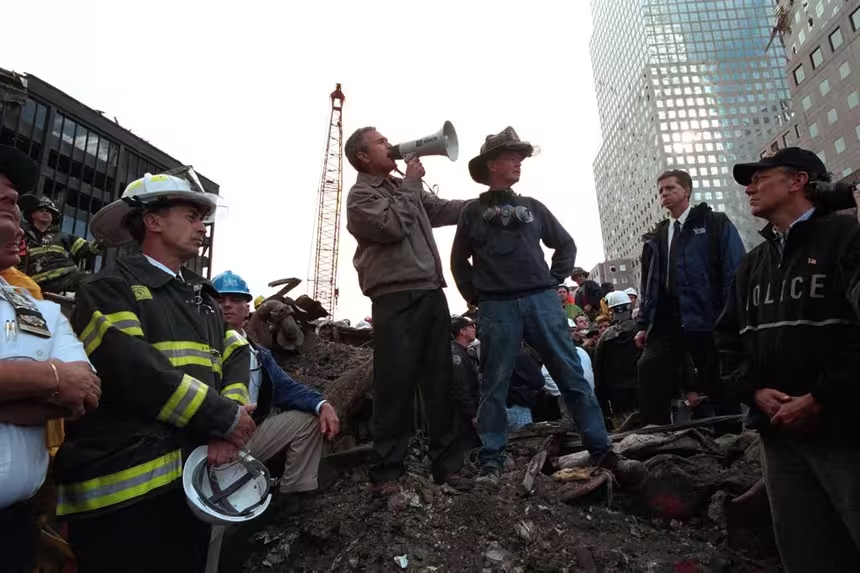
10 big stories Washington Week covered
Washington Week came on the air February 23, 1967. In the 50 years that followed, we covered a lot of history-making events. Read up on 10 of the biggest stories Washington Week covered in its first 50 years.Providing Support for PBS.org
Learn Moreabout PBS online sponsorshipVivian Salama: President Trump walks into his State of the Union facing damning headlines and sagging poll numbers as voters watch the turbulence at home and abroad.
Tonight, with midterms looming, can the president use next week's primetime address to reset the story of his second term, next.
Good evening and welcome to Washington Week.
I'm Vivian Salama in tonight for Jeffrey Goldberg.
President Trump is days away from delivering his State of the Union address and his speech comes at a moment of deep division, challenges to core elements of his agenda, friction with allies abroad, and questions about the balance of power here in Washington.
Joining me tonight to discuss this and more, Peter Baker is chief White House correspondent for The New York Times, Eugene Daniels is a senior Washington correspondent and a co-anchor of The Weekend at MS NOW, Lisa Desjardins is the Congressional correspondent for PBS NewsHour, and Susan Glasser is staff writer at The New Yorker.
Thank you all so much for joining me.
So, the Supreme Court dealt a major blow to President Trump's economic agenda today, striking down the broad global tariffs that he imposed through this authority that's known as the International Emergency Economic Powers Act.
The Supreme Court held that the president lacked authority to leave these sweeping tariffs without explicit Congressional approval.
Peter, the president came out to the podium today and tried to respond to the Supreme Court's decision.
How did that play out?
Peter Baker, Chief White House Correspondent, The New York Times: Yes, he took it graciously, of course.
Vivian Salama: Yes, obviously.
Peter Baker: He attacked the Supreme Court justices and said that they were unpatriotic, that they should be ashamed of themselves, their parents should be ashamed, that their family should be ashamed of them, that they had been influenced by foreign interests.
It's a kind of reaction we shouldn't be surprised by, but not the kind of reaction we normally see from a president toward a Supreme Court ruling.
And it's just -- he sees the Supreme Court as a political body.
He doesn't see it as a judicial body in that sense.
They're supposed to rule for me because I appointed them.
He gives that impression about the three justices he put on there, two of whom went against him today, Amy Coney Barrett and Neil Gorsuch.
And he then, you know, made clear he wasn't going to basically bow down just because they have made this ruling.
By the end of the day, he'd already put out a new order trying to re-impose tariffs under a different legal authority.
Vivian Salama: So, he said today that because he couldn't use that legal authority, he would impose 10 percent tariffs on countries around the world using different authorities.
He actually took the Truth Social around the same time that he was at the podium, you know, opposed through his account.
And he said this was an important case to me, more as a symbol of economic and national security than anything else.
The good news is that there are methods, practices, statutes, and other authorities as recognized by the entire court and Congress and even -- and are even stronger than the IEEPA tariffs available to me as president of the United States.
So, Susan, obviously, he's looking for workarounds here.
Susan Glasser, Staff Writer, The New Yorker: Yes.
I mean, the Supreme Court was very clear.
That's not how our system is supposed to work, and I think that's really powerful, if you read these decisions.
You know what's supposed to happen in a situation like this?
The Supreme Court told the president of the United States very clearly, if you want these tariffs, get Congress to pass a law to issue these tariffs.
Donald Trump has ruled out doing that.
And, of course, he doesn't actually have the votes, even though it's a Republican-controlled House and a Republican-controlled Senate.
He's trying to bypass the way our system is supposed to work.
And I think it's really notable here that one of the justices who concurred in the majority opinion, Justice Gorsuch, as you mentioned, he's a Trump appointee, he's a real conservative.
He's ruled against, you know, many, many, many beloved issues of liberals.
And yet what he wrote in his concurrent is something that you're seeing passed around Washington today a lot, he said, essentially, if you bypass Congress and the system is not supposed to work, so that one man has this much power.
Vivian Salama: I mean, talk to me also about the way that the president has used this as basically a central tool in dealing with countries, allies and adversaries alike, you know, imposing tariffs on India because it was buying Russian oil and for other reasons as well, imposing it on European allies because he wanted to compete on steel and aluminum.
I mean, it's sweeping.
How are you -- what are you hearing from sources abroad about how the Supreme Court ruling has been received, but also how President Trump has conducted himself through his economic agenda?
Susan Glasser: That's exactly right.
This is a pillar of how he was using his aggrandizement and his aggressive view of the powers, the sweeping powers of the American presidency, to rewrite international diplomacy, which for Donald Trump is very much about economics anyways.
You know, Europeans are already so terrified about the unraveling of our decades-long alliance, you know, that there was real questions as recently as last weekend, the Munich Security Conference.
You know, is this an alliance where the United States has gone so far off the rails?
Are there checks and balances left in the system?
And I think there'll be a little bit of relief that, okay, it seems that the Supreme Court is still, at a certain point, willing to step in and check and balance, but the fact that Trump immediately then is trying to circumvent the Supreme Court's ruling.
And let's be clear, that's what he's doing.
He is trying to circumvent the court's ruling and that's going to unleash a whole new wave of uncertainty in the economic markets.
It creates turmoil, by the way, that is affecting not just the United States but other countries around the world that we're connected to.
So, again, it's a sign of Donald Trump's chaos affecting not just Americans but people all over the world.
Vivian Salama: It's not really just a question of circumventing the court's ruling, right, Lisa, like we've seen significant reasons to be concerned about the erosion of the independence of the judiciary.
I mean, just this week we saw a huge banner with President Trump's picture on it go up outside the Department of Justice, which is pretty astonishing.
So, today, you know, we were just saying that President Trump called Justices Neil Gorsuch and Amy Coney Barrett, two of the justices he nominated in his first term, an embarrassment to their families.
He said they were making a big mistake.
You cover the Hill.
You know, how are these attacks being received, particularly among Republicans who do believe in essence of the independence of the judiciary and other branches?
Lisa Desjardins, Congressional Correspondent, PBS NewsHour: Somewhere in Fitbit headquarters, they are noticing heart rates going up among Republicans wearing those watches.
I think that Republicans right now are concerned about their ability not just to hold the House but really to have even a close margin in the House because things are not going the way.
They need Trump to be charming Trump, not angry Trump.
We'll get into that in the State of the Union.
But when it comes to tariffs, Susan mentioned that our allies are terrified about what this means, the unraveling of like the European alliances.
I think a lot of Republicans on the Hill are terrified of a potential tariff vote if the president decides he does want to go to the Hill with this and what that would mean for the unraveling of the very tricky MAGA moderate alliance of voters that they all need and they don't want to take those tariff votes.
The House and Senate have both passed bills opposing tariffs in the past, but it hasn't led to serious consequences.
Vivian Salama: But are they ready for that kind of a fight with Trump, especially for an issue that's so near and dear to his heart?
Lisa Desjardins: No.
It would be a very difficult vote for most Republicans.
But I'll tell you who would love it.
Democrats.
They are ready for this.
Let's talk about tariffs as much as we want to talk about how they say he's failing on inflation and failing on prices.
They think this is a good example of an economic agenda failing, and Republicans have to figure out their message.
Vivian Salama: Okay.
So, Eugene, in 2025, economic growth slowed compared to the year before.
And economists say it was largely driven by President Trump's tariffs, as well as the government shutdown that we saw in the fall.
Many economists believe the tariffs are hurting the country.
Many people in states that backed Trump overwhelmingly are being -- are feeling the pain of these tariffs.
So, why is President Trump so dedicated to still - - or why is he so committed to this policy?
Eugene Daniels, Senior Washington Correspondent, MS NOW: He has been obsessed with the idea of tariffs forever, right?
When he was a businessman in New York City, that was something he talked about a lot, interestingly enough.
It is why he believes like Japan is such a powerhouse because of tariffs.
He sees it as this kind of ability and tool, and he's used it, as Susan was talking about, as a cudgel against both your enemies and your allies.
And that's why when people are -- when I talk to Republicans, I'm sure you have too, who are like, oh, if the Supreme Court will just get rid of this, these tariffs, everything will be fine.
Well, maybe we won't get this -- yes, we can move on.
That is not what's going to happen.
It was never what was going to happen.
Donald Trump truly believes that this is a way to do economics.
And when you look at his kind of economic plan, this is kind of it, right?
Like there hasn't been other bills that he's been trying to pass.
They passed the one reconciliation bill they keep talking about.
Maybe they're working on something else, but there's no real movement on that.
Lisa Desjardins: They would say tax cuts.
Vivian Salama: Right, exactly, tax cuts.
Lisa Desjardins: They would say, extending the tax cuts, they'd say, right?
Susan Glasser: So, give more money to wealthy corporations and individuals and make everyday people pay more money.
I thought it was very interesting on the politics today that you had J.B.
Pritzker, the governor of Illinois, sending Donald Trump -- it was almost a Trumpian like gesture, right?
He sent him an invoice.
He said, okay, I'd like you to pay back the people of my state for all the money that they had to pay extra for goods and services as a result last year of your tariffs.
Eugene Daniels: Because the politics of this is on Democrats' side.
Like when you look at how voters think about tariffs, they don't like tariffs.
It's not -- Republicans don't like tariffs.
Democrats don't like tariffs.
Independents don't like the concept of tariffs, because they understand that the connection between their prices going up and President Trump signing these executive voters.
Vivian Salama: But President Trump always says short-term pain, long-term gain.
You know, that's kind of his mantra on the campaign trail.
But, you know -- Eugene Daniels: Voters don't think like that.
They have bills.
Vivian Salama: I mean, and on that note, speaking of the economy, the issue is expected to feature prominently when President Trump addresses the joint session in Congress on Tuesday.
Listen to how President Trump previewed his speech earlier this week.
DONALD TRUMP, U.S.
President: Watch the State of the Union.
We're going to be talking about the economy.
We inherited a mess and now we have prices way down.
We have energy way down.
Gasoline is now breaking $2 a gallon in many places, and it's been actually amazing.
Vivian Salama: So, Peter, broadly speaking, what can we expect to hear from President Trump for his second State of the Union of his second term?
Peter Baker: Yes.
First of all, a lot of things he just said there, not true, just to be clear.
Vivian Salama: Okay.
Peter Baker: Okay.
He inherited an economy that had been afflicted by high inflation, but by the time he inherited, inflation was at 3 percent, is currently at 2.4 percent, 2.5 percent, something like that.
So, it's relatively where it was.
He inherited an economy that was actually producing a lot of jobs.
In fact, it's actually gone down this year in terms of jobs.
Last year, there was only 180,000 jobs, something like that, for the entire year, a fraction of what had been produced in the year before.
So, people are feeling this anxiety.
And they're feeling anxiety because of the advent of A.I., which is coming along and people think, is that going to take my job?
I don't know.
They're feeling anxiety because prices haven't gone down.
They haven't gone up as much, but they're not going back down overall.
And you saw his inability to stick to that discipline message just this week, right?
They send him to Rome, Georgia to talk about affordability.
He says, I won affordability, as if it's all over, and everybody should just simply stop caring about it, right?
And on the same day, he's meeting with his Board of peace to talk about Gaza.
He's talking about war with Iran, never mind that we have a Board of Peace, while we're talking about war.
We can get into that.
He's talking about everything it seems like from a lot of Americans other than their lives.
And Susie Wiles, the chief of staff, has said, we need him to focus more on these issues of bread and butter, you know, kitchen table issues for voters, but he just can't seem to do it.
He doesn't seem to be interested in it, and he sees it as obviously a vulnerability, Vivian Salama: and the administration has been very intent on trying to kind of pin this on the Biden administration, any kind of, you know, aching and pain that the voters feel.
President Trump's top economic adviser, Kevin Hassett, in December actually addressed this question of whether or not Trump at some point inherits the economic -- the pain of the economy.
And here's what he said.
KEVIN HASSETT, Director, National Economic Council: At what point does it become the Trump economy?
Well, it's the Trump economy now.
Our policies are changing people's lives.
But when are we going to be able to point to numbers and say that we fixed the problem, we filled the hole that Biden dug?
You know, that'll depend on what thing.
So, for example, we're way past a success on eggs.
But there are other things that are going to take longer.
Vivian Salama: So, Susan, it is the Trump economy on select issues.
Susan Glasser: I would say that if it's good, it's the Trump economy, and if it's bad, somebody else did it, which to be fair, you know, many, many leaders of both parties have had that view of how things should work.
And as you know, Americans tend to wildly overstate the role of individual accents.
That's what's so remarkable actually about what Trump did in his first year, which is that he took an economy that was headed in one direction and they had to -- you know, the forecasters actually had to take down their estimates for American growth last year as a direct result of Donald Trump's tariff policy and the uncertainty he injected in the economy.
His attacks on immigration, we could talk about that, that also plays a role in the strength of the American economy.
And then, of course, the fact that he's going after our friends and neighbors, especially in Canada, again, we are intertwined, economically speaking.
So, these are very direct results of a president.
And, you know, look for Donald Trump who's made bashing his predecessor, Joe Biden and Barack Obama, before that, you know, probably the over the top signature of his presidency, it's really got to gall him that you now see some of these surveys coming out saying that Americans are so dissatisfied with the direction of the country.
They believe definitely that Barack Obama, but even that Joe Biden, you know, did a better job in the presidency for someone who has literally vilified Joe Biden, who's hung a picture of an auto pen in his new gallery of the presidents at the White House.
I really think that this is a really embarrassing political moment for Donald Trump to be going up to Capitol Hill for the State of the Union.
Lisa Desjardins: You know, I think, going back, I'm sure even at this table there have been long debates about does a president affect the economy or not?
How soon does that happen, as you kind of you played right there.
But to Susan's point, this is a president direct effects, and you can add to that long list that Susan had, the firing and retiring of federal workers, which is a huge part of how government, how this country operates in terms of its economy.
And when you look at the surveys in particular, like in our last poll, you see some key groups really getting, shaking their faith with him, especially white non-college educated men.
In our poll right before the election last year, they voted 70 percent for Donald Trump.
But in our latest poll, they are 50-50 on whether they even approve him.
And the situation's even worse for women, college and non-college.
And Republicans see this, and he said, you've got to get back into people's lives.
Vivian Salama: I mean, these are the issues he ran on, right, the economy, first and foremost, and also immigration.
And now he's having to go out there and justify both his economic record and also some of his immigration tactics as well.
I mean, Eugene, we talk about ICE raids in Minnesota, which, you know, even Republicans have started to feel uneasy about, controversies over the Epstein files, you have threats to invade Greenland.
How much of these issues are creating a fissure within Trump's inner circle, his base, I mean?
Eugene Daniels: Yes.
Vivian Salama: And how much is he -- are we going to hear about that in the State of the Union.
Eugene Daniels: You might not hear much about it in the State of the Union.
He's going to not just say that the State of the Union is strong and the country's great, but that his base is great, the Republican Party is great.
He -- that is how he has always operated trying to sell this everything's fine kind of veneer.
But I will say the fissures are not -- it'd be one thing if the fissures are one thing, right?
If it was just the Epstein files, you probably sew that back up.
But the fissures are all those things that you're talking about, right?
It is on immigration.
It is on Epstein.
It is on tariffs.
It is on, you know, him focusing more on foreign policy than he is on domestic policy, according to Steve Bannon, right, all of those things.
And that is why -- one of the thing that's so interesting about Trump 2.0 is that Donald Trump is really usually pretty good about understanding how people are feeling, right, the emotions of people, Lisa Desjardins: His intuition.
Eugene Daniels: Yes.
And he's always been really good at that and focusing on that.
That is not how he's operating anymore.
And, you know, when I talk to folks around him and in the White House, what they say is he's focused on his own legacy.
That does not include Congress winning back the -- you know, winning in November, really.
It is about him.
Lisa Desjardins: The large arches, the big ballroom.
Eugene Daniels: Right.
It's the big things that he can -- that he -- when he leaves this earth, he can look -- people will look back and say, Donald Trump did that.
That is not those issues, the bread and butter issues of the American people.
Vivian Salama: Well, and, Lisa, Republicans are nervous.
I mean a number -- we have a record number of seats this year up for grabs in Congress.
Redistricting fights are raging around the country.
There really isn't room for error.
And so how are they approaching President Trump's - - not only President Trump's speech but basically the agenda moving forward until midterms?
Lisa Desjardins: Well, the redistricting fight does not seem like it's going the way that they wanted it to.
Vivian Salama: Right.
Lisa Desjardins: We don't know if that's going to save it.
You know, it's funny.
They are being semantic about it.
When I talked to some top Republican advisers at the Capitol about a month ago, they were trying out these kinds of lines on me.
Well, it's not about prices.
It's about lowering costs.
It's like, wait, isn't that -- but how are you doing -- what, you know?
And we think our policies lower costs.
We're lowering healthcare costs.
We're doing all this sort of things.
But are you?
How are you exactly doing it?
So, I think they're still trying to feel out their message.
I think on immigration, they really -- a year ago, you would have heard from Republicans that they thought that's what they were going to be running on, you know, closing the border, as they say it making, the country more safe.
But now they have to run away from it.
So, I wouldn't be surprised if the president does talk about this idea that, oh, we've taken all these terrible criminals out of the country and he'll say a lot of what we've heard before, which really does not give us a sense of what's actually happening here because that's a smaller percentage of who's being rounded up.
But I think he's going to run on that because that is something you're going to hear Republicans try to get back to.
Eugene Daniels: And at the end of the day, it doesn't matter how much they want to get back to it.
If Donald Trump doesn't want to get back to it, that is what the message of the party is, both in the way that we cover him, but also in the way that the American people think about it.
Well, and also, speaking of the MAGA coalition, notably absent person from this year's address is going to be Marjorie Taylor Greene, and a former MAGA stalwart turned Trump nemesis.
Just the fact that she's no longer in Congress that they had this spectacular break in their relationship, I mean, what does it say to you, Lisa, about where the MAGA coalition stands today?
Lisa Desjardins: Well, and you know, and that Donald Trump still feels that Rome, Georgia, where he was.
That's her turf.
So, he's really taking it to her.
She is tweeting out every day very specific problems with exclamation points that she's having with Donald Trump.
So, that's problem one.
But talking to members in Congress, I talked to one who is, you know, in the MAGA coalition who's leaving and who said, I really don't know what the State of the Union's going to be like without her because she is -- if anyone's going to yell, it's going to be Marjorie Taylor Greene.
She broke House rules to wear her MAGA hat, right, kind of was trying to get -- Vivian Salama: Heckled Biden during his State of the Union.
Lisa Desjardins: Heckled Biden, exactly.
So, there's a real question.
And I think I can confidently say there's a hope by most members of Congress, Republican, and Democratic leaders, that there won't be the kind of yelling that you see.
They -- both sides have something to lose by that.
However, there's a question about Democratic progressives.
They're having an alternate event.
Some of them are skipping the State of the Union all together, but some will attend.
Leader Jeffries, I've been told by many Democrats, is asking Democrats to just be respectful.
But he has many progressives who are seething and who -- it's going to be hard for them to not yell when he says something they see as a lie.
Vivian Salama: And, Peter, also Eugene alluded to this about his foreign policy track record and how he's going to take this to the State of the Union.
You know, a number of his closest supporters and allies believe that he is focused too much on foreign policy at the expense potentially of domestic affairs.
And so do you expect that he leans in heavily on that?
I mean, he's been very proud to talk about peace deals that he may or may not have actually made over the course of his second term so far.
How much does he lean into that versus, say, the economy and his efforts to kind of, lift people's spirits there?
Peter Baker: It's a good question and I think that it would be surprising if it were very heavy on foreign policy.
Most States of the Unions are not.
They don't really speak to most Americans.
But he'll, obviously, he'll run through the record as he sees it, as he portrays it, I've solved all these wars, I've got, this, that, and the other thing going on, getting the oil from Venezuela.
I would expect, you know, a quick, you know, greatest hits.
But that's not the task in front of him.
He doesn't need to convince the country that he is doing well in foreign policy.
They don't care, unless he gets into a war, in which case that could change things around.
In fact, the war with Iran is one more possible fissure point with that MAGA coalition, which isn't really happy about that.
He got to office promising to end these kind of wars in the Middle East.
And the idea we're going to get him to get another one seems certainly politically problematic, if not geopolitically problematic.
But I think that he will stick mostly to domestic issues.
And the one place he ever demonstrates some discipline on speeches is the State of the Union.
He does tend to follow the set piece on the State of the Union: It doesn't mean to have some moments, right, where he will interact with the crowd or have some, you know, ad hoc thing, but he's pretty good about sticking to the speech.
Vivian Salama: So, we're talking of a policy speech, not a rally speech?
Peter Baker: Not a policy speech.
It'll be more a rally speech, but it'll be more domestic than foreign policy.
Vivian Salama: Susan, with regard to foreign policy, obviously, Iran is still a major issue, President Trump just today saying that he was weighing limited strikes on Iran.
He's had his envoys, Steve Witkoff, and also his son-in-law, Jared Kushner, trying to negotiate a deal.
Can you bring us up to speed on where that stands?
Susan Glasser: Yes.
I mean, first of all, he sent an enormous, essentially an armada, you know, into the Middle East.
Many of them were pulled away from here in the Western Hemisphere as part of the previous buildup around Venezuela.
None of this, I should say, has been done with consultation with Congress or with any public effort to explain to us what he's doing, which is why it makes so notable Peter's point that he's very unlikely even in this State of the Union address to sort of spell out what's the theory of the case.
Remember, this goes back -- Donald Trump seems to want to have a new Iran deal on nuclear issues that he could put his name on.
Remember, in his first term, he blew up the actual Iran deal that Barack Obama had negotiated with the Iranians, and that even key members of Trump's first government said, you know, Iran was more or less sticking to the terms of that.
Why is this happening now?
Trump seems to want a new Iran deal, but he also put out on social media the idea when this horrific, and it really is a horrific, and, in many ways, undercovered thing that's happened inside around the horrible massacre of, you know, thousands, even tens of thousands of protesters in cities across the country, an enormous use of force on their own people.
Trump at one point suggested that he was going to, you know, sort of wade into that and to do something on behalf of the protesters.
He didn't follow through on that.
So, we don't really know.
And, again, the president of the United States is taking the most powerful military in the history of the world.
He's using it.
But to what end, we're not clear.
And that's what I think it's very hard to understand in a democratic small D society is.
What's the case for why the American military should potentially be used to topple this government in Iran?
Obviously, we've been adversaries with this Iranian government for decades, going back to the hostage crisis, but, you know, people are very worried that we are on the brink of another war in the Middle East without even understanding why or on what terms.
Vivian Salama: It's a very important story that we'll definitely be following in the weeks to come.
Unfortunately, we have to leave it there.
But thank you to our guests for joining me and thank you at home for watching us.
I'm Vivian Salama.
Goodnight from Washington.
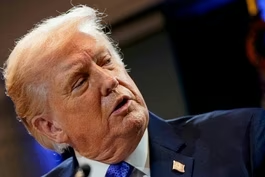
Can Trump reset the story of his second term?
Video has Closed Captions
Can Trump reset the story of his second term? (14m 22s)
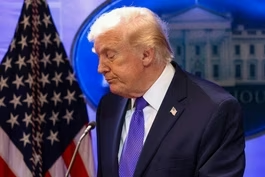
Trump dealt major blow by Supreme Court
Video has Closed Captions
Trump dealt major blow by Supreme Court (9m 50s)
Providing Support for PBS.org
Learn Moreabout PBS online sponsorship
- News and Public Affairs

Top journalists deliver compelling original analysis of the hour's headlines.

- News and Public Affairs

FRONTLINE is investigative journalism that questions, explains and changes our world.












Support for PBS provided by:
Major funding for “Washington Week with The Atlantic” is provided by Consumer Cellular, Otsuka, Kaiser Permanente, the Yuen Foundation, and the Corporation for Public Broadcasting.