
Carbon program pays landowners to keep forests standing
Clip: 5/22/2026 | 8m 9sVideo has Closed Captions
Carbon credit program pays small landowners to keep forests standing
Markets to offset carbon emissions are now worth about $2 billion annually, and supporters say they're a key tool to address climate change. But carbon credits have also been criticized for being opaque and not reducing emissions nearly enough. Stephanie Sy reports on an effort to boost the integrity of carbon markets and open them up to small landowners. It’s part of our series, Tipping Point.
Problems playing video? | Closed Captioning Feedback
Problems playing video? | Closed Captioning Feedback
Major corporate funding for the PBS News Hour is provided by BDO, BNSF, Consumer Cellular, American Cruise Lines, and Raymond James. Funding for the PBS NewsHour Weekend is provided by...
Carbon program pays landowners to keep forests standing
Clip: 5/22/2026 | 8m 9sVideo has Closed Captions
Markets to offset carbon emissions are now worth about $2 billion annually, and supporters say they're a key tool to address climate change. But carbon credits have also been criticized for being opaque and not reducing emissions nearly enough. Stephanie Sy reports on an effort to boost the integrity of carbon markets and open them up to small landowners. It’s part of our series, Tipping Point.
Problems playing video? | Closed Captioning Feedback
Where to Watch PBS News Hour
PBS News Hour is available to stream on pbs.org and the PBS app.
Providing Support for PBS.org
Learn Moreabout PBS online sponsorshipWILLIAM BRANGHAM: The idea is a simple one, and it's been around for decades.
You plant or preserve trees as a way to offset the emission of carbon dioxide, which warms the planet.
You then create a market to buy and sell these offsets.
They're known as carbon credits.
Supporters say these markets are a key tool to address climate change, but carbon credits have also been criticized for being opaque and not nearly reducing emissions enough.
Stephanie Sy reports on an effort to boost the integrity of carbon markets and to open them up to small rural American landowners.
It's part of our ongoing series Tipping Point.
WAYNE STRADER, Family Forest Carbon Program Participant: What's nice with this section it, has some nice trees in it, though.
MAN: Yes.
STEPHANIE SY: On an unusually warm early spring morning, Wayne and Michelle Strader walked through the woods with a forester.
MAN: We got a good diversity of hardwoods here, exactly what we're looking for to enroll, nationally regenerating hardwood forest.
STEPHANIE SY: The expertise Isaac Sloan (ph) brings in helping them manage their forest land is one of the reasons the Straders chose to participate in the Family Forest Carbon program.
For committing to defer harvesting most trees on their land, they also receive an annual stipend that's paying for the climate change-causing carbon their forest sequesters.
WAYNE STRADER: It was about what's doing right for the environment, but also being able to utilize the land and get something out of the land, as opposed to it just sitting there not producing any income or something of that nature.
STEPHANIE SY: Almost 40 percent of the forested land in the United States is owned by people like the Straders with relatively small acreages.
This program gives those landowners an opportunity to capitalize on the growing demand for carbon credits, which large corporations purchase to offset their own emissions.
RITA HITE, President and CEO, American Forest Foundation: They're not getting rich, but this is an annual source of income that helps them pay the bills and keep going as a family landowner.
STEPHANIE SY: Rita Hite leads the American Forest Foundation, which developed the program with The Nature Conservancy.
Since launching in 2020, it has enrolled 200,000 acres across 20 states, paying between $200 and $260 an acre over the course of a 20-year contract.
RITA HITE: Forests already, right now, capture and store about 15 percent of our annual emissions, right?
So they're already doing this hard job.
And we expect, over the life of this program, with just the offers we have right now, to enroll about a million acres.
So it's an opportunity for probably about 1 to 2 percent of the families out there that are owning forests.
STEPHANIE SY: But voluntary carbon markets have not always been transparent.
Recent research found only about a quarter of projects that sold offsetting carbon credits by preventing deforestation actually delivered real emission reductions.
REBECCA SANDERS-DEMOTT, Clean Air Task Force: I think we have a lot of credits that are circulating that may not represent the climate benefit that they are intended to.
STEPHANIE SY: Rebecca Sanders-DeMott at the Clean Air Task Force co-authored a study that scored 20 different methods that have been used to help the climate credits from forests.
Not a single one was classified as robust enough to guarantee credits were delivering the climate benefits they claimed to.
REBECCA SANDERS-DEMOTT: We have to remember companies buy these credits to offset their emissions.
But if the credits they're using aren't high quality and don't represent the climate benefit that they're supposed to, it can actually cause more harm than good, because we think we're making progress, and we're not.
STEPHANIE SY: Markets for carbon credits have also faced some political headwinds.
RITA HITE: Corporations typically pre this administration would be shouting from the rooftops their purchase of carbon credits.
Now they're doing it quietly, right?
STEPHANIE SY: But they're still doing it?
RITA HITE: But they're still doing it.
And there is a race to integrity, where we know that that claim of carbon capture and storage is real.
STEPHANIE SY: The project starts somewhere around these pines, right?
MICHELLE STRADER, Family Forest Carbon Program Participant: Right.
STEPHANIE SY: Michelle and Wayne Strader say they see the climate threat coming for their own forest, now filled with invasive grass and vines and scarred by severe storms.
And they're happy to have a climate-friendly option that offsets some of their costs.
WAYNE STRADER: And as we kind of look through, I mean, there's still some bigger trees in here that could be taken out now and allow some of the other smaller stuff to continue to grow up.
But now that it's in the forest program, I'm going to leave them be.
STEPHANIE SY: In fact, the Straders are logging some of their acreage not in the program right now.
But the 168 acres in the program will remain largely off-limits from harvesting until the 2040s.
MICHELLE STRADER: You're getting monies every year and eventually starts to go up, whereas, if you timber hard timber, you get paid once.
WAYNE STRADER: The one parcel was 40 acres.
It was purchased just as a timber track.
That was kind of the intent of why it was purchased that we would timber it to get some of the value back out of what we paid into the investment.
So I think the program is definitely encouraged.
STEPHANIE SY: What did you end up doing with that 40 acres?
WAYNE STRADER: It's in the program and it's -- right now, we're not doing anything with it.
It's growing naturally and reducing carbon.
STEPHANIE SY: How do you know that you're not just paying people for something they would have done already, that they wouldn't already be taking care of and preserving their forests with the side effect of it capturing carbon RITA HITE: This is at the heart of integrity.
We want to make sure that we're not just paying landowners for things they would have already done, because, if that's the case, then you don't actually get additional carbon.
The atmosphere doesn't feel a difference.
STEPHANIE SY: The Family Forest Carbon program tries to account for this by comparing the plots of land in the program with control plots that are not, but with similar types of trees, owners, and even ground slope, then seeing how they measure over time.
It's an approach known as a dynamic baseline.
RITA HITE: So, at the end of the day, our enrollees essentially have to outcompete their neighbors.
We're only issuing credits if we actually measure the carbon and see the difference, right?
We're not projecting and saying, OK, we think we're going to generate these credits, and we're going to tell you credits right now off of that.
No, we're doing it based off of real-time data capture.
REBECCA SANDERS-DEMOTT: These dynamic baselines that use data from other locations are a real step forward.
STEPHANIE SY: In Sanders-DeMott's study, the method that the Family Forest Carbon program is using was the only one to score as -- quote -- "satisfactory."
REBECCA SANDERS-DEMOTT: Science is evolving really rapidly in this space, but forest carbon credits and their accounting is always going to be really difficult.
It's certainly not a system that we can rely on to solve both our fossil fuel emissions reductions, nor to really provide the funding we need to get all that we can out of our forest.
MICHELLE STRADER: I always thought when I was growing up that I was a water baby, but I'm not.
I'm a forest baby.
STEPHANIE SY: For Wayne and Michelle Strader, who moved to this rural stretch of West Virginia from urban Pennsylvania, protecting the forest goes beyond just the carbon being collected.
When you come out here and you look at this project, are you thinking about climate change?
Are you thinking about those big picture issues and the role you're playing?
WAYNE STRADER: I don't want to say it's the forethought, but, I mean, it's always in the back of your mind that what we're doing is making an impact on our future.
MICHELLE STRADER: Here, it's kind of -- it's just a way of life.
You do think about it, but, for me, I'm thinking more about the beauty of it and how I'd be broken-hearted this was gone.
STEPHANIE SY: Taking care of the land they love while playing a small role in the big fight against manmade climate change.
For the "PBS News Hour," I'm Stephanie Sy in Upshur County, West Virginia.
Brooks and Capehart on Trump's loyalty demands
Video has Closed Captions
Brooks and Capehart on Trump's loyalty demands (10m 50s)
Gabbard’s record and impact on U.S. intelligence community
Video has Closed Captions
Tulsi Gabbard’s record and impact on the U.S. intelligence community (10m 4s)
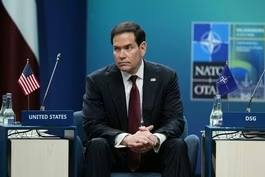
News Wrap: Rubio meets NATO allies amid troop questions
Video has Closed Captions
News Wrap: Rubio meets with NATO allies amid troop level confusion (7m 15s)
Shein's purchase of sustainable Everlane sparks outcry
Video has Closed Captions
Shein's purchase of sustainable fashion brand Everlane sparks outcry (6m 14s)
What's behind the 'learning recession' for American students
Video has Closed Captions
What's behind the decade-long 'learning recession' for American students (8m 19s)
Providing Support for PBS.org
Learn Moreabout PBS online sponsorship New Episode
- News and Public Affairs

Today's top journalists discuss Washington's current political events and public affairs.

- News and Public Affairs

FRONTLINE is investigative journalism that questions, explains and changes our world.

 New Episode
 New Episode
 New Episode
 New Episode
 New Episode
 New Episode

 New Episode
 New Episode
Support for PBS provided by:
Major corporate funding for the PBS News Hour is provided by BDO, BNSF, Consumer Cellular, American Cruise Lines, and Raymond James. Funding for the PBS NewsHour Weekend is provided by...