Living St. Louis
How Native Plants Are Transforming South St. Louis City
Clip: Season 2026 Episode 14 | 4m 24sVideo has Closed Captions
Alley Asters works to transform St. Louis alleyways into native plant gardens.
Alley Asters works to transform St. Louis alleyways into native plant gardens, turning a search for more growing space into a community effort to beautify neighborhoods and support local ecosystems.
Problems playing video? | Closed Captioning Feedback
Problems playing video? | Closed Captioning Feedback
Living St. Louis is a local public television program presented by Nine PBS
Support for Living St. Louis is provided by the Betsy & Thomas Patterson Foundation.
Living St. Louis
How Native Plants Are Transforming South St. Louis City
Clip: Season 2026 Episode 14 | 4m 24sVideo has Closed Captions
Alley Asters works to transform St. Louis alleyways into native plant gardens, turning a search for more growing space into a community effort to beautify neighborhoods and support local ecosystems.
Problems playing video? | Closed Captioning Feedback
Where to Watch Living St. Louis
Living St. Louis is available to stream on pbs.org and the PBS app.
Providing Support for PBS.org
Learn Moreabout PBS online sponsorship- What if the alleys in our city were beautiful?
- Three purple cornflowers, two foot goldenrod.
- We are trying to beautify the alleys by filling them with wildflowers and at the same time create ecologically productive spaces, so habitat for pollinators, food for pollinators, food for birds, et cetera.
And yeah, just kind of get the word out about native plants and introduce people to them by kind of bringing them into the community.
I would like to remove a plant.
- Alley Aster's is a volunteer run ecological gardening group created by Tower Grove South resident Myles Tan after he ran out of space in his own yard to plant native perennials.
So he moved into his back alley and then got an idea to expand.
He runs the group alongside Rachel Rigdon and together with volunteers, they go out to tend, search for available space and plan.
- There's all these small little spots that typically go unloved and underused.
This means that if they're not utilized, it's a great place for invasive plants to kind of take hold.
There's a lot of potential there.
There's a lot of opportunity for us to fill that with plants that are beneficial and remove invasive plants at the same time and also beautify our alleys.
- In St.
Louis City, alleyways are usually places of unwanted items or trash, maybe even places of controversy and are rarely seen as environments where plants can thrive.
But Alley Aster's is turning unwanted or hard to manage spaces into opportunities for new growth.
A lot of people when they think of their alleys, they think of their dumpsters and places they're trying to spend as little time as possible.
But they are parts of our community and you know, if we can change our perspective on them, I think that'd be really cool.
Since the project began in 2022, they've planted over 950 natives across 55 plots around Tower Grove South.
It only takes about two years of plot management, like weeding and watering, for the natives to become self-sufficient.
And yes, these spaces are more visually appealing, but these are plants that have been in our region since the last ice age.
They're surviving in an ever-changing climate while simultaneously benefiting our ecosystem and overall infrastructure.
We need to be planting the plants that have evolved here over a long period of time and to fill those roles.
Our native perennials here have really deep root systems which allow them to be more drought tolerant and allow them to help decompact soil and allow more rainwater to be absorbed into the ground which reduces the stress on our wastewater system and just kind of keeps more water where it falls.
In a city that has a history of floods, cave-ins, and an intricate sewer pathway, it's interesting that plants could have that kind of impact.
And when we turn to our alleys, there's prime space for native perennials to flourish, providing nutrients that our insects and animals are familiar with, and a connection to nature for people living in an urban environment.
I think that a lot of people have, they think that they need to drive hours to be immersed in nature and I just think that people can see nature and be immersed in nature when they see a cliff goldenrod in the crack of concrete in their alley or sidewalk and just feeling that connection and that you are not, you are a part of your ecosystem and feeling more connected with the spaces around you.
These plots are collectively certified as wildlife habitats by the St.
Louis Audubon's Bring Conservation Home Program.
The program is one of many that give people in our region the opportunity to get involved with native plants.
Ones like the Missouri Prairie Foundation's Grow Native and the St.
Louis Wild Ones Chapter or MSD's Rainscaping Program.
And now, Alley Aster's.
So if we can be the first native plants on your property, maybe you're surprised about, you know, how resilient they are and how well they do in that space.
And that might say, oh, I might think of the MSD Project Clear Grant for, you know, my lawn that I don't really want to take care of.
So the introduction for people and hopefully inspire people kind of around the city who also have alleys to kind of think about those spaces as potential places for native plants to turn them into something productive and beautiful.
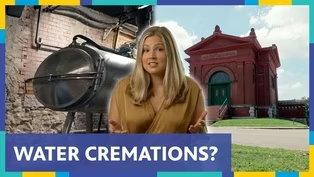
The Groundbreaking Past (And Future) of The Missouri Crematory
Video has Closed Captions
Clip: S2026 Ep14 | 7m 14s | Missouri Crematory continues to pioneer alternative end-of-life services through water cremation. (7m 14s)
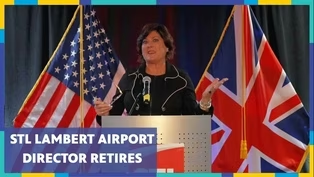
Lambert Airport Director Rhonda Hamm-Niebrugge Retires After 16 Years
Video has Closed Captions
Clip: S2026 Ep14 | 6m 52s | After 16 years as the director of Lambert Airport, Rhonda Hamm-Niebrugge is set to retire. (6m 52s)
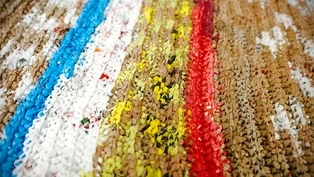
Plarn Quilts | What Do I Do with This?
Video has Closed Captions
Clip: S2026 Ep14 | 5m 10s | Volunteers crochet plastic grocery bags into sleeping mats for people experiencing homelessness. (5m 10s)
Providing Support for PBS.org
Learn Moreabout PBS online sponsorship










Support for PBS provided by:
Living St. Louis is a local public television program presented by Nine PBS
Support for Living St. Louis is provided by the Betsy & Thomas Patterson Foundation.