Living St. Louis
April 27, 2026
Season 2026 Episode 8 | 27m 7sVideo has Closed Captions
Antiques Roadshow, Great Rivers Greenway, Urban Buds, Dork Dancing.
A behind-the-scenes look at the production of Antiques Roadshow at Grant’s Farm last year. Plus, we mark 25 years of the Great Rivers Greenway, visit Urban Buds, a family greenhouse operation in South St. Louis City, and embrace the Dork Dancing movement.
Problems playing video? | Closed Captioning Feedback
Problems playing video? | Closed Captioning Feedback
Living St. Louis is a local public television program presented by Nine PBS
Support for Living St. Louis is provided by the Betsy & Thomas Patterson Foundation.
Living St. Louis
April 27, 2026
Season 2026 Episode 8 | 27m 7sVideo has Closed Captions
A behind-the-scenes look at the production of Antiques Roadshow at Grant’s Farm last year. Plus, we mark 25 years of the Great Rivers Greenway, visit Urban Buds, a family greenhouse operation in South St. Louis City, and embrace the Dork Dancing movement.
Problems playing video? | Closed Captioning Feedback
Where to Watch Living St. Louis
Living St. Louis is available to stream on pbs.org and the PBS app.
Providing Support for PBS.org
Learn Moreabout PBS online sponsorshipWelcome to Living St.
Louis.
I'm Brooke Butler, and this week we're on the brand new stretch of the Brickline Greenway, nearly a mile along Market Street that connects Harris-Stowe St.
State Universit to Energizer Park.
This stretch runs through the heart of what was once Mill Creek Valley, now reimagined as a people-first corridor for biking, walking, and gathering.
This is the first major part of the Brickline Greenway, with many more miles already underway, part of a long-term effort to connect neighborhoods, parks, and people across the region.
And as always, that same spirit runs through our stories in today's show.
On This Living St.
Louis, a behind-the-scenes look of Antiques Roadshow, when the PBS favorite came to St.
Louis last year.
How 25 years ago, Great Rivers Greenway started with the bold idea of connecting the region.
We'll visit Urban Buds, a historic South City farm reimagining urban farming.
And we'll meet the St.
Louisan behind a joyful movement promoting mental well-being through Dancing Like a Dork.
It's all next on Living St.
Louis.
♪♪ If you watch Living St.
Louis, chances are you also like watching Antiques Roadshow.
And for the next few episodes for the show's 30th season, you might recognize some familiar settings.
May of 2025 was a busy time for Grant's Farm.
But this line of guests didn't come for the beer garden or the animals.
Thousands of attendees showed up with books, jewelry, art, and more to be appraised for the 30th season of Antiques Roadshow.
The last time we were in St.
Louis was in 2017, which was our final year of doing events and productions inside convention centers.
And since then, we've been going to these kind of outdoor, historical, iconic American locations.
Jill Giles is the line producer for Antiques Roadshow.
She is one of the people who helps choose the venues for appraisal events.
"We try to repeat places every five or ten years and it's been almost that long since we've been in St.
Louis and we know that we have a huge fan base here, we know we draw a great crowd.
I think St.
Louis was one of our highest ticket applications this year for the ticket lottery so we knew we would draw a huge crowd.
19,837 people registered for tickets in St.
Louis, according to executive producer Marsha Bemko.
And when you think about the odds of getting a ticket, the odds of getting a ticket for you this city here in St.
Louis, it's a little over 10%.
The city with the least amount of applicants was Salt Lake City.
It's close to 20, 25% chance of getting a ticket because they still had close to 9,000 applicants, but you had a lot more.
But to come back to St.
Louis, the roadshow team had to find the perfect location.
And Grant's Farm is one of those weird locations that checks like every box.
You know, it has the home that Ulysses S. Grant built.
So it has deepened history.
It has the estate of the Anheuser-Busch family and that legacy.
So like another giant estate.
It's also a zoo.
It's also a beer garden, courtyard.
So it's hard to like wrap your head around how many boxes it checks, but it's a pretty cool place.
Antiques Roadshow arrived just one day early to set up for the over 3,000 guests and 23 appraisal categories.
But the planning process took much longer.
- We've been working on this almost a year with the roadshow team.
Can't tell you how excited we are.
This is such a rare opportunity.
Not only is it exciting for us, it's really a big deal for the St.
Louis community.
- That's Steve Bird, the general manager for Grant's Farm.
He says that set up for the event went smoothly and the animals are mostly used to the commotion.
- Well, that is one of the challenges.
We are a farm, right?
So you'll see peacocks roaming around and all our furry friends.
We've had to relocate a few of them to some other pens where there's filming areas, but they're still, this is their home.
So they'll be watching the show just like St.
Louis.
- Some animals seem to enjoy the spotlight though.
(peacock squawking) - You know what's special about Grant's Farm is that while I'm sitting here talking to you, you're gonna hear a peacock.
It's a really cool place.
This is a nice natural environment.
We like not being in the convention centers.
I have literally stood in a convention center and said, "Where am I?"
And I wasn't joking.
And so it's really nice to be in a place that gives you a sense of place.
It's a nice experience for the 2,500, 3,000 people we'll see tomorrow.
On the day of the event, 3,146 people came to have their antiques appraised.
Attendees brought all sorts of items.
Well, I brought my mother's junk jewelry.
Okay.
Telling her to call it costume jewelry.
I believe this is a Salvador Dali lithograph that's signed and numbered and I have another print that goes with it that's from the same series.
We're not sure really what its value is.
We got it in a state sale for a pretty good deal.
What I have here, this is a birthday invitation from the Emperor of Japan in 1904.
My dad collected a lot of music memorabilia, so we've got some Rolling Stones, Ronnie Wood screen prints and then a Imagine vinyl signed by John Lennon.
But only some people are chosen for the show.
We're looking for something where the price does affect the story.
I think people are inherently affected by value.
But also the stories themselves often tell a much bigger story, much bigger narrative about either America or this particular person's family or some other thing that the audience can relate to.
Sam Farrell is a supervising producer at Antiques Roadshow.
This area is known for its ancient cultures, the ancient Mississippi cultures, we might see some of that.
And of course, this was a gateway to the West.
And this is where a lot of things came through during the Westwood expansion.
And there's a lot of history here.
Choosing people for the show involves a lot of hands.
We have a system with our volunteers calling a radio, calling our central appraiser liaison who then enters it into a system.
Then Farrell looks at the notes and his team chooses people to advance.
And then we move people to the green room and then to taping.
Some people aren't so lucky and they don't get picked.
One of the appraisers at the event was Nicholas Lowry, who has been on Antiques Roadshow for 29 years.
It's been a fantastic experience.
I mean, almost 30 years doing anything.
You either have to be incredibly passionate or a lunatic to do that.
So it's half passion, half lunacy.
Sometimes it's just, oh, my God, that's that's super cool.
I wish I'd known something like, holy cow, that's super valuable.
You just you don't know what it is.
And so you have to have you have to approach it with a childlike innocence.
So thousands of people come to the door today of which maybe 100 actually get filmed.
So an appraisal that we do table side here is going to be very different from an appraisal that we do in front of the cameras.
And if we're doing an appraisal in front of the cameras, you want to get a little bit of the history, a little bit of the acquisition story, the origin story of the piece, and then the value.
So it's like you distill it down to a three point appraisal to make it much better for the viewing audience.
Antiques Roadshow also recruits some local crew and appraisers.
I feel very fortunate that we're in St.
Louis, my hometown, and I'm hoping that I can find some examples of regional art that I've worked with so much in the past.
Susan Kime is the president of Link Auction Galleries.
So I've been in the auction business for 30 years and I've handled a lot of local artists' work.
So selfishly, that's what I hope to see today.
But the appraisal price doesn't need to be big for attendees to have a good time.
This one is actually a more popular print, but this one goes for a couple of thousand dollars and this one can go for a little bit more than that because it's a more popular edition.
So, you know, for the amount that we paid, we're doing very good.
You guys won today.
Yes.
And it's just one of our favorite artworks in our house, so it's just nice to know.
It's not going anywhere, but I don't know.
It's nice to kind of know what it's worth.
The footage will appear in three "Antiques Roadshow" episodes on April 27th, May 4th, and May 11th of 2026.
I think the people from the St.
Louis area, just like everybody that watches the show, I hope they feel connected to it the way that, you know, it reminds them.
They'll see something in the episode that will remind them of their history.
Last year marked the 25th anniversary of Great Rivers Greenway, an idea that started with the simple question, "What if parks and trails could do more?"
Nearly a quarter of a century later, that idea has grown into a region-wide effort, connecting neighborhoods, counties, and cities, bringing people together through possibility, public space, and partnerships.
On September 15th, community members came together for the Great Gather Round.
This was Great Rivers Greenway's big celebration for their 25th anniversary, and featured 1,500 feet of tables surrounding the circle drive of the History Museum, which is also one end of the St.
Vincent Greenway.
There were food trucks, activities, music, free cupcakes, but the real celebration is accomplishing 140-plus miles of greenway that connects the St.
Louis region both physically and collaboratively.
We have built with our community 140 miles of greenway trails where people can walk, run, ride a bike.
Give it up for your collective accomplishment of 140 miles and counting.
I don't know if y'all have... Riggs vs.
Greenway is a very unique system and model nationwide.
It is.
To my knowledge, there's nothing else exactly like it.
Emma Klues is the vice president of communications and outreach for Great Rivers Greenway.
To have 120 towns across three counties vote to create something that's a public agency to connect it all together, to our knowledge, does not exist anywhere else.
♪♪ - So let's go over that again, because one of the common misconceptions of Great Rivers Greenway is that it's a nonprofit or an organization, and while they do have a foundation side of their work, they are a government agency funded by taxpayer dollars voted into existence 25 years ago.
I like the fact that we are building something that is going to be here long after I'm gone, that will be here for future generations.
Todd Antoine is the Chief of Planning and Projects at Great Rivers Greenway.
When I started, I was employee number three at the time, and hired by David Fisher, our first executive director.
It was David with his 30 plus years of running a major city park and trail system, me with my growing experience working at a regional agency, and then also Janet Wilding, who Janet was working at the time at St.
Louis County Economic Council.
So we all came in in the very beginning to really sort of taking our sort of government hats that we had and experience and putting the initial organization together.
After consulting with numerous partners, agencies and community members, they came up with what they called the River Ring Plan, consisting of 45 greenways across a 600-mile system.
And the whole idea was just set the vision.
And then in that, we started doing individual greenway plans.
So like our St.
Vincent Greenway was an early one, which is a very popular greenway from Forest Park up to UMSL.
- So I always tell people, like, if you think you're at the History Museum and you're gonna go to the show at the Two Hill, you're probably thinking about like three highways to get there.
- Uh-huh, right, yeah.
- And there's the Metrolink, the red line.
- Oh, yeah.
- So this greenway parallels the red line, so you can kind of hop on and off as you need to, going all the way up to the North Hanley Station.
- But you would never know the Metrolinx was there.
I mean, this feels like you're in the middle of nature.
- Yes.
- And that is one of the goals, right?
Is to have people feel more connected with nature, but in the city.
- Absolutely, in the whole region.
- Yeah.
- We want people to have access to natural spaces, access to transportation choices, and whatever they need for them to live healthy, active, vibrant lives.
But it's not just Great Rivers Greenway guessing or assuming what the region wants out of these trails.
Each project involves multiple partners, communities, and various opportunities for the public to give feedback.
Community engagement is critical to our work.
It is the foundation of how we are successful because there's a responsibility as being good stewards of our tax dollars for us to be gaining trust and working with residents, working with folks in the communities about a potential project.
So projects always have, in the very beginning, you know, there's always the fear of crime about, oh, who's going to be potentially out there on these greenways and things like that.
But once we really got the system built and started building sections all over the three counties and people start to say, oh, now I see what that looks like and this is great and I have a great experience on it and things, it's building trust and understanding.
And I feel now that we've been around for 25 years, there are people that are like, when's it our turn to get it?
They want, you know, they want the trail that's identified on the map as the coming soon at some points.
-And one of those projects coming soon is the Baltic Creek Greenway in St.
Charles County.
We attended one of the last public forums for the project, where you can see the adaptations to the plan based on community feedback.
-That kind of feedback and the feedback that we hope to get tonight will be very valuable for us to -- -What I always appreciate, and we hear this a lot from residents and people on the committees that we talked about or people that just go to our public meetings and whatnot, that comments that they made or things that they saw and the conceptual thing, they're like, "Oh, I see what I said back then, "maybe it would have been a year and a half ago.
"I see it's actually been built and being constructed."
People love seeing that.
- Sometimes you're working with, I mean, like just mile to mile, it's different municipalities.
- It might be 10th of a mile, yeah.
- Yeah, it might, yeah.
- Sometimes we'll build a greenway that's maybe three miles and there might be four different towns and they may or may not know each other yet or have been collaborating.
And so the process of building the greenway really does connect the region together, even just by way of talking about it.
The day-to-day operations and maintenance is for the partner to handle.
So whether that's a county park system or a municipality, then they are the ones that it might be like repatching a hole in the pavement or fixing a bench or things like that.
But we know that with 120 towns in our region, they're not all the same.
They don't have all the same resources.
So we really try to jump in and help with our own staff, with vendors, with volunteers, with trainings for our partners.
Maybe they've not taken care of a rain garden before.
They don't have something like that in their community.
So whatever it takes, we want everyone, we think everyone deserves great greenways.
So we want to make sure that we jump in and help however we can to have a great system across 1200 square miles.
Yeah.
If you're like me, when you think of farming, wide open spaces, far outside of the city limits, probably come to mind.
But right here in the heart of the 314, the city of St.
Louis, crops are blooming in the middle of a neighborhood.
You don't have to go all the way out to the country to see how things grow.
This is Mimo Davis, co-founder and horticulturalist at Urban Buds, a one-acre, fresh-cut flower farm located in the Dutchtown neighborhood of South St.
Louis, proving that agriculture doesn't have to be rural, and buying locally grown blooms are possible in every season.
We grow over 80 varieties of cut flowers.
We grow year-round and we sell direct to florists, do small weddings and events, and sell at Tower Grove Farmers Market every Saturday.
I wouldn't even know what you would call this.
These are called high tunnels.
Okay.
And we have two of them that are heated.
Plants will grow all winter long.
It really, you know, it really takes some sun and warmth to get them to bloom.
Are you the sun and warmth that comes in in the winter?
I come in the winter and just, yeah, blow on them.
When Mimo and her business partner purchased this property on Tennessee Avenue in 2012, they didn't know it was the last remaining piece of what was once a 30-acre family farm.
- We knew it was a florist shop.
We did not know that they grew flowers here.
- Well, that's meant to be, if you've ever heard it.
- Right, it gave us chill bumps.
- When they bought this property, it was a shadow of its former self.
- It was abandoned, it was condemned, it was vandalized.
This was an eyesore for this neighborhood.
It's not unusual to find vacant land in metropolitan cities that can be turned into urban farms, especially in older post-industrial cities like St.
Louis.
What is unusual is when that land is successfully cared for, cultivated, and integrated into the neighborhood.
Urban farms stand out not because the land exists, but because they transform vacancy into something productive, visible, and stabilizing.
- So this is our alley.
And why can't alleys in our city be beautiful?
They don't have to be dumping grounds.
Harvard did a study that even just to look and see a beautiful scene of flowers automatically reduces your blood pressure.
It's a calming effect.
And that's what this alley does for people now.
When it's in full bloom, they say, "It's beautiful."
They just love what we've done with the alley.
Mimo also understands the business of locally farming flowers.
That's, as she puts it, growing flowers that don't do well in a box.
80% of flowers are imported from South America.
So at her small urban farm, she grows crops that foreign growers won't ship.
Because we definitely don't want to be competing with, you know, South America.
So we want to grow specialty flowers, like the lupins.
Like, where are you going to get a lupin?
I don't know.
I don't even know what a lupin is.
Mimo began her career cultivating and growing flowers in 1993 at a farm she owned two and a half hours west of St.
Louis.
And I was driving into St.
Louis twice a week.
And that just wasn't sustainable in my life.
Right.
Commutes like that also aren't great for the environment.
Transporting crops, flowers, and other products from rural farms to urban markets, not to mention imports from South America, produce significant carbon emissions and air pollution.
You know, there's farm to table.
That's mostly about food, but there's flowers too.
Flowers to vase, field to vase.
Growing where she sells has turned Mimo's five-hour round-trip delivery into a two-mile commute to the Tower Grove Farmers Market and a short drive for florists to pick up the freshest, locally city-grown flowers they can buy.
A job that never gets old for this farmer.
It's the best work.
I mean, can you imagine that, like, this incredible flower comes out of that little tiny seed?
I mean, isn't that, like, mind-blowing?
It's crazy.
♪♪ Spring always makes me feel better.
It brings warmer weather, people are out on the greenways, and overall mood increases.
Spring also brings Mental Health Awareness Month, and in May we'll see a lot of different events come up.
But one group in St.
Louis sets the tone for letting everything go.
>>Imagine being able to dance freely, without judgment, joined by other like-minded people.
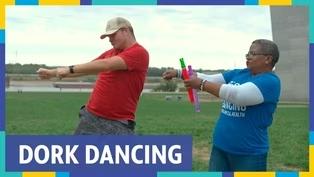
Whether you dance on the beat or not, dork dancing is all about embracing movement.
>>You're dancing with strangers out in public, which isn't a normal or typical thing to do at all.
So people might often come to dork dancing feeling quite uncomfortable, but then they feel a sense of community, a sense of liberation and fun that really helps them ease into the experience and just feel better.
Dork dancing is dancing however you want to, with strangers in public, to break stigmas.
And like Ethan said, it can be quite uncomfortable at first.
But in this case especially, being a dork isn't a negative thing.
Listening to music has always helped me feel better, especially in response to my own personal mental health challenges.
And someone called me a dork after I posted a video online, thought that was funny, and the name Dork Dancing was born.
Back in 2020, Ethan was quarantined in Vietnam, dancing online to get through COVID-19 and the global mental health crisis that followed.
Per classic internet behavior, his videos gained some traction and people around the world began joining the dork dancing movement.
Once COVID restrictions allowed, Ethan took it to the public.
- Bit by bit, more and more people joined and people got more comfortable with the idea of dancing out in public in the name of mental health.
So started small, but it grew just in three weeks.
Was dancing out in public every day and it grew kind of fast actually.
- It wasn't until last year that St.
Louis was graced with dork dancing, becoming the fourth city in the world with a chapter.
It's a blend of advocacy with free spirited movement, showing up as you are and moving how you want.
- Get it, get it Matthew.
I'm the first dork dancer in St.
Louis.
I met Ethan and we met at Tower Grove Park and I volunteered to grow the chapter with him.
I have been an advocate for mental health for years and so hearing someone else doing something about it and wanting to get out in community and really trying to do something, it really touched me and so I had to be a part of it.
At its core mission, Dork Dancing is about improving mental health and overall well-being.
It's about reclaiming what it means to be a dork and creating an open space for community.
I'm an empty nester so I had to find a purpose and you kind of lose yourself a little bit to mental health when you're trying to find a purpose.
It can go one way or it can go another way and I lucked up on Meet Up St.
Louis and fell into dork dancing.
It's became my purpose because mental health is it hasn't not touched anyone.
It's dancing but so much more than that.
It's about relief from the pressures of the world and having fun while doing it.
Knowing that it doesn't matter what other people think even for a moment.
Dork dancing is a space for people to just embrace their authentic selves and be who they are and regardless of their background, their age, their gender, their sexuality, their identity, we really see that there's an inner dork in everyone.
And that's Living St.
Louis.
Have you been on a greenway yet this year?
What's your favorite thing to do?
Do you ride your bike or just walk?
Let us know.
We love hearing from you at NinePBS.org/LSL.
I'm Brooke Butler.
Thanks for joining us.
♪♪ Living St.
Louis is funded in part by the Betsy and Thomas Patterson Foundation and the members of Nine PBS.
Video has Closed Captions
Clip: S2026 Ep8 | 3m 33s | Dork Dancing encourages people to embrace awkwardness and dance freely in public. (3m 33s)
Providing Support for PBS.org
Learn Moreabout PBS online sponsorship









Support for PBS provided by:
Living St. Louis is a local public television program presented by Nine PBS
Support for Living St. Louis is provided by the Betsy & Thomas Patterson Foundation.