Living St. Louis
June 22, 2026
Season 2026 Episode 12 | 27m 23sVideo has Closed Captions
I Am St. Louis: Mound City, Q Fest, What Do I Do with This? Hand-Me-Downs or Throw-Me-Outs.
Find out the origins of the name “Mound City,” then we visit Cinema St. Louis's QFest, and then we consider the question of what to do with kids' stuff and all those toys on What Do I Do with This?
Problems playing video? | Closed Captioning Feedback
Problems playing video? | Closed Captioning Feedback
Living St. Louis is a local public television program presented by Nine PBS
Support for Living St. Louis is provided by the Betsy & Thomas Patterson Foundation.
Living St. Louis
June 22, 2026
Season 2026 Episode 12 | 27m 23sVideo has Closed Captions
Find out the origins of the name “Mound City,” then we visit Cinema St. Louis's QFest, and then we consider the question of what to do with kids' stuff and all those toys on What Do I Do with This?
Problems playing video? | Closed Captioning Feedback
Where to Watch Living St. Louis
Living St. Louis is available to stream on pbs.org and the PBS app.
Providing Support for PBS.org
Learn Moreabout PBS online sponsorshipWelcome to Living St.
Louis.
I'm Brooke Butler.
Summer in St.
Louis feels different everywhere you go.
I'm not just talking about the humidity, but the events, attractions, celebrations.
It's a great time for our city to show off all the cool things and places we have to offer, including the Delmar Loop.
Our show today features stories about a couple of those cool places and some creative alternatives for those kids who may be going a little stir-crazy and their parents.
On This Living St.
Louis, we look back thousands of years uncovering the layered history of Mound City.
Pride Month hits the spotlight once again with Cinema St.
Louis' Q-Fest.
And uncovering how we ended up with so many toys and what happens to it after our kids leave it behind.
It's all next on Living St.
Louis.
♪♪ - The Cahokia Mound State Historic Site has partially reopened its museum after four years of renovations.
This museum provides context to the nearly 80 mounds that exist on the site.
But many St.
Louisans don't know that there used to be mounds on the Missouri side too, the largest of which was right where I'm standing today.
Today you might call St.
Louis the gateway to the West or even The Lou.
But one of the city's earliest nicknames was Mound City.
St.
Louis was known as Mound City because of the dozens and dozens of earthenwork mounds that existed here from approximately 800 CE to 1869.
Brady Wolf is the curator of indigenous collections at the Missouri Historical Society.
They were an object of fascination for European colonizers.
They were a point of pride for many St.
Louis citizens who used them as meeting places, as places of enjoyment, and most importantly, they were sacred spaces and often burial spaces for the indigenous communities that constructed them centuries ago.
Only one mound remains in St.
Louis City, as they were systematically leveled throughout the 1800s.
But many mounds still exist on the Illinois side, at the Cahokia Mounds State Historic Site.
Cahokia Mounds Archeological Site is the largest archeological site north of Mexico in terms of size and population.
It originally had 120 mounds and the population size was estimated at the height of around 1050 AD to be 10,000 to 20,000 people.
That's Angela Cooper, a site interpreter and archeologist at Cahokia Mounds.
Cooper says the mounds on the Missouri side were probably a bit smaller than the ones at Cahokia, but they would have looked similar to the mounds you still can see today.
It was probably a satellite community.
It was probably like a suburb, subdivision, right?
The groups on the Missouri side also would have had strong ties to Cahokia.
But they also would have had, you know, different daily rituals and customs and their own ways of living and senses of humor and ways of talking with each other and things like that.
But before many were leveled, the St.
Louis Mound Group around downtown had about 25 mounds.
There were an additional dozen or so in Forest Park and then another untold amount that were poorly documented, perhaps another couple dozen in South City and along the River De Peres.
So anywhere from 50 to 100 mounds across all of St.
Louis, depending on who you ask.
One of the most notable mounds in the city was Big Mound.
It was the largest in the St.
Louis Mound Group and was located near North Broadway and Mound Street.
A monument for Big Mound stands in its former location today, but when we went to see it, its plaque was missing and the area was covered in litter.
The Native American groups who built the mounds are known as the Mississippians.
That was a huge sprawling society that covered most of the Eastern United States from the Great Lakes to the Southeast and all along the Mississippi Corridor.
They had trade routes to the Southwest for obsidian, to the Great Lakes for copper, to the Gulf of Mexico for shells.
They were a truly expansive, enormous metropolitan society.
Cahokia was America's first city and the largest city north of Mexico.
- But around the 1350s, the Mississippian culture declined.
- There was some sort of event, whether it was disease or resource depletion or martial conflict.
There's a lot of debates on that.
But we do know that people went elsewhere.
And by 1500, many of the mounds were abandoned.
But many modern Native American groups can trace their lineage to the Mississippians.
In St.
Louis, the Osage Nation has the strongest, noted, and longest-running occupation in the St.
Louis area.
Because of that, it is safe to say they have a unique and significant connection to the St.
Louis Mound Group.
There were three types of mounds in what Angela Cooper calls the "Cahokia Metro Area."
Other Mississippian sites only have two.
There's platform mound or flat top, and that had structures on top, probably priests and leaders doing sacred ceremonial things inside.
Conical mounds, which often are viewed as burial mounds or cemeteries.
And then in the Coquia Metro area is ridgetop mounds, which seem to have mortuary components to them, and also multiple mounds that were then capped off together to create one mound.
- And white settlers later had their own uses for the mounds.
- In 1844, there was actually a pavilion constructed on top of Big Mound, which was quite a hotspot, a gathering place.
It burned down several years later, and then unfortunately by 1869, it was completely leveled.
- And though many people enjoyed the mounds and viewed them as landmarks or gathering places, some St.
Louisans had little appreciation for the historic structures.
An 1869 article about Big Mound in the Missouri Republic stated, "The insignificance of the artistic thought, if there is any at all connected with the mound, evidently is the cause of the indifference of our scientific institutions during the removal of this immense monument of American antiquity.
Widespread destruction of St.
Louis's mounds began in the 1830s.
The Indian Removal Act was published by the federal government in 1830.
So I think it is fair to say that having that sort of removal vindicated by the federal government allowed St.
Louisans to justify the removal of indigenous landmarks in our city.
So street grading processes took a lot of the mounds down and they were used for railroad fill and other backfilling operations.
They were looted intentionally and aggressively.
A lot of the cultural heritage was taken from them and many folks are still working on recovering that.
The only mound remaining in the downtown area is Sugarloaf Mound on Ohio Avenue.
Though many mounds still stand in Cahokia today, the site wasn't spared from destruction either.
So 120 mounds and today there's 80 left.
So 40 were destroyed.
East St.
Louis had 45 and I believe there's only two, just like a few of the bases of the mounds remaining.
So that's the entire mound group.
Now that most of the Missouri side mounds are gone, St.
Louis' nickname as the Mound City seems to be disappearing too.
People were much more aware of the mounds as they were declining and used that as sort of a branding opportunity.
And then all of a sudden it didn't make sense because they were gone.
Cooper says the mounds that remain in our region deserve just as much attention as the arch or other landmarks.
We'll also come to the mound, see this other monumental structures out here that was made with 40 to 50 pound baskets filled with earth and stone tools and no heavy machinery, no beasts of burden, like seeing that influence is a reminder of the people who've been before us and will still be here when there's people after us.
So I think the legacy of it is important.
Brady Wolf says a good way to honor the destroyed mounds is to learn as much as you can about them.
We do have but one left, so it's a very good opportunity to start really thinking about how we can take care of it.
Luckily, the Osage Nations are very good and rightful stewards of Sugarloaf Mound, but we should think about ways where we can take care of the land where the mounds were as a show of respect.
If we are gonna firmly declare that this place is our home, we should treat it as such.
And an acknowledgement that it was someone else's home before us and that it was taken.
We cannot rebuild them, they are gone.
And so to avoid repeating that history, we have to start taking care of what we have.
And in many ways, I think it could help us take care of each other too.
Through the month of June, St.
Louis has a lot of events to celebrate pride.
There's parades and shows, community gatherings, and as Olivia Moses shows us, it's also as easy as going to the movies.
Earlier this month at the High Point Theater near Forest Park, Cinema St.
Louis presented its 19th annual QFest, a week-long celebration of LGBTQIA+ film and culture.
The fully submission-based festival gives local moviegoers a chance to enjoy vendors and films set around a relevant theme for the year.
"I wanted to make sure that everybody sees themselves on screen.
That this is not just a place where people come to see films, but they feel like they're part of a community.
And I think all of our festivals do that, but especially QFest."
Emmett has been with Cinema St.
Louis for two years.
The non-profit's main focus is engaging with the St.
Louis community through curated film exhibitions, like QFest, and other educational programs.
It's about creating cinematic experiences that enrich and build local community.
If you have traditionally been pushed to the margins, it can be really isolating.
And to not only come here and be in community and see yourself on screen, and then, you know, for some of our films, we're having conversations after them.
I think that is just so important.
Some people feel like saying, like, a safe space is sort of trite, but it really is, and I think it's okay to acknowledge that.
- That experience of seeing yourself or queer people on the big screen does have an impact.
According to an accelerating acceptance study by the Gay and Lesbian Alliance Against Defamation, when non-LGBTQ+ people see queer representation in media, familiarity increases by 34%, and 78% of non-LGBTQ+ Americans do believe everyone should be represented in media.
I've had so many conversations with people who felt seen because they've seen a film here, or we programmed something that they haven't seen before, or they want to be a filmmaker because they are part of our education program or have seen something here.
And sort of helping give people that power, I think it's so important.
I don't like it when people say that we're giving a voice to somebody, because everybody's always had a voice, it's just that not everybody has listened.
And so we are here to do that.
- From June 12th to June 21st, QFES featured nine films, local vendors and more centered around the theme, Out Loud.
A reflection of visibility, resilience and joy at a moment when living openly can still feel like an act of courage.
- You don't have to be LGBTQ to connect with somebody in the film.
A lot of them are just about people's dreams.
A lot of them are about people having rough times and everybody has hard times and everybody has dreams.
And so you'll be able to see yourself on our screens no matter how you identify.
- We have a fun problem.
I don't mean the problem is fun.
I mean, we have turned childhood into a $90 billion industry, which is hilarious because children are more entertained by a pile of rocks.
I'm Brooke Butler, and in this episode of "What Do I Do With This," hand me down or throw me out.
We're unstuffing the problem with kids' stuff.
Toys, gear, gadgets, clothes, the must-have items that will make your baby smarter, sleep better, and make your life easier.
All that made up of 90% plastic and 80% ending up in the trash.
And it's not just the clutter that's concerning.
Some toys emit thousands of chemicals over time, which is a problem considering how kids interact with toys.
I'm talking mouthing, chewing, like fully committing.
But before we go any further, this is a guilt and judgment-free episode, not for buying too much or the wrong thing or even throwing things away.
We only exist in the system built for us, and the solutions lie not in being perfect, but awareness and choices.
So let's start with toys.
Any caregiver of young kids have all probably reached the same boiling point.
How did we end up with so many toys?
I think we're in a big day and age where parents don't want to hoard all the things and store all the things.
I'm not using it.
It's gone.
It sat in my basement for too long.
It's it's in the trash.
It's being donated.
It's in the trash.
And, you know, why are we buying these for them to only use it for such a short amount of time?
Seeing those were the same thoughts as so many other parents, mom friends Emily Koch and Tiffany Booth created Swap the Playroom.
Think of it like a library for toys.
Although, yes, it does cost a small fee to rent, but the benefits will save you not only money, but sanity.
- Good toys, quality toys are expensive to buy outright.
- You go to Target, you buy a new toy, and you're like, "You're gonna be so excited about this."
15 minutes later, gone.
- Done.
- Gone.
- Yep.
- And that's what a lot of these are.
They're a lot of single-use, single-goal toys, especially like this Key & Lock set.
They only can do it a few times, and then they're like, "Can I have a new toy now?"
Yeah, so out here, like these cardboard bricks, so they're really great to build with.
- So fun.
- And you can do a lot of different things with these, but as you see, they take up an entire tote.
A lot of people don't have this extra storage to be able to store this massive rescue house.
- Do you ever wish like, "Oh, it'd be nice to have my garage back."
- Every day.
(laughing) Honestly, no, like we've done a really good job.
- Each year, nearly 900 million new toys are manufactured.
That's roughly 3.6 billion pounds.
And around a third of those will end up in the landfill.
Why?
Four main reasons.
Quality of the product.
If it's cheaply made, it's quick to break.
Which also leads to donation obstacles.
When parts are missing, broken, or growing a certain mystery bacteria, nobody else wants to play with that.
Toys generally have a short lifespan, sometimes due to quality and durability, but also because kids outgrow things very quickly.
And one of the biggest factors to toy waste is overconsumption.
The average family in the US has 87 toys, which, yeah, sounds like a dream, but research shows that too many toys actually make it harder for kids to play and focus.
- Less is more.
- Less is more.
- I keep very low amount of toys on my shelves at times because the more toys you have, the more overwhelmed they get, and then they feel like they need you to play with them, their creativity is stopped.
So I definitely think that whole less is more thing.
They honestly get more engaged with it.
And how you have them set up is so important, too.
Yes.
You have them set up ready to play.
Ready to play.
Not in a storage container.
Yes.
Ready to play.
Personally, I rotate my own playroom with my two year old.
We have a cabinet in the basement where toys go to hide for a little bit, bring them out, because as soon as you bring them back out of hiding, it's like a brand new toy all over again, whether or not they've played with it 100 times before.
- We do a lot of community play dates and try and just bring moms together.
I say moms, but parents too.
But typically moms really need that community aspect more, especially in that season of having toddlers or preschoolers.
It's a hard season, so having a community is really important.
♪♪ What Swap the Playroom is doing, keeping things in rotation instead of piling up, is a part of circular economy that is vital to sustainability because the alternative, recycling, for things like plastic toys is incredibly complicated.
And I know what you're thinking.
If this stuff is so dangerous for kids, why is it being made and sold in the first place?
Great question.
And there are efforts for lawmakers and policy makers to stop those kinds of things.
But it's a long, slow, tedious process.
And in the meantime, we're kind of left to our own devices.
But we don't have to do it alone.
Safety Stop is a free injury prevention service that we offer to the community.
Anybody who's watching a child, who's transporting a child, having them ride on their bikes at their house, whatever it may be, we're happy to educate you and it's always a free service.
We educate on four main topics.
We do car seat safety, home safety, safe sleep and bike helmet safety.
We want to prevent the injury before it even happens and we do that by educating on what kind of car seat should a child be in, how does that look, is it installed properly, are they harnessed or belted properly, bike helmets, making sure they're fitting correctly so that way they're not on the back of their heads with their full forehead exposed but they can actually protect them if they fall off their bike.
Safe sleep is a really big one for us.
We want to make sure that those infants 12 months or less are sleeping alone on their back in a crib, bassinet, pack and play in an area with no smoking.
And then for home safety, we want to make sure those little ones when they start to crawl, they're not crawling around and falling down the stairs.
They're not putting their little fingers in outlets.
So talking to parents and caregivers about how to keep that home as safe as possible for your little ones as they're growing and exploring.
I mean, as a parent myself, just hearing those things are like, "Oh, scary."
- I know, I know.
- I think about it, but even more important to talk about it.
So you're not like faced with a fear-based situation in the home.
- Yeah, we want you to feel prepared and confident on how to properly and appropriately protect your child in different scenarios.
- Okay, so here we have a kid in a car seat.
(laughing) Step one, put the kid in the car seat.
- When you're done using the car seat, especially if it's old, expired, damaged, we don't want a child unknowingly being in this seat.
So what we want you to do is cut the harness straps, right, expired on the fabric and big Sharpie, and put it in a black trash bag out for the trash so nobody can accidentally see the seat and use it for their kiddo, not knowing that it's not a safe seat.
- It's one of those things where it's like environmental health or human health, you know?
- I mean, it's a lot.
- Car seats are a lot of plastic, they are.
And so luckily there are a couple recycle programs.
Twice a year Target does a recycle program where you can bring it, trade it in, they'll give you like a coupon for a new baby gear to buy as well.
And they recycle that big hunk of plastic, which is great.
- So I think we can all agree about the importance of safety when it comes to kids.
But there are a lot of products out there that claim they're great for kids, but in fact, do the opposite.
Why?
I know this is gonna come as a shock, but it's about money.
Again, this isn't about guilt.
It's about awareness that knowledge is power and our choices do make a difference.
So systems are really great at getting things into our homes, but not great at taking into account those who don't have the same resources or access.
And once again, that's where community steps up.
You know, with group of friends, people are always handing stuff down.
Well, we can be that best friend that everybody needs, and we will get it out to people you don't even know when you're impacting them.
Since 2011, Helping Hand-Me-Downs has supported over 40,000 families around the St.
Louis region.
Their services start by simply providing the basic necessities, essential items that can turn crisis into stability.
But the real mission goes beyond the physical items.
Through their many trusted partnerships, families are then connected with resources to go from surviving to thriving.
All we are is just a conduit.
We are taking from the families who have and they have plenty and we're trying to get them to the families who don't have anything.
Founded by Stephanie Soljack, a foster mom who saw the need for this kind of service, this grassroots effort is powered by volunteers, packed into a small warehouse in Ellisville with plans to expand their efforts because of the need but also because of the support.
There's something about the St.
Louis community that they show up when they know how.
Yes, it's truly overwhelming how amazing people are because we needed, I think we needed 10 car seats at the beginning of this week to fill orders.
And people, I mean, not only are they dropping off car seats, but they're Venmoing us money, they're cash apping us money saying, "Go buy a car seat, go buy a car seat."
They don't want, if they know that there's a need and they know they can help, they will help.
This is our donation drop sheds.
They're open 24/7.
So this is usually what they look like.
Sometimes they're even up to here.
Oh, wow.
Packed full of stuff.
This is from last night into today.
So this will all be unloaded.
This was just from one day.
- Yeah.
- Oh, wow.
- Like really, we left at 12 yesterday and they were empty.
Each kid, when they open up the bag, they get so excited to see the books and the stuffed animal and the toys.
And those are such tangible items that we all have access of.
- The biggest need that I saw were people leaving the hospital without the appropriate equipment.
So car seats and cribs were the biggest safety need.
- We take a lot of things that people don't, like the unexpired car seats, the cribs are a big one, pack and plays, swings, bouncers, anything that if you have children or you've watched children that you need to help raise them day in and day out safely.
We also, our biggest thing that we give out is clothes.
Ten outfits and some PJs.
We go through everything and make sure it looks good.
- Yeah, yeah.
- We have to know when we're giving something that it can be safely used, pretty self-explanatory.
So strollers, they have to have the five-point harness.
Same thing with the infant car seats.
- How do you think volunteering here has changed your buying habits as a mom or just like as a consumer in general?
- It really hit me one day.
We're giving these families, like each kid gets 10 outfits, some PJs, stuffed animal toys and books and shoes.
And it's like crazy to think about a lot of those families, like that's all that kiddo has.
So it just kinda checked me to teach me and my family that we don't need excess and people donating their stuff.
They don't want it to go in a landfill.
They know it still has more life.
They just don't know where to go with it.
And that's Living St.
Louis.
What's on your St.
Louis summer bucket list?
Let us know.
We love hearing from you at Nine PBS.org/lsl.
I'm Brooke Butler.
Thanks for joining us.
♪♪ - Living St.
Louis is funded in part by the Betsy and Thomas Patterson Foundation and the members of Nine PBS.
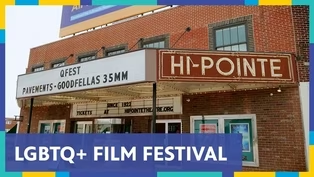
Cinema St. Louis' QFest Celebrates LGBTQ+ Films
Video has Closed Captions
Clip: S2026 Ep12 | 3m 18s | Cinema St. Louis presented the 19th annual QFest, a weeklong festival featuring LGBTQ+ films. (3m 18s)
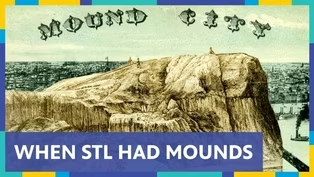
The Lost Native American Mounds of St. Louis
Video has Closed Captions
Clip: S2026 Ep12 | 8m 34s | In it's early days, St. Louis was known by many as the "Mound City". (8m 34s)
Providing Support for PBS.org
Learn Moreabout PBS online sponsorship











Support for PBS provided by:
Living St. Louis is a local public television program presented by Nine PBS
Support for Living St. Louis is provided by the Betsy & Thomas Patterson Foundation.