Living St. Louis
Urban Buds Provides Locally Grown Flowers for St. Louis
Clip: Season 2026 Episode 5 | 4m 58sVideo has Closed Captions
Producer Anne-Marie Berger spoke to Mimo Davis about how the business started.
When Mimo Davis and her business partner bought the Urban Buds property in 2012, there was a lot of work to be done. But soon, they transformed the condemned lot into a year-round urban farm for flowers. Anne-Marie Berger spoke to Mimo Davis about how the business started and how urban farms can transform vacant lots in St. Louis.
Problems playing video? | Closed Captioning Feedback
Problems playing video? | Closed Captioning Feedback
Living St. Louis is a local public television program presented by Nine PBS
Support for Living St. Louis is provided by the Betsy & Thomas Patterson Foundation.
Living St. Louis
Urban Buds Provides Locally Grown Flowers for St. Louis
Clip: Season 2026 Episode 5 | 4m 58sVideo has Closed Captions
When Mimo Davis and her business partner bought the Urban Buds property in 2012, there was a lot of work to be done. But soon, they transformed the condemned lot into a year-round urban farm for flowers. Anne-Marie Berger spoke to Mimo Davis about how the business started and how urban farms can transform vacant lots in St. Louis.
Problems playing video? | Closed Captioning Feedback
Where to Watch Living St. Louis
Living St. Louis is available to stream on pbs.org and the PBS app.
Providing Support for PBS.org
Learn Moreabout PBS online sponsorship♪♪ - You don't have to go all the way out to the country to see how things grow.
- This is Mimo Davis, co-founder and horticulturalist at Urban Buds, a one-acre, fresh-cut flower farm located in the Dutch Town neighborhood of South St.
Louis, proving that agriculture doesn't have to be rural, and buying locally-grown blooms are possible in every season.
- We grow over 80 varieties of cut flowers.
We grow year-round, and we sell direct to florists, do small weddings and events, and sell at Tower Grove Farmers Market every Saturday.
- I wouldn't even know what you would call them.
- These are called high tunnels.
- Okay.
- And we have two of them that are heated.
Plants will grow all winter long.
It really, you know, it really takes some sun and warmth to get them to bloom.
- Are you the sun and warmth that comes in then in the winter and makes it all happen?
- I am, I come in the winter and just, yeah, blow on them.
♪♪ - When Mimo and her business partner purchased this property on Tennessee Avenue in 2012, they didn't know it was the last remaining piece of what was once a 30 acre family farm.
- We knew it was a florist shop.
- Uh-huh.
- We did not know that they grew flowers here.
- Well, that's meant to be if you've ever heard it.
- Right, it gave us chill bumps.
- When they bought this property, it was a shadow of its former self.
- It was abandoned, it was condemned, it was vandalized.
This was an eyesore for this neighborhood.
- It's not unusual to find vacant land in metropolitan cities that can be turned into urban farms, especially in older post-industrial cities like St.
Louis.
What is unusual is when that land is successfully cared for, cultivated, and integrated into the neighborhood.
Urban farms stand out not because the land exists, but because they transform vacancy into something productive, visible and stabilizing.
So this is our alley.
And why can't alleys in our city be beautiful?
They don't have to be dumping grounds.
Harvard did a study that even just to look and see a beautiful scene of flowers automatically reduces your blood pressure.
It's a calming effect.
And that's what this alley does for people now.
When it's in full bloom, they say, "It's beautiful."
They just love what we've done with the alley.
- Mimo also understands the business of locally farming flowers.
That's, as she puts it, growing flowers that don't do well in a box.
80% of flowers are imported from South America.
So at her small urban farm, she grows crops that foreign growers won't ship.
Because we definitely don't want to be competing with South America.
So we want to grow specialty flowers, like the lupins.
Like, where are you going to get a lupin?
I don't know.
I don't even know what a lupin is.
Mimo began her career cultivating and growing flowers in 1993 at a farm she owned two and a half hours west of St.
Louis.
And I was driving into St.
Louis twice a week.
And that just wasn't sustainable in my life, right?
- Commutes like that also aren't great for the environment.
Transporting crops, flowers, and other products from rural farms to urban markets, not to mention imports from South America, produce significant carbon emissions and air pollution.
- You know, there's farm to table.
That's mostly about food, but there's flowers too.
Flowers to vase, field to vase.
Growing Where She Sells has turned Mimo's five-hour round-trip delivery into a two-mile commute to the Tower Grove Farmers Market, and a short drive for florists to pick up the freshest, locally city-grown flowers they can buy.
A job that never gets old for this farmer.
It's the best work.
I mean, can you imagine that, like, this incredible flower comes out of that little tiny seed?
I mean, isn't that, like, mind-blowing?
It's crazy.
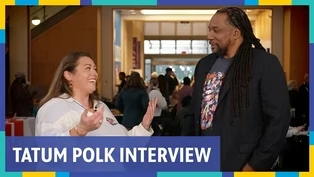
The 20th Anniversary of 314 Day
Video has Closed Captions
Clip: S2026 Ep5 | 2m 5s | Producer Brooke Butler spoke with #314Day founder Tatum Polk about the 20th anniversary. (2m 5s)
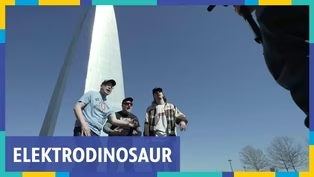
Behind-The-Scenes of Elektrodinosaur's "The Gateway Arch" Music Video
Video has Closed Captions
Clip: S2026 Ep5 | 3m 52s | Producer Mike Gualdoni goes behind the scenes of Elektrodinosaur's "The Gateway Arch" music video. (3m 52s)

Debunking The "Arch Effect" with Steve Templeton
Video has Closed Captions
Clip: S2026 Ep5 | 3m 17s | Some St. Louisans believe that The Gateway Arch can somehow divert storms and tornadoes. (3m 17s)
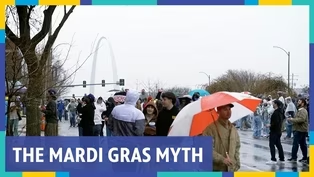
Does St. Louis Have The Second Biggest Mardi Gras in the US?
Video has Closed Captions
Clip: S2026 Ep5 | 6m 33s | Dive in to the myth, Soulard Mardi Gras history, and why the numbers don't really matter. (6m 33s)
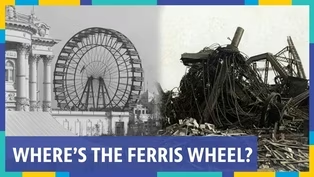
Is The 1904 World's Fair Ferris Wheel Buried in Forest Park?
Video has Closed Captions
Clip: S2026 Ep5 | 2m 55s | Producer Veronica Mohesky is debunking some famous St. Louis myths, including this one. (2m 55s)
Providing Support for PBS.org
Learn Moreabout PBS online sponsorship










Support for PBS provided by:
Living St. Louis is a local public television program presented by Nine PBS
Support for Living St. Louis is provided by the Betsy & Thomas Patterson Foundation.