Living St. Louis
August 24, 2026
Season 2026 Episode 14 | 27m 18sVideo has Closed Captions
Alley Asters, Lambert Airport Director Retires, Missouri Crematory, Plarn Quilts.
A search for more growing space transforms St. Louis alleyways into native plant gardens, Lambert International Airport Director Rhonda Hamm-Niebrugge retires, Missouri Crematory pioneers alternative end-of-life services, and St. Stephen Parish volunteers crochet plastic grocery bags into sleeping mats for people experiencing homelessness.
Problems playing video? | Closed Captioning Feedback
Problems playing video? | Closed Captioning Feedback
Living St. Louis is a local public television program presented by Nine PBS
Support for Living St. Louis is provided by the Betsy & Thomas Patterson Foundation.
Living St. Louis
August 24, 2026
Season 2026 Episode 14 | 27m 18sVideo has Closed Captions
A search for more growing space transforms St. Louis alleyways into native plant gardens, Lambert International Airport Director Rhonda Hamm-Niebrugge retires, Missouri Crematory pioneers alternative end-of-life services, and St. Stephen Parish volunteers crochet plastic grocery bags into sleeping mats for people experiencing homelessness.
Problems playing video? | Closed Captioning Feedback
Where to Watch Living St. Louis
Living St. Louis is available to stream on pbs.org and the PBS app.
Providing Support for PBS.org
Learn Moreabout PBS online sponsorship♪♪ - Welcome to Living St.
Louis.
I'm Brooke Butler, and I'm here in the Nine PBS master control room.
And if all these screens and equipment look cool to you, well, it's about the last time it's ever gonna look like this, because our station is getting ready to have a major makeover.
When all of this is built in 1998, it took all of this equipment to make television happen.
But now in the digital era, this technology can fit into a fraction of the space.
And as Nine PBS continues our community-focused mission, we need more space for what matters most, people.
So less hardware, more humanware.
Construction is currently underway and we're looking forward to returning to our Midtown home in the fall of 2027.
And don't worry, we'll continue bringing you the stories and programming that you love, including the stories in our show today.
On This Living St.
Louis, what started as one gardener's search for more growing space is helping transform St.
Louis alleys into blooming community assets.
As she prepares for her final departure, Lambert Airport's longtime director reflects on the highs, lows, and unforgettable moments of the past 16 years.
From introducing cremation to America in the 1880s to pioneering water cremation today, one St.
Louis institution continues to reshape how we think about life's final chapter.
And finally, meet the volunteers turning discarded plastic grocery bags into handmade sleeping mats for neighbors experiencing homelessness.
It's all next on "Living St.
Louis."
♪♪ - What if the alleys in our city were beautiful?
- Three purple cornflowers, two foot goldenrod.
- We are trying to beautify the alleys by filling them with wildflowers and at the same time create ecologically productive spaces, so habitat for pollinators, food for pollinators, food for birds, et cetera.
And yeah, just kind of get the word out about native plants and introduce people to them by kind of bringing them into the community.
I would like to remove a plant.
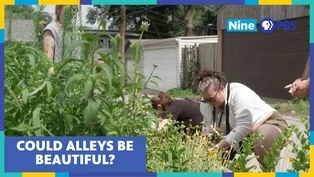
- Alley Aster's is a volunteer run ecological gardening group created by Tower Grove South resident Myles Tan after he ran out of space in his own yard to plant native perennials.
So he moved into his back alley and then got an idea to expand.
He runs the group alongside Rachel Rigdon and together with volunteers, they go out to tend, search for available space and plan.
- There's all these small little spots that typically go unloved and underused.
This means that if they're not utilized, it's a great place for invasive plants to kind of take hold.
There's a lot of potential there.
There's a lot of opportunity for us to fill that with plants that are beneficial and remove invasive plants at the same time and also beautify our alleys.
- In St.
Louis City, alleyways are usually places of unwanted items or trash, maybe even places of controversy and are rarely seen as environments where plants can thrive.
But Alley Aster's is turning unwanted or hard to manage spaces into opportunities for new growth.
A lot of people when they think of their alleys, they think of their dumpsters and places they're trying to spend as little time as possible.
But they are parts of our community and you know, if we can change our perspective on them, I think that'd be really cool.
Since the project began in 2022, they've planted over 950 natives across 55 plots around Tower Grove South.
It only takes about two years of plot management, like weeding and watering, for the natives to become self-sufficient.
And yes, these spaces are more visually appealing, but these are plants that have been in our region since the last ice age.
They're surviving in an ever-changing climate while simultaneously benefiting our ecosystem and overall infrastructure.
We need to be planting the plants that have evolved here over a long period of time and to fill those roles.
Our native perennials here have really deep root systems which allow them to be more drought tolerant and allow them to help decompact soil and allow more rainwater to be absorbed into the ground which reduces the stress on our wastewater system and just kind of keeps more water where it falls.
In a city that has a history of floods, cave-ins, and an intricate sewer pathway, it's interesting that plants could have that kind of impact.
And when we turn to our alleys, there's prime space for native perennials to flourish, providing nutrients that our insects and animals are familiar with, and a connection to nature for people living in an urban environment.
I think that a lot of people have, they think that they need to drive hours to be immersed in nature and I just think that people can see nature and be immersed in nature when they see a cliff goldenrod in the crack of concrete in their alley or sidewalk and just feeling that connection and that you are not, you are a part of your ecosystem and feeling more connected with the spaces around you.
These plots are collectively certified as wildlife habitats by the St.
Louis Audubon's Bring Conservation Home Program.
The program is one of many that give people in our region the opportunity to get involved with native plants.
Ones like the Missouri Prairie Foundation's Grow Native and the St.
Louis Wild Ones Chapter or MSD's Rainscaping Program.
And now, Alley Aster's.
So if we can be the first native plants on your property, maybe you're surprised about, you know, how resilient they are and how well they do in that space.
And that might say, oh, I might think of the MSD Project Clear Grant for, you know, my lawn that I don't really want to take care of.
So the introduction for people and hopefully inspire people kind of around the city who also have alleys to kind of think about those spaces as potential places for native plants to turn them into something productive and beautiful.
For many travelers, the airport is simply the beginning or end of a journey.
But behind every arrival and departure is a complex system of operations.
And as one era comes to a close at Lambert International Airport, Kara Vaninger tells us about the leadership that helped guide the airport through years of change.
We could not be more excited today with our partnership with Air Canada and our nonstop service to Montreal.
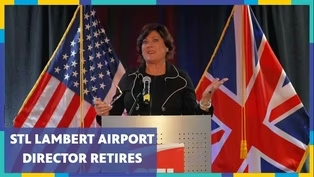
After 16 years as the director of St.
Louis Lambert International Airport, Rhonda Hamm-Niebruegge is set to retire at the end of August 2026.
She recently sat down with Nine PBS to reflect on her tenure, the challenges, the hard-won successes and one of the most dramatic moments.
I'd been in the job about 14 months.
Felt really good about the plan we were trying to create and put forward to build back this airport, try to make sure that the business community understood this industry.
As we were doing all of that and really sort of bringing people into the fold, the Good Friday tornado hit.
(glass shattering) - My husband and I were celebrating a birthday dinner that Friday evening, and then I received the call from one of the young men that was in our airport operations tower and said, you know, Rhonda, we just got hit.
And I said, hit, hit by what?
And he said, the tornado immediately.
You know, we hopped in the car and my heart just sank.
And when I walked in, it was a mess in terms of, you know, the windows broken and everything upside down and computers blown away.
It was calm.
I found out that there were especially no deaths, thank God.
The police were in place.
The firefighters were in place.
Our operational team that was here was out helping people, gathering, making announcements.
And all of a sudden it made me think, "Okay, we can get through this."
That night I started getting calls from all the business leaders that I had spent the last year trying to bring to the table about what happened in this industry and what we need to do to pull together to think about the future.
All of a sudden they're all calling, "What do you need?
Where can we help?
Like, we need plywood to board up windows.
We need dump trucks.
We need people to help pick up trash.
We need food.
We've got people working around the clock."
And all of that just appeared.
So from that initial shock of, "Oh my God, I don't know what to expect, and can we handle this?"
to all the support that came through and opening the very next day in 100% on Monday of our operation, I think was an incredible opportunity for us to really showcase the airport.
When Lambert was first built in 1956, it set the aesthetic standard for airports all over the country.
Designer Minoru Yamasaki's iconic domes mimicked the shapes and wonder of flight, while also feeling distinctly futuristic.
But not everything would stand the test of time as well as Yamasaki's domes would.
Hamne Brugge and her team have been working with the airlines to secure approval and funding for an enormous renovation that would see a consolidated terminal, new, easier-to-navigate road system, and more parking.
It's a good feeling to know that our airline partners have enough faith and trust in us that we're good stewards of the airport, that they authorized the first $335 million.
The second phase was another $650 million.
It includes all of the design work and for the program management teams, for the construction management teams, but it also brings into play some more of the outdated buildings that need to be relocated, like the new airfield maintenance and the new de-icing pad.
We're getting a new commissary distribution unit.
We're moving our ground service fueling.
All of those are really revitalizing the campus.
Over the generations, everybody's been good stewards of this airport, but it's now time to think about the next five or six decades, and that's what we're doing.
With the renovation anticipated to take at least four more years, the project will be handed over to Hamm-Niebruegges successor.
But this upgrade is only possible because of the director's other major focus during her time at Lambert.
Ladies and gentlemen, I'd like to welcome you to St.
Louis' Lambert Airport.
After becoming TWA's primary domestic hub in 1974, St.
Louis Lambert experienced a time of rapid expansion, increased passenger traffic, and the addition of nonstop flights to Europe.
- And people in St.
Louis got very accustomed to having lots of flights.
It peaked really in the year 2000, 30 million passengers per year coming through.
American Airlines bought TWA in 2001.
Then 9/11 happened, and the hub at St.
Louis was no longer seen as important and something to be retained.
Half of the flights were eliminated, and it was a real psychological blow, I think, to St.
Louisans who enjoyed amazing connections internationally.
- There was not a lot of faith in the airport at the time.
The frustration of having lost that status, of having lost that international, and really people not understanding this industry or what was happening, you know, it's been my whole life since 1982.
So I came from the airline side, so I understood the industry and some of the changes.
So I think what I realized initially was we just we have to help educate this the community and we have to build partnerships to make people feel like they're part of where we're going and how we get there.
The airline partnerships have been a really I think key success of my time.
The growth that we've seen with Southwest seeing the connecting traffic coming back through this airport.
This region offers so much for visitors, for residents, for young adults and students, but the ability to move our community forward is absolutely essential as we think about growing the reach and the impact of our visitor economy.
But you can only do that to a limited degree without a great airport and great connectivity.
So we think about the future of St.
Louis, it's directly tied to Lambert International and improved connectivity.
I think today is probably the proudest moment of my career.
When I first took this job, you know, over 16 years ago, the business community came and they said, "Rhonda, you have one priority.
It's to get London service back."
And I thought, "Okay, well, that won't be that hard, right?"
Sixteen years later, we've answered that plea.
"It's bringing back some of what St.
Louis was.
We have the companies that are doing trade.
We have universities that attract talent and students from all over the world.
Part of it is really recognizing it, and now these flights legitimizing just exactly who we are.
That is St.
Louis being a globally competitive city.
- All of a sudden, people looked at the airport again with pride, and that's what's important to me, you know, making sure that people have pride in our airport.
- What do I want to happen to my body after I die?
It's an important but often uncomfortable question that humans have been dealing with for, well, forever.
For centuries, burial was the most popular option in the U.S.
But one building in St.
Louis was, and still is, an epicenter of change in funerary methods.
So St.
Louis has a really neat hidden gem in the Missouri crematorium.
It's only one of the, it's like the sixth oldest one in the country.
It came about in the 1880s.
And before that, if you were cremated, you would have had to go to Pennsylvania.
Amanda Clark is a public historian at the Missouri Historical Society.
While cremation was a common practice in many cultures for centuries, the Christian belief in the resurrection of the body after death made cremation taboo in the US around this time.
In 1888, the Missouri crematory was the first of its kind to be built west of the Mississippi, and it marked a huge shift in attitudes about death.
You start to see more spiritualism after the Civil War, people being more open to this idea that we can connect with the dead on a spiritual level.
And once you see that shift, you start to see a little more acceptance to the idea of not needing your body to be physically preserved afterwards.
In St.
Louis, this idea was ushered in largely by German immigrants, specifically German revolutionaries who arrived in the late 1840s.
Political revolutionaries tend to be artists, musicians, people that are a little more open to progressive ideas.
That movement is called the German Freethinkers.
The Freethinkers are the ones that are open to cremation as being an option, so they're the ones that are introducing these progressive ideas to St.
Louis.
A German immigrant named Albert Todd had the Missouri crematory built, but he died before it was completed.
So he does not get to be cremated there, but his daughter, Elizabeth Todd Terry, is able to be cremated there and she's the first cremation to happen at her father's crematory.
She was able to prepare ahead and when she was cremated, she made sure that the front page of the newspapers carried the story of her cremation with very detailed description of what would happen to her remains.
And I think while he led the way to get it done, her doing that is the biggest story in the beginning of that crematory.
- What was once considered a radical idea started gaining acceptance in St.
Louis.
Slowly, cremations began to tick up.
A number of prominent Missourians have been cremated at the facility, including Frank James, Jesse James' brother.
And the Missouri crematory would influence the rest of the western United States.
So it would take a few years, but it definitely was on the forefront, and it would have influenced other cities.
According to the National Funeral Directors Association, over 60% of people choose cremation today, which is an exponential increase from the 1970s, when only about 5% of people were cremated.
And that number is only projected to grow over the years.
The Missouri Crematory was instrumental in bringing about change in funerary practices in the late 1800s, but that building is still making headlines about how remains are processed today.
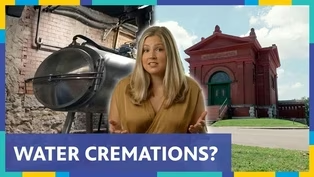
We are the first providers of alkaline hydrolysis, or what's known as aquamation, here in the state of Missouri.
That's John Hughes, funeral director and owner of Hughes Funeral Alternatives.
He moved his business to the historic crematory a little over three years ago and brought the first alkaline hydrolysis machine to Missouri.
Hughes took us on a tour of the crematory to get a closer look at how the aquamation process works.
This machine will do a process in anywhere between four to six hours, fall in process, the chamber isn't open, and what's left is mineral ash remain, mineral bone particles that are then dried and processed into the fine ash, placed in an urn and then given back to the family.
What is the solution made up of?
So the solution is about 95% water, and then the other 5% would be alkali, and that's just to mimic what the alkalinity in the soil does during burial, we can mimic that process here in this machine.
Because we're controlling the amount of alkali, the time, and the temperature of the water, we can do it in a much faster time span.
It's currently the only place in Missouri that provides alkaline hydrolysis, or aquamation, for remains.
So we thought, as we were looking for a new building to expand from where we originally opened, we thought this would be a good marriage of the first aquamation machine would be in the first crematory building here within the state.
When Hughes Funeral Alternatives moved in, the Missouri crematory hadn't done cremations in the facility for decades.
We just took the, I guess, the footprint of the building and, you know, fit for our process of aquamation.
His company also owns the historic columbarium, which holds cremains, but is now undergoing construction, and a chapel and mausoleum that was built on the property in the 1970s.
What is the cost of aquamation compared to other funeral services?
So the overall cost of aquamation, it's very comparable to what a normal direct cremation would be, if not less.
So it would be, in most cases, under $2,000 for everything.
It's also eco-friendlier than flame-based cremation.
Aquamation produces a carbon footprint 18 times smaller, with 90% less natural gas, 60% less electricity, and 90% less CO2 emissions.
Every year we tend to serve more families.
As more people find out about what this process is, not only acceptable here in Missouri, but it's opened up and offered here within the state.
The practice of acclimation isn't available or even legal in many states due to historic laws and slow changes in the industry.
We have served families, in fact last month we served four families alone from the state of Texas.
It's not legalized in Texas, so we are the closest machine.
Still, Hughes admits this process may not be for everyone.
I don't expect everybody to choose this.
My goal is that everybody has the option to choose this.
More people are becoming more and more eco-friendly.
Personally, I never did like the aspect of putting somebody in open flames and heat, so that's how I got interested in this, and then I just slowly kind of gravitated towards the eco-friendly version of this.
We also hear a lot that, you know, we had a hard time thinking about putting our father or grandfather in flames or fire, and for whatever reason, that water is just a more peaceful mindset for them as they say goodbye to the loved one.
So that's why I think what we do here is important.
Plastic grocery bags aren't known for their staying power, but in the hands of dedicated crafters, they're getting a second life and a whole new purpose.
Every week at Immaculate Heart of Mary Church, part of St.
Stephen Parish, volunteers gather around tables for a kind of sewing circle.
Only their material of choice, plastic grocery bags.
- We've all become bag snobs.
You know, we all have all these preferred bags and colors and so on.
- They've become known as the St.
Stephen Parish Plarn Patrol.
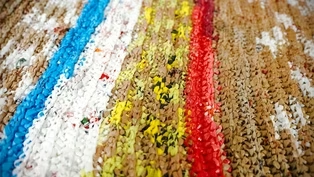
Plarn being the term for the plastic yarn they use to crochet these mats.
The mats are then donated to the St.
Patrick's Center to be distributed to those experiencing homelessness.
It's a two-fold thing.
It helps the environment and it helps the homeless.
And it's a good way to use your plastic bags, but you know, really, we should be using cloth bags.
>>But as long as we have these, we want to keep these out of the landfill.
And so what she does is she flattens them, and then all of us do is different aspects.
But then I fold them in a certain manner, and I cut off the parts that we can't use.
Some people flatten and fold, some people take the flatten and fold and cut the strips, and some people are taking the strips and weaving it together to make a long strip like corn.
And then you ball it up and then crochet.
We're making the corn.
We tie the balls to make the balls of plarn.
About two of these and a little more will make our mat.
And so we all put them together and then we crochet.
It looks beautiful too.
It is.
I'm not talented enough to do that.
But I can do this.
But it takes a team.
It takes a village, right?
Yes, sure.
Yeah, I crochet at home.
And I keep them company.
Yeah, that's important.
Yeah.
And so I heard, is it one of you who like have a record of like one a week?
Is that right?
Yeah, I try.
Yeah.
That's incredible.
Each mat is roughly three feet by six feet, uses around 600 plastic bags, and takes several hours of labor.
In the larger context of homelessness and environmental waste, it's a modest gesture.
The mats won't solve homelessness, and they won't eliminate plastic waste.
But for the volunteers who make them, that's not really the point.
In a world of problems that can seem impossible to solve, they're choosing to make one thing they can hold in their hands.
It's a good thing to come and be a part of something that's meaningful, that we can not only, it sounds like such a trivial thing to do, but at least it's something that we can do.
If we didn't need to use them at all, it would be the greatest gift and that's the biggest challenge.
This also isn't a new or unusual pastime, especially for church groups.
Plarn has been used for craft projects since the early 2000s, and turning it into sleeping mats has become a familiar volunteer effort in communities across the country.
Part of the appeal is practical.
Plastic bags are easy to collect, the costs are low, and the work offers volunteers a chance to gather, socialize, and create something together.
Some critics point out that there are other ways to direct time and resources toward helping people experiencing homelessness.
But supporters see these mats as a practical second life for material headed for the landfill, and a simple way to provide a little extra comfort and insulation to someone spending nights outdoors.
It came as a great surprise, I think, to all of us that it's become a thing.
We've really come to enjoy each other.
This is a very good community to be part of, and I appreciate all of these people.
Anyway, we've all become bag snobs.
It's the color that gets us along.
The color and the weight.
Yes, exactly.
Yeah.
So, that's the snob part.
I'll tell you my favorite bags are the Straub's bags because they're really shiny and they're a nice green color, but you have to cut them thinner.
And they're a little bit hard to crochet, but I like how they come out.
It takes quite a long time.
We said they would be priceless if you had to put a price on them.
Think about it.
You're driving down the highway, you're driving down the street, and you see plastic bags.
To start repurposing, to stop using them all together would be the greatest.
And that's Living St.
Louis.
If porn piqued your interest, you can watch the full episode of What Do I Do With This All About Plastic Bags on the PBS app or on Nine PBS's YouTube channel.
I'm Brooke Butler.
Thanks for joining us.
♪♪ - Living St.
Louis is funded in part by the Betsy and Thomas Patterson Foundation and the members of Nine PBS.
The Groundbreaking Past (And Future) of The Missouri Crematory
Video has Closed Captions
Clip: S2026 Ep14 | 7m 14s | Missouri Crematory continues to pioneer alternative end-of-life services through water cremation. (7m 14s)
How Native Plants Are Transforming South St. Louis City
Video has Closed Captions
Clip: S2026 Ep14 | 4m 24s | Alley Asters works to transform St. Louis alleyways into native plant gardens. (4m 24s)
Lambert Airport Director Rhonda Hamm-Niebrugge Retires After 16 Years
Video has Closed Captions
Clip: S2026 Ep14 | 6m 52s | After 16 years as the director of Lambert Airport, Rhonda Hamm-Niebrugge is set to retire. (6m 52s)
Plarn Quilts | What Do I Do with This?
Video has Closed Captions
Clip: S2026 Ep14 | 5m 10s | Volunteers crochet plastic grocery bags into sleeping mats for people experiencing homelessness. (5m 10s)
Providing Support for PBS.org
Learn Moreabout PBS online sponsorship












Support for PBS provided by:
Living St. Louis is a local public television program presented by Nine PBS
Support for Living St. Louis is provided by the Betsy & Thomas Patterson Foundation.