
Curious Antarctica, Part 2
Season 8 Episode 802 | 27m 59sVideo has Closed Captions
Seals snoozing on ice; penguin highways; whale spouts & flukes; Shackleton's heroic adventures.
Who made it to the South Pole first? What was so heroic about Ernest Shackleton's expedition? Where do whales migrate to? Why do penguins spread their wings? When did the Antarctic Treaty prevent the building of a skyscraper, a military base or a Starbucks? How can you tell one humpback whale from another? Who What Where Why When and How... so much to be curious about in Antarctica.
Problems playing video? | Closed Captioning Feedback
Problems playing video? | Closed Captioning Feedback
Curious Traveler is presented by your local public television station.
Distributed nationally by American Public Television
Curious Antarctica, Part 2
Season 8 Episode 802 | 27m 59sVideo has Closed Captions
Who made it to the South Pole first? What was so heroic about Ernest Shackleton's expedition? Where do whales migrate to? Why do penguins spread their wings? When did the Antarctic Treaty prevent the building of a skyscraper, a military base or a Starbucks? How can you tell one humpback whale from another? Who What Where Why When and How... so much to be curious about in Antarctica.
Problems playing video? | Closed Captioning Feedback
Where to Watch Curious Traveler
Curious Traveler is available to stream on pbs.org and the PBS app.
Providing Support for PBS.org
Learn Moreabout PBS online sponsorship- Antarctica is the world's fifth largest continent, and of course, its southernmost continent.
And nearly all of it is covered in a very thick sheet of ice.
So bundle up, it's going to be a chilly one.
(bright lively music) "Curious Traveler" is made possible by the following.
(images whooshing) - [Narrator 1] You can immerse yourself in the very soul of Europe, aboard a European Waterways luxury hotel barge cruise.
Europeanwaterways.com.
(spirited upbeat music) (bright upbeat music) (ethereal upbeat music) - [Christine] Antarctica, the final frontier, the last pristine continent on Earth.
(ethereal upbeat music) It is also the world's coldest, iciest, windiest, driest, and highest continent, with average heights of 7,200 feet above sea level.
(ethereal upbeat music) And did I mention it's cold here?
The lowest recorded temperature here was 128 degrees below zero.
It is also 5.5 million square miles big, and most of it is covered in an ice sheet that is about a mile thick.
So it's no surprise that the only residents are the penguins, the seals, the whales, and the birds.
And their home is protected from pesky humans thanks to the 1959 Antarctic Treaty, which prevents all military, commercial, or residential developments here.
So that's why you'll see no skyscrapers, no Starbucks, and no traffic here, other than a penguin highway or two.
So here's what I'm curious about in Antarctica.
Who made sure these seals could live their best lives?
What is this whale doing?
Where did Ernest Shackleton's expedition go and where didn't it go?
Why do penguins do this and this?
When was there a race to claim this icy continent?
How do we know which humpback whale this is?
Who, what, where, why, when, and how?
So much to be curious about in Antarctica.
(playful music) So where does the name Antarctica come from?
Well, the answer will help you to remember that polar bears live in the north and penguins live here in the south.
So the name Antarctica simply means the opposite of the Arctic.
And the Arctic gets its name from the Greek arktos, which means bear.
But here's where it gets a little tricky.
It was not named bear because of the polar bears that live there, but in fact, from the "Big Bear" constellation that can be seen up in the sky.
But it's still a good way to remember that polar bears live in the north, penguins here in the south.
Now they're both really fuzzy and cute, but here's a little tip.
The penguins here in Antarctica, they're a bit friendlier.
(light playful music) All right, enough of this being cozy, warm and dry on the big ship.
And time to get into a tiny, wet and bouncy boat called a Zodiac.
(indistinct chattering) Oh, look at that.
Yep, it doesn't take long to spot something amazing out here.
All right, so I see one that's really, really close to us.
- [Thérèse] Yeah.
- Can you kind of tell which direction they're going, just by the shape of the water?
- [Thérèse] Yeah, I mean from this position it's a bit hard, but actually you see always a little bit like a, it looks like an oily spill.
- [Christine] Yeah.
- And it's simply the mucus when they breathe out, you know, it's mucus coming as well, and so it makes a bit of an oily spill.
And then some, you really have to follow the ripples of the water.
I mean, if they have a deeper dive now, they can come up here, they can come up here and you see the pattern.
And before the... Ooh, they're coming up again.
Look!
- [Christine] Oh my gosh.
- [Thérèse] Fantastic.
- [Christine] Unbelievable.
- [Thérèse] So magical when you hear them breathing.
- [Christine] That's incredible.
Most of the whales we're seeing today are humpback whales, named for the little hump you can see popping up above the surface.
But don't be fooled by the size of this little hump.
The length of a humpback whale is about 10 to 12 times as long as what you see here.
So that makes it about 50 feet long, or about eight times as long as a curious traveler.
(playful music) You know, I think I'm glad we can't see underwater right now.
(playful music) Do they communicate with other whales and say, "Hey, this is a good spot."
- Yeah, yeah, yeah.
- Or they say, "No, I don't want to tell anybody."
- I don't know if they tell anybody, but there is a lot of, you know, we have tail slapping.
They actually do communicate.
They have these low frequency grumbles and they can be heard several hundred kilometers actually when they talk on the water.
- [Christine] Unbelievable.
- [Thérèse] Wow.
- [Christine] Unbelievable Ah, he just waved at us.
Hi, buddy.
- [Thérèse] Another, look, another maybe.
- [Christine] That's amazing.
Do they typically travel in groups like that?
Would that be a family?
- No, they're very loose groups.
They're no family bonding, so very different to the orcas.
This is a family group, it's a matrilineal group, so basically, the grandma is leading the pod.
- As life should be.
- Yeah.
- As life should be.
- She shows where the good food is.
- [Christine] Yeah.
Tell me about that migration.
What's the distance that they go and are they born at one end and they kind of go to the other?
Do they breed in the warmer waters or how does it go?
- Yeah, exactly.
So when they're breeding, they're actually in the warmer waters because you have to imagine when the calf is born, it doesn't yet have this very fat blubber layer.
It doesn't have so good insulation, right?
It needs to keep warm, and that's why they're born in the warmer waters, but they're not so nutritious, these waters than down here.
So they actually, they can do one migration of a humpback whale which was tagged, was recorded at almost 11,000 kilometers.
That's how far they actually can go in one migration.
So we always hear it.
- [Christine] I keep hearing it.
Oh.
- [Thérèse] Look!
Yes.
- [Christine] Wow.
- And I can see now the flukes of the humpbacks, they actually eat.
- [Christine] Yeah, trying to do an interview when all these beautiful whales keep swimming by gets rather tricky.
But there's one more curious bit of whale trivia that will surely wow you, and it has something to do with that fluke we keep screaming about.
A whale's fluke is simply its tail.
The name possibly comes from the Low German word for a wing or an old Norse word for flat fish.
Whatever its origin, you won't believe this next part.
- [Thérèse] The flukes of the humpbacks, they're actually each of them is individual.
So some of them are quite white, some are more black, and the mixture of this pattern when you look at the underside of the tail fluke from the humpbacks is also individual.
- And it's as unique as a human fingerprint?
- Exactly.
It is.
- That's amazing.
- It's really a human fingerprint.
And there is actually a database where we take photographs, only photographs.
It's nothing, no tagging, nothing needed.
It's really growing big also here in Antarctica.
And thanks to many travelers coming down here submitting photos as well.
- [Christine] While their fluke patterns may be unique and individual, their food preferences are all the same.
Whales like krill, lots and lots of krill.
Humpbacks can eat up to 5,000 pounds of krill and small fish per day.
And you know I had to ask, do they think we look tasty too?
Do we have any idea, do they think this is another fish?
- Yeah.
- They think it's another whale?
- Basically, they go for krill, right?
So tiny small, six centimeters, small animals.
They're not going for zodiacs and so.
And we have our guidelines how close we, because we don't want to disturb them at all.
So we approach very slowly.
We do approach from exactly a specific angle what we are allowed to.
We keep the distance, but sometimes maybe, yeah, maybe a whale comes a little bit up or swims underneath the boat that can actually happen, but it's nothing that we encourage.
We're not doing.
So it's always the whale has the right of way.
- [Christine] And we experienced a whale having the right of way right under our Zodiac on a different outing.
(whale groaning) Oh my God.
As you can see here.
Hey, if a 50 foot long, 40 ton whale wants the right of way, I have no problem with that.
(whale growling) This is my first time visiting Antarctica.
Hopefully not my last.
I can't get over this.
Every single time I squeal and go, "Oh my good look at that."
- Yes.
- How is it for you?
Is it still exciting every day?
- It's still exciting every day.
You know, it's something you realize how small we are and how not important human beings are.
- Exactly.
- Basically.
So everything gets quite relative and seeing such a big animal, it's just, yeah, it's just a gentle animal as well.
It's just fantastic.
(playful upbeat music) - [Christine] Next, we go from big majestic whales to some cute and cuddly tuxedoed penguins.
Okay, rule number one, do not actually cuddle the penguins.
These seemingly cartoony little fellas with their big round bellies are actually pretty impressive athletes.
Some swim for thousands of miles over weeks of time just to get here for the summer.
We were lucky enough to get to land at one of the penguin colonies, although no swimming was required on our part.
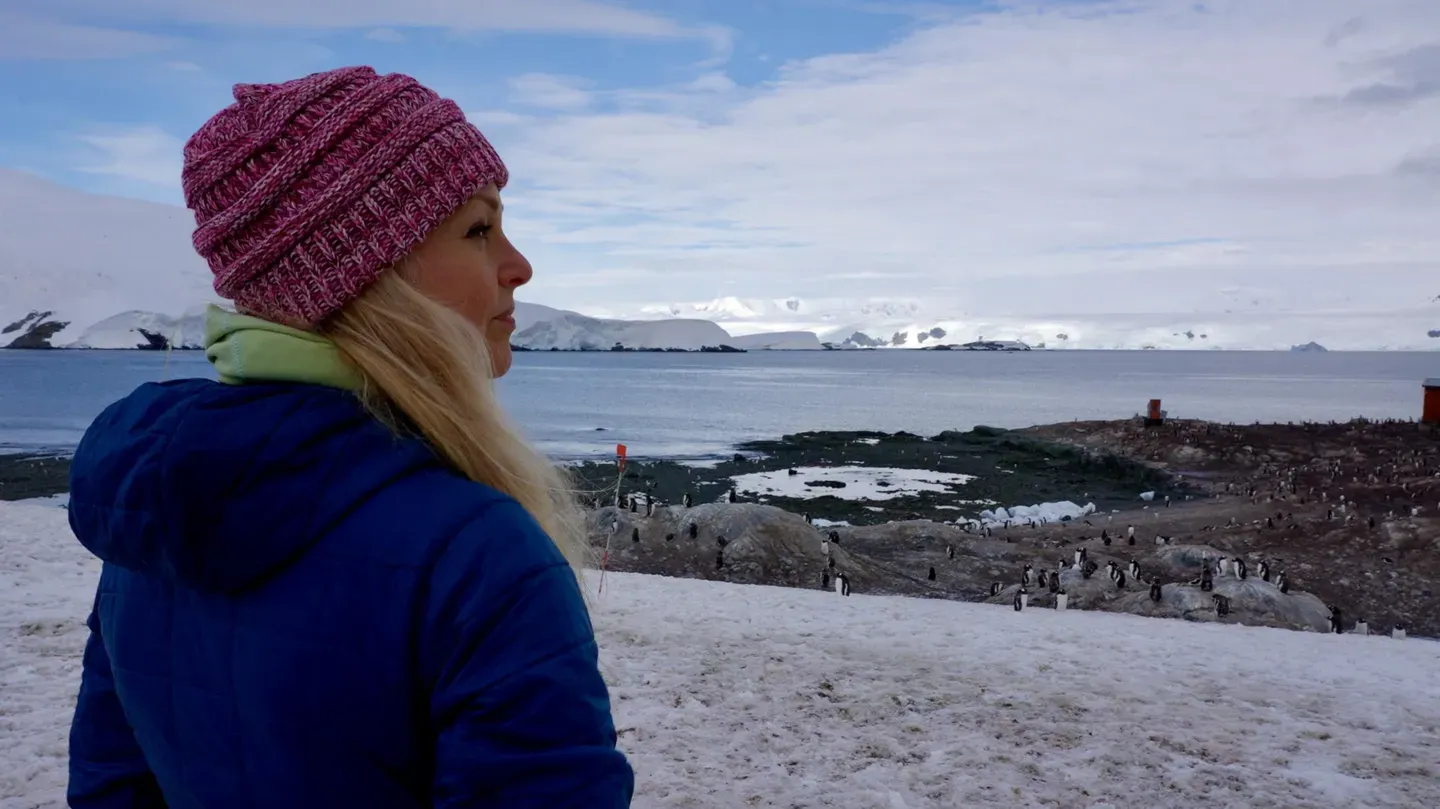
This is Two Hummock Island, where hundreds of these penguins congregate to feed and breed each year.
Penguins, penguins, penguins.
Why do we love penguins so much?
Well, they are really, really cute.
They wear their little tuxedos all the time and they walk around like this, so what's not to love?
There are three main types of penguins here in Antarctica, the gentoo, the chinstrap, because they've got a cute little chinstrap here, and the Adélie.
And their behavior is fascinating.
One of the things they do is called porpoising when they swim, because they kind of swim like this like a porpoise, and they get a nice big breath of fresh air, and then go underneath again and continue to swim to hunt for fish.
Something else they do, which is adorable, is if they get too hot, they kind of lay on their bellies like this and spread out, and hopefully let the heat come out of their body.
But the thing that I really respect penguins for the most is their capacity to keep their energy up all day through something called micronapping.
To learn more about micronapping, porpoising, and the general adorableness of penguins, I bordered a Zodiac with naturalist, Rachael Iverson-Brown, who has studied the behaviors of penguins for decades.
- So these guys are porpoising, so what they do basically is they just jump out of the water and during that jump, they take in a deep breath.
So they don't have to slow down.
They can keep going at that same speed.
- It's kind of like when we humans do the butterfly stroke.
You get that breath real quick.
Get that breath real quick.
That leads me to my next question.
Anytime they're going for a swim, are they usually hunting and trying to get fish or sometimes do they just swim for fun?
- So when they're in the water, they're going for feeding.
But, you know, their colonies are quite dirty.
They've got guano stains on them or they could have soil or dirt on them.
- [Christine] Kind of like cats.
They want to keep themselves clean.
So they're like, "Oh, this is gross around here.
I need to clean things up," and so they go for some cleaning themselves.
- [Rachael] Yeah.
(seagull squawking) - [Christine] And if they are rolling in the water, that tells us that they are cleaning themselves.
This process is known as preening.
These penguins do need to look their best, you know, they are wearing their tuxedos.
And when they're not performing the perfect butterfly strokes, spinning or preening, these penguins are hanging out here in their penguin colonies, also called a penguin rookery.
(penguins babbling) Here, they're keeping watch for predators and taking care of their baby chicks and generally looking adorable.
I always find it fascinating that with different species there's different behavior and patterns regarding the family unit.
So with the penguins, is it the mother that stays with the young and the dad goes out hunting for fish?
How does the family work?
- They work as a unit.
So both the parents, males and the females will look after that egg and then the chick.
With the chinstrap penguins, for example, they are monogamous throughout the season.
- Oh, good.
Oh, the season.
Oh, throughout season.
- Through seasons.
Yeah.
- Oh sorry.
- They can change partners the following year but throughout the season they stay monogamous.
So once that egg is laid, the parents will take in turns to incubate and the other will go out and feed, and then they'll swap over.
Depending on the penguin species, that might be a few hours, it can be a couple of days.
- [Christine] And here's how you can spot the baby penguins called chicks.
Just look for the ones with fuzzy feathers, like this little fella right here.
You'll notice that the babies are never going into the water, and there's a curious reason for that.
Their little fuzzy feathers are not waterproof yet.
The baby chicks start to shed or molt these soft down feathers at about age two to 13 months old, and then they begin to grow their waterproof signature black and white sleek tuxedo feathers, which they can swim in.
Then they can finally take their first dip into these icy, 30 degree waters.
Yeah, I think I'd wait for my waterproof insulating feathers to grow into.
And then, once they're in the water, they sometimes do something quite curious that turns them from a normal Clark Kent penguin into a super turbocharged penguin.
- They have this really cool ability of pushing their feathers against their body, and that pushes that air out, and that basically acts like a lubricant, and they can double, sometimes triple their speed underwater, and that can help them get down low, it can help them escape predators, or it can help them jump out onto an ice floes.
- [Christine] Okay, watch this.
(funky music) See how this little guy boops himself into the air from underwater, onto the rocks, and just about perfectly sticks the landing?
This amazing little bit of penguin physics is called the bubble boost, and believe it or not, this little trick is so effective that engineers have studied it to design faster underwater vehicles.
And of course, penguins need to swim fast, not just to dive deep down to catch fish, but also to escape predators.
Their main predators are the skuas a type of bird, the occasional killer whale, but mostly these guys.
While the leopard seal might look cute as could be, they are quite the vicious predator for the penguin.
- They're kind of ambush predators, so they'll hide behind these burgee bits and these ice floes waiting for penguins to come out, and they'll shoot out and try and grab them.
- Unfortunately, that's the part I don't like.
I'm not a realist when it comes to this sort of thing.
Like they all get along, they all live in harmony, they all live in harmony.
And because of the need to watch out for predators, penguins developed yet another fascinating behavior.
There was a study done a few years ago now on chinstrap penguins and how they sleep and how they cope being in a colony that's busy, got penguins coming and going, squawking skuas flying overhead.
And they actually put electrodes on the brains to track how they slept.
And they found that they took micronaps throughout the day.
But what's the crazy thing is that those micronaps on average lasted four seconds, which is super, super short, and I wish I had that ability.
- Tell me about it.
- But it's kind of thought that the sleep is good enough that it's, you know, enough to rejuvenate the body and all the rest of it, and they can survive quite well doing that.
- So that's their normal sleeping patterns?
They accumulate enough of these micronaps within a 24 hour period that they're getting how many hours?
- [Rachael] Yeah, so they were still sleeping from around about 11 hours sleep.
- [Christine] Oh, wow.
- Plus they were in the colony during the day.
So, you know, it's like four seconds asleep, four seconds awake, four seconds asleep, four seconds awake.
- [Christine] So, penguins can turbo boost underwater, porpoise swim on the surface of the water, take care of their fuzzy little babies by micronapping.
It's all very impressive, but still... Even though they are these fantastic creatures that can survive in all these conditions, it's okay to still think of them as very cute, right?
- They are insanely cute.
And that's what's made them so popular.
- [Christine] Yeah.
- They're popular for a reason.
(light playful music) (penguins squeaking) - [Christine] Now that we've studied the wonderful wildlife of Antarctica, let's talk about the human history on the continent.
Between 1897 and 1922, the Heroic Age of Antarctic Exploration took place.
This was when daring explorations, important discoveries and milestones were made.
One of the most important was in 1911 when Norwegian explorer Roald Amundsen was the first explorer to reach the South Pole.
This event kicked off the incredible, almost unbelievable story of explorer, Ernest Shackleton.
This is Jeff Bullied, a polar expedition leader, wildlife photographer, and lecturer on the history of the Heroic Age of Exploration.
He explains how Ernest Shackleton, who had accompanied others on their journeys, but had never led his own journey used his P.T.
Barnum skills to put together a crew for a trip that would go down in history.
- The advertisement he placed for this exhibition was amazing.
Basically, he said, you know, men wanted extremely high risk of expedition, chances of success, highly unlikely.
Basically he said, "You're likely to die."
- But come on, it'll be an adventure.
- But perhaps should we make it home, yeah, there might be some fame involved.
- Yeah, yeah.
Well, a lot of the worst could happen and did happen.
(waves roaring) The original plan was to start at South Georgia Island, then sail to the Weddell Sea, and then get out and walk across the entire length of Antarctica, passing the South Pole and ending at the Ross Sea.
There was a second ship starting at the end point, which was to bring supplies to the crossing crew.
But right from the start, the troubles began.
(light brooding music) - About 80 miles away from where he was supposed to land on the Weddell Sea coastline, they got locked into ice.
In essence, you've got a wooden ship, which is kind of like a cabin now.
- [Christine] Yeah, yeah.
- [Jeff] And it's stuck in the ice and the ice is moving along with the current and the wind, et cetera.
His ship drifted about 2,000 miles along the Weddell Sea coast and up farther north.
At one point, his ship was crushed in the ice.
The men got off, they got off with three lifeboats, and they lived on the ice for about eight months.
- [Christine] What was their plan?
Why did they stay there for eight months?
Did they think maybe someone was going to come get them, or they though, "We don't know what to do.
We'll at least survive where we are."
- So as soon as the ship was crushed, the expedition was off.
This now became a survival mission.
- Survival, okay.
- And it was the greatest survival story, probably ever told.
- [Christine] Yeah.
- They had three lifeboats, but they had hundreds of miles of sea ice around them, so there could be 15, 20 foot ridges and trying to go over those with one time- - We were pulling them?
- Yeah, they were pulling them like manually.
- It's incredible.
- Yeah.
- It was incredible.
- [Jeff] So they just couldn't go that far.
They tried it and it was a nightmare.
- [Christine] Yeah.
- [Jeff] So their plan was to keep the lifeboats ready to go as soon as the ice started to break up.
- [Christine] So the ice finally did break up and all 28 men got into the three small wooden lifeboats and headed towards the nearest spot, Elephant Island.
It took seven days of rowing across 100 miles of stormy and dangerous seas.
- By the time they landed in Elephant Island, they were starving.
Most of the men physically couldn't walk off those lifeboats.
- [Christine] Wow.
- [Jeff] They were in very, very bad shape.
He realized that he had to go get help.
Nobody knew where they were.
Nobody was coming to find them ever.
- And Elephant Island is where the next part of the story happens.
- Yes.
- And correct me if I'm wrong, that's where Shackleton did one of his speeches, "Hey, I'm probably gonna die, but I need a couple of men to come with me to try to go get help from the whalers.
You can either come or stay."
So the decision was made that Shackleton and five of his crew would head out into the treacherous waters to get help, and 22 men stayed behind.
And the ones that stayed behind, is that where they turned the boats upside down and they had one small candle made out of seal fat or - [Jeff] Seal blubber.
- And they somehow survived there how many months?
- Four months.
- Four months?
- Four months.
- [Christine] And as horrible as those conditions were on Elephant Island, for the crew with Shackleton, their adventures and dangers were just beginning.
This tiny wooden boat had to sail 800 nautical miles to try to get back to South Georgia Island.
- This is the greatest small boat journey in the world that has ever happened.
They had to go across the Drake into the Drake Passage, 40, 50 foot seas.
- Yeah.
- And then they had hung a right and they got blown along with the Drake.
They had one thing to navigate with, and that was sextant.
But if they missed by one degree, they would've blown past South Georgia and then would've died in the Southern ocean- - For sure.
- Exposure, starvation.
- [Christine] But miraculously, after 17 days, they did make it to South Georgia Island.
But then, guess what?
- Well, of course it was a hurricane.
'Cause they needed- - Of course, well, of course, because they haven't had enough challenges.
- They've been having all this good luck so far.
- Yeah, yeah, yeah.
So Shackleton made yet another emergency decision.
They sailed around the entire island and landed on the south side.
By this time, three of his men were too sick and too weak to go on.
So they were left with shelter and supplies on the shore, and the other two men plus Shackleton, now had to cross 32 miles in the ice and snow on foot to get to the station.
This journey was going to take nearly 40 hours.
- They didn't stop except finally his men became so exhausted they said, "We have to stop and sleep."
Shackleton knew that if they fell asleep, they'd die, they'd freeze to death because they just wouldn't wake up.
So he stayed awake.
- [Christine] This unbelievable story has one more crazy adventure to it.
The men had to climb a huge mountain, and then at the peak, they could finally see the whaling station below.
But how are they going to get down from the mountain?
The answer sounds straight out of a movie.
They get to the top and they say, "We don't know how we're going to get down."
And they Tobogganed together, just with no sled, just with their legs around each other like this and slid down.
- Yeah, it was kind of a rope toboggan, but yes, you're quite right.
They did this.
- Oh, okay, okay.
- They went down about almost 2,000 feet in a couple of minutes.
Modern mountaineers have been over the same route, and they said it was just an act of sheer desperation because there were crevasses everywhere, there were cliffs.
The fact that they survived just that one thing was a miracle.
- [Christine] And of course, Shackleton and his crew had survived so much, much more.
So then, finally, Shackleton and his men made it to the whaling station, the same station where their journey began two years earlier.
But after surviving, being stuck in an ice sheet, frostbite, starvation, they didn't exactly receive a hero's welcome from their friends and colleagues for a very curious reason.
- They were a wreck.
Their clothes were thread, but they'd been wearing the same clothing for a year.
Their faces were black from the tallow, from the fat they'd been burning.
Matted beard, scraggly hair.
They just were emaciated from starvation, and when he knocked at the door of, he knew the station master, the station master said, "Who are you?"
- He's like, "I'm Shackleton.
Don't you recognize me?"
From here, the story wraps up in the best of ways.
With the help of the Chilean Navy, Shackleton sails back to rescue the men on the other side of South Georgia Island, and then sails across to Elephant Island to get the other 22 men.
And then, together, all 28 men who started the mission sailed back to safety in Chile, where they finally received their hero's welcome.
That's why he's such a legend for being a leader, taking care of his men, and the fact that every single one of his men survived.
- He helped his men believe that they could survive this horrible situation they were in, and they believed that they were in that trouble for 22 months.
- Incredible.
(playful music) So, from an other worldly icy landscape, to a whale's unique fingerprint found on its fantastically flippy fluke, to those oh, so adorable penguins who speed along, thanks to some turbo boosting bubbles, and a few micronaps, to the Heroic Age of Exploration and one extraordinary tale of endurance, Antarctica has so much to be curious about.
Thank you for joining us on our educational journey, and hopefully now you're even more curious about the who, what, where, why, when, and hows of magical Antarctica.
We hope you had a whale of a time, but remember, please stay off the penguin highways.
(playful music) Close caption funding provided by... - [Narrator 2] Eden Andalou Aquapark & Spa, an all inclusive luxury resort in Marrakesh.
Moroccan-inspired suites, authentic cuisine, all set in a desert oasis.
- [Christine] "Curious Traveler" is made possible by the following.
(images whooshing) (bright lively music) - [Narrator 1] You can immerse yourself in the very soul of Europe, aboard a European Waterways luxury hotel barge cruise.
Europeanwaterways.com.
(ethereal music) (bright upbeat music) - [Christine] Still curious?
Go to curioustravelertv.com and find our links to follow us on social media.
(lively upbeat music) (bright music)














Support for PBS provided by:
Curious Traveler is presented by your local public television station.
Distributed nationally by American Public Television