Chicago Stories
Designing the White City
Clip: 10/2/2026 | 7m 19sVideo has Closed Captions
Burnham, Root, and Olmsted set out to design the White City.
Daniel Burnham, John Wellborn Root, and Frederick Law Olmsted are hired to design a dazzling – but temporary – White City in Jackson Park.
Problems playing video? | Closed Captioning Feedback
Problems playing video? | Closed Captioning Feedback
Chicago Stories is a local public television program presented by WTTW
Lead support for CHICAGO STORIES is provided by The Negaunee Foundation. Major support is provided by the Abra Prentice Foundation, Inc. and the TAWANI Foundation.
Chicago Stories
Designing the White City
Clip: 10/2/2026 | 7m 19sVideo has Closed Captions
Daniel Burnham, John Wellborn Root, and Frederick Law Olmsted are hired to design a dazzling – but temporary – White City in Jackson Park.
Problems playing video? | Closed Captioning Feedback
Where to Watch Chicago Stories
Chicago Stories is available to stream on pbs.org and the PBS app.
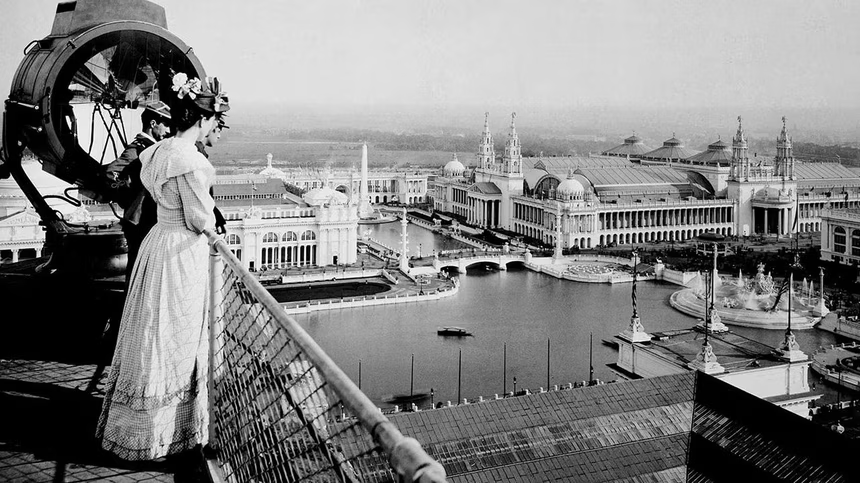
Chicago Stories - New Season!
Season 6 includes: The World’s Fair of 1893, Toy Town, Skyscrapers, and Home of the Irish.Providing Support for PBS.org
Learn Moreabout PBS online sponsorship- [Narrator] Chicago's business titans hired America's finest landscape architect, the visionary behind New York Central Park.
- You cannot go wrong when you hire Frederick Olmsted to be the landscape architect, the man who will design beautiful, beautiful plots and beautiful, beautiful parks all over the world.
- [Narrator] Olmsted knew the dazzling lakefront was the city's real showstopper and perfect backdrop.
He had designed Jackson Park years earlier, but it remained a marshy wasteland.
This was the site chosen to host the world.
- It was a swamp.
It was a bog.
We have less than three years to get this in gear, convert it from Mud City into a temporary city that will fulfill all of these dreams.
(light music) - [Narrator] Chicago turned to Daniel Burnham and John Wellborn Root to show the world what it could do.
They had designed the Rookery, a skyscraper flooded by light, where commerce was elevated to art.
The partners were a study in contrasts.
Burnham, driven, disciplined, commanding; Root, instinctive, imaginative, a man able to see every brick of a building in his head before putting pencil to paper.
Meeting with Olmsted in their office atop the Rookery, they faced a daunting task: to build an entire city from scratch.
- And so they had this incredible session where Root was drawing on this huge brown paper.
- [Narrator] They anchored the site along Lake Michigan, weaving lagoons, waterways, and a wooded island.
Visitors would enter a monumental Court of Honor, flanked by five enormous exhibition halls.
- A member of the Chicago Commission said that the fair had to be designed to dazzle and delight.
- [Narrator] Burnham appealed to the nation's most celebrated architects, mostly Easterners, to design the Court of Honor.
John Root welcomed them to his Astor Street home.
- One of the very sad things about the story is that it was time for everyone to leave, and he was walking each of the architects out to their carriage and didn't have on a coat.
He had a terrible cold.
It turned into pneumonia, and then he died several days later.
- [Narrator] Root was 41.
The loss devastated Burnham at the very moment he needed him most.
- He carried on.
Like so many Chicagoans, he carried on.
- [Narrator] Within weeks, construction was underway.
Crews drove forests of wood pilings into the soft ground to hold the fair and Chicago's future.
- Daniel Burnham, the man who famously said, "Make no little plans."
That could have been the theme of the World's Columbian Exposition because they tried everything.
And if it didn't stick, they moved on, and they kept trying and trying and trying, knowing that New York was waiting in the wings.
- [Narrator] Among the 40,000 laborers who built the fair was a carpenter named Elias Disney.
Walt Disney's father earned a few dollars a day, one more working man whose name never appeared in the official record.
Burnham agreed to an eight-hour day, but the work remained brutal and dangerous.
- Buildings were going up, and then a roof would collapse due to snow, or wind damage would knock down some structures.
- [Narrator] There were 700 accidents and 18 deaths in only 20 months.
Men fell from scaffolds, were crushed by falling beams, died in fires.
- Daniel Burnham was so dedicated to this cause that he moved all the way to the fairgrounds and stayed there just to make sure that these great, great plans were realized.
- [Narrator] Away from his wife and beloved children, weighed down by Root's death and unforgiving deadlines, Burnham kept vigil by a fire at night, steadfast in purpose.
The punishing pace took a toll on everyone, especially landscape architect Frederick Law Olmsted, 68 years old and in fragile health.
- He's struggling.
He had a lot of ailments.
He had terrible bouts of depression.
He was under so much pressure.
- [Narrator] Olmsted walked the grounds constantly, watching its contours take shape.
He was obsessed with his lagoons, boats, and wildlife.
- Olmsted was so particular about every single element.
It's so fascinating that he ended up being the person who actually decided on what the list of birds would be: 700 ducks, 700 pigeons, 100 geese.
- [Narrator] While Olmsted counted ducks and geese, the exposition buildings rose along Lake Michigan.
Wooden frames coated in staff, a fast-setting mixture of plaster and jute.
They were never meant to last.
- It would make something that some people called the counterfeit marble.
It was cheap, it was easy, and it was a lot faster to put together.
- [Narrator] The fair's crushing deadline left no room for stone or steel.
These were not buildings.
They were illusions.
- The outside of the buildings looked like palaces, but they're just wood-frame construction.
Large machines that would quickly spray paint the outside of the buildings white.
Having them all the same color would save time if they had to do any patchwork.
- [Narrator] In the end, the White City was built to open on time, not to last.
Frederick Douglass and Ida B. Wells Protest the Fair
Video has Closed Captions
Douglass and Wells object to the exclusion of African Americans from the World’s Fair. (3m 3s)
The Spectacle of the Midway Plaisance
Video has Closed Captions
The Midway Plaisance offered a different kind of energy at the World’s Fair. (7m 46s)
Video has Closed Captions
What was it like to visit the White City? Journey back as we imagine the World’s Fair. (5m 17s)
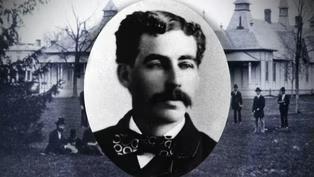
Video has Closed Captions
H.H. Holmes moves to Chicago, and a young woman later goes missing. (5m 23s)
Providing Support for PBS.org
Learn Moreabout PBS online sponsorship












Support for PBS provided by:
Chicago Stories is a local public television program presented by WTTW
Lead support for CHICAGO STORIES is provided by The Negaunee Foundation. Major support is provided by the Abra Prentice Foundation, Inc. and the TAWANI Foundation.