Chicago Stories
The Spectacle of the Midway Plaisance
Clip: 10/2/2026 | 7m 46sVideo has Closed Captions
The Midway Plaisance offered a different kind of energy at the World’s Fair.
The Midway Plaisance, a mile-long strip of land just west of Jackson Park, offered a different kind of energy at the World’s Fair. On the Midway, entertainment was the name of the game.
Problems playing video? | Closed Captioning Feedback
Problems playing video? | Closed Captioning Feedback
Chicago Stories is a local public television program presented by WTTW
Lead support for CHICAGO STORIES is provided by The Negaunee Foundation. Major support is provided by the Abra Prentice Foundation, Inc. and the TAWANI Foundation.
Chicago Stories
The Spectacle of the Midway Plaisance
Clip: 10/2/2026 | 7m 46sVideo has Closed Captions
The Midway Plaisance, a mile-long strip of land just west of Jackson Park, offered a different kind of energy at the World’s Fair. On the Midway, entertainment was the name of the game.
Problems playing video? | Closed Captioning Feedback
Where to Watch Chicago Stories
Chicago Stories is available to stream on pbs.org and the PBS app.
Chicago Stories - New Season!
Season 6 includes: The World’s Fair of 1893, Toy Town, Skyscrapers, and Home of the Irish.Providing Support for PBS.org
Learn Moreabout PBS online sponsorship(inspirational dramatic music) - [Narrator] Beyond the White City's soaring halls and serene lagoons, a very different energy pulsed along a mile long strip called the Midway Plaisance.
Here, a Harvard anthropologist curated ethnological villages, turning non-European peoples into attractions for Western audiences.
- You have the recreation of all of these little Native villages, which everybody thought was wonderful, but then in hindsight, it's really just underscoring the marginalization of many people.
- [Narrator] After a 21-year-old showman named Saul Bloom took over, entertainment ruled the Midway.
Bloom transformed the strip into a panoply of villages, cafes, concert halls, and thrill rides.
There were mosques, and pagodas, Hindu jugglers, and a traveling zoo.
- The Midway was where all the fun stuff was.
There was a lot of exciting things happening there.
It inspired a lot of imaginations.
- [Narrator] The Midway wasn't just entertainment, it was a way to earn back the fair's investment.
Visitors flocked to the more exotic attractions.
Bloom gave prime real estate to a crowd favorite, the Street in Cairo.
- With vendors, and camel rides, and donkey rides, and every day they'd have a wedding celebration of sorts.
(upbeat classical music) - [Narrator] Nearby, the Algerian village drew controversy.
Belly dancers performed what Americans quickly dubbed the "Hoochie Coochie."
The name came from a catchy tune composed by Saul Bloom.
- And he composed a tune that goes like this.
♪ Duh duh duh duh, duh duh duh duh duh duh duh ♪ - It takes on a life of its own, and over the ensuing century, that is what our collective minds default to when we think of a snake charmer.
(classical upbeat music) - [Narrator] The White City may have inspired all, but on the Midway, fairgoers could let down their guard.
(classical upbeat music) - I love all the cafes.
It'd be fun to just sit in old Vienna and have a beer.
In addition to that, you could have an ostrich egg omelet, because they had a California ostrich farm.
They did not actually cook ostrich eggs.
It was just chicken eggs.
- [Narrator] A 19-year-old escape artist was still just another act trying to draw a crowd.
- Many Americans for the first time saw Harry Houdini at the Midway.
- [Narrator] Houdini couldn't compete with a swashbuckling frontiersman named William Buffalo Bill Cody.
His Wild West show featured trick riders, stagecoach chases, and a sharp shooter named Annie Oakley.
(gun shooting) Fair organizers denied Cody a spot on the grounds, so he set up just outside the gates as a separate ticketed attraction.
It became one of the fair's biggest hits.
(horse neighs) - You'd have this very dramatic fight scene, wild and rambunctious horse riding.
- [Narrator] Cody reenacted the Battle of the Little Bighorn.
Rare film from the era shows the spectacle.
He employed Native American performers, some of whom had actually fought there.
Cody treated them with respect, but the show left a complicated legacy.
- I think Buffalo Bill's legacy can't be understated in terms of its power as a stereotype.
When you see something that's meant to entertain you, it sticks differently.
- [Narrator] The exposition celebrated Columbus's discovery of America, but it never offered a clear story about the people who were already here.
On the Midway, visitors walked through an encampment showing traditional tribal life.
Elsewhere on the grounds, the federal government's Indian Bureau operated a boarding school exhibit.
- They would be taught and they would be in a classroom setting for people to watch and see.
And so that was really the government's way of saying this is how we see Indigenous people being part of America's future.
(inspirational classical music) - [Narrator] Amid all these divisions, there was one attraction that united the crowd.
Engineer George Ferris's 264-foot steel marvel.
- The Ferris wheel, the contraption that was supposed to out-Eiffel the Eiffel Tower.
- [Narrator] Approved late and plagued by delays, the Ferris wheel didn't open until mid-June, more than a month into the fair.
But once it began to turn, it captured the world's attention.
- The Ferris wheel was twice as tall as any building most people had ever seen before.
- [Narrator] 36 cars could carry 2,000 passengers at a time, lifting them high above the Midway.
Two full rotations took 20 minutes, not a ride for the faint of heart.
- There is a story that was in a Chicago newspaper of a man who was simply terrified, really panicked.
A woman gently took off her skirt and threw it over his head to calm him down, so she saved the day and the Ferris wheel was a huge moneymaker.
That really saved the fair from financial ruin.
- [Narrator] With as many as 20,000 people a day climbing aboard the Ferris wheel, crowds at the fair soared.
Everyone from Mayor Carter Harrison to Daniel Burnham took a spin.
- The number of famous or soon-to-be-famous people walking around the fairgrounds is just incredible.
- They included future President Theodore Roosevelt, a Spanish princess, social reformer Jane Addams, and a young Chicagoan who would soon create "The Wizard of Oz."
- Imagine that you are L. Frank Baum who takes his wife and children to the fair, and it's magnificent.
And then 10 years later, you're writing a book and reaching maybe subconsciously for inspiration for this emerald city.
(inspirational classical music)
Video has Closed Captions
Burnham, Root, and Olmsted set out to design the White City. (7m 19s)
Frederick Douglass and Ida B. Wells Protest the Fair
Video has Closed Captions
Douglass and Wells object to the exclusion of African Americans from the World’s Fair. (3m 3s)
Video has Closed Captions
What was it like to visit the White City? Journey back as we imagine the World’s Fair. (5m 17s)
Video has Closed Captions
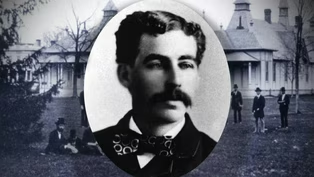
H.H. Holmes moves to Chicago, and a young woman later goes missing. (5m 23s)
Providing Support for PBS.org
Learn Moreabout PBS online sponsorship










Support for PBS provided by:
Chicago Stories is a local public television program presented by WTTW
Lead support for CHICAGO STORIES is provided by The Negaunee Foundation. Major support is provided by the Abra Prentice Foundation, Inc. and the TAWANI Foundation.