Living St. Louis
New Safari Park Coming to St. Louis in 2027
Clip: Season 2026 Episode 16 | 6m 28sVideo has Closed Captions
Endangered hoofed animals are settling into their new habitat at WildCare Park in Spanish Lake.
Endangered hoofed animals are settling into their new habitat at WildCare Park in Spanish Lake as the Saint Louis Zoo prepares to open its newest conservation campus to the public in 2027.
Problems playing video? | Closed Captioning Feedback
Problems playing video? | Closed Captioning Feedback
Living St. Louis is a local public television program presented by Nine PBS
Support for Living St. Louis is provided by the Betsy & Thomas Patterson Foundation.
Living St. Louis
New Safari Park Coming to St. Louis in 2027
Clip: Season 2026 Episode 16 | 6m 28sVideo has Closed Captions
Endangered hoofed animals are settling into their new habitat at WildCare Park in Spanish Lake as the Saint Louis Zoo prepares to open its newest conservation campus to the public in 2027.
Problems playing video? | Closed Captioning Feedback
Where to Watch Living St. Louis
Living St. Louis is available to stream on pbs.org and the PBS app.
Providing Support for PBS.org
Learn Moreabout PBS online sponsorshipAs the St.
Louis Zoo's Wild Care Park nears its public opening, pastures of tall native grasses and plants cover the grounds.
And across the 425-acre property, giraffes, grubby zebras, and horned oryx are among more than 17 species, many endangered, that are settling into their new home.
A year and a half ago, I think we had one barn complete.
Now there's 11.
And the barns, of course, are where the animals are going to go to when it's bitter cold.
Now we have buildings for our guest area popping up.
We're a little bit more than halfway through the project.
And we should be hitting the opening date of sometime in 2027.
Visitors will explore the grounds through a woodland or savanna driving safari, a walking safari, an interactive museum, and more.
And while these attractions can be exciting, another part of the park will focus solely on maintaining and growing populations of endangered hooved mammals.
What General Curator Martha Fischer and I are looking at is a private pasture that's part of the Kent Family Conservation and Animal Science Center.
Our animal population has grown tremendously.
We're up to 125 animals.
Oh wow!
17 different species.
Some of that has happened because we have incorporated new animals from other associations of zoos and aquariums, zoos, from around the country.
But the other part of the growth is that we've had 27 births from six different species.
So we're growing both by acquiring animals from the outside, but also growing from the inside as well.
Wildlife parks and zoos are not without critics.
Some animal advocates question whether zoos and safari parks provide the right environment for large mammals.
But Martha tells me conservation efforts like this are essential to maintain endangered species populations.
The St.
Louis Zoo in general is familiar with these efforts and recognized worldwide for innovative approaches to animal care.
Wild Care Park is just their latest endeavor to strengthen that conservation and research with a more open approach.
You know, it's been a lot of time working on this, but it's such a big, big project.
And getting the animals acclimated to the space and each other, that also takes time, I imagine, too.
It does take quite a bit of time for them to get used to it.
You know, this, this group is very cohesive now, this group of oryx, but they came from, I have to stop and think, but probably six or seven different zoos.
And so it was a lot to get them all here and then to introduce them to each other and introduce them to their new home.
But obviously you can tell they're very comfortable now and very satisfied with being at Wildcare Park.
Yeah, they all seem like good friends now.
They do seem like good friends.
Many major city zoos, including St.
Louis, are accredited by the Association of Zoos and Aquariums, a nonprofit focused on advancing zoos while requiring high standards of animal care and welfare.
When it comes to wild or safari themed parks, there are only 17 accredited in their system.
This can make Wild Care Park a regional draw, with an expected economic impact of nearly $660 million by 2034.
And for Spanish Lake, a community often overlooked, supporters see the project as an opportunity to bring new visitors and positive attention to an area that's experienced decades of disinvestment and population decline.
While admission cost is still unknown for city residents, it will be free for county residents.
We have the the know how to do a safari.
And really that know how comes with our animal keepers and our animal care team.
They've been all over the world.
We are in so many countries right now trying to help.
If an animal goes extinct, we have the animals on campus that if Africa or those areas are in need of those animals, then we can breed them here.
And then we can send the little ones to a to a holding area, which they may be released into the wild.
So it's just one of those things.
If you're going to have a conservation campus, we may as well have the public enjoy it.
So we decided that we would do a full blown safari for everyone to come and visit.
But long before visitors arrive, that conservation work begins with the staff responsible for helping each animal adjust to its new surroundings.
During our visit to Wild Care Park, a zoological manager gave me some insight into what this type of care really looks like.
A lot of patience.
It's taking things very slow.
That's what I've learned with this whole process is just being patient and taking it day by day and letting the animals kind of tell you what they want and whatnot.
There are some times where you think that you're going to open the doors and they're going to run out on pasture and like you're going to have to be like calm down, but they'll take two days before they go out or something that and you just have to be patient with them and let them go at their own pace and letting them kind of tell us what they need and what they want so they're kind of in charge here they always are they really are well it may seem odd to see a southern white rhino in Missouri the animals at Wild Care Park were specifically selected for our region they are hardy species used to harsh temperatures and already familiar with the zoo or safari park system.
Jamie tells me that these animals are ambassadors for their wild counterparts with potential for reintroduction into the wild, providing a unique experience for visitors when the park officially opens in 2027.
People are going to have so much fun.
And every single time you come, you're going to experience something different.
And you're going to experience some like them running and them sparring and them just laying and being lazy, but a different adventure every single time you come.
 New
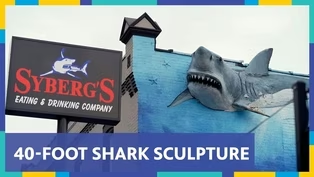
How Did a Shark Become Syberg's Mascot?
Video has Closed Captions
Clip: S2026 Ep16 | 5m 4s | The story behind the Syberg’s shark, a quirky mascot that has become an iconic symbol. (5m 4s)
 New
James Beard Award Winner Loryn Nalic
Video has Closed Captions
Clip: S2026 Ep16 | 7m 49s | Loryn Nalic earned the James Beard Award for Best Chef: Midwest. (7m 49s)
Providing Support for PBS.org
Learn Moreabout PBS online sponsorship











Support for PBS provided by:
Living St. Louis is a local public television program presented by Nine PBS
Support for Living St. Louis is provided by the Betsy & Thomas Patterson Foundation.