Living St. Louis
April 13, 2026
Season 2026 Episode 7 | 27m 30sVideo has Closed Captions
Kirkwood Train Station Remodel, What Do I Do with This? Disc Junkies, I Am St. Louis: Water Quality.
The recently renovated historic Kirkwood Train Station serves as both a transportation hub and a community gathering place. In our sustainability series, What Do I Do with This?, we tackle the stacks of media piled up in our homes, and I Am St. Louis returns to the early 1900s to solve tap water problems.
Problems playing video? | Closed Captioning Feedback
Problems playing video? | Closed Captioning Feedback
Living St. Louis is a local public television program presented by Nine PBS
Support for Living St. Louis is provided by the Betsy & Thomas Patterson Foundation.
Living St. Louis
April 13, 2026
Season 2026 Episode 7 | 27m 30sVideo has Closed Captions
The recently renovated historic Kirkwood Train Station serves as both a transportation hub and a community gathering place. In our sustainability series, What Do I Do with This?, we tackle the stacks of media piled up in our homes, and I Am St. Louis returns to the early 1900s to solve tap water problems.
Problems playing video? | Closed Captioning Feedback
Where to Watch Living St. Louis
Living St. Louis is available to stream on pbs.org and the PBS app.
Providing Support for PBS.org
Learn Moreabout PBS online sponsorshipWelcome to Living St.
Louis.
I'm Brooke Butler.
Downtown Kirkwood has a way of holding onto its history while making room for growth.
You can see it in the storefronts, in the neighborhoods, in the farmers market, and most recently, the train station.
Our stories today are all about the things our region inherits, the places, the resources, even the things in our home, and how they continue to shape how we connect with and live in our city today.
On This Living St.
Louis, a historic train station is getting new life and a fresh look for downtown Kirkwood.
The story behind St.
Louis' water, how a murky start grew into its clean, high-quality reputation, and a new way to think about the stuff piling up at home, from vinyl and DVDs, family memories, the hidden impact of streaming, and crafty reuse.
It's all next on "Living St.
Louis."
♪♪ - If you watch Nine PBS's other local fan favorite, Donnybrook, and I know many of you do, you've undoubtedly heard Alvin Reid boast about his hometown, Kirkwood.
Kirkwood's charm is hard to argue with.
There's local restaurants and bars and shopping.
They have their own adorable library.
But the cherry on top?
Kirkwood has trains.
(train bell ringing) - You hear it before you see it.
In Kirkwood, the sound of a train has been part of daily life for more than 170 years.
Kirkwood didn't just happen to be near the railroad.
It grew up because of it.
In 1853, the Pacific Railroad expanded west from St.
Louis and stopped here, and slowly, this town formed around it.
The train station was built in 1893, and all these years later, it's still the heart of Kirkwood.
- The train station is very, a vital aspect to the city of Kirkwood, and it's actually in our city logo, so it is paramount to the city, and really what makes Kirkwood, Kirkwood.
This stop is the second busiest station in the state of Missouri.
60 trains day and night pass through here, including four Amtrak trains that board 80,000 passengers from this location each year.
It brings tourists to the city of Kirkwood, creates downtown as an amenity to all residents and other residents throughout the St.
Louis area.
So almost 135 years after the first stones were laid, the Kirkwood train station is getting a glow-up.
A more than 5 million dollar renovation inside and out.
So it all starts off with doing as much research as we can on the building.
Jake Banton is with Mackey Mitchell Architects Design Team.
The Kirkwood train station is on the National Registry of Historic Places and they have the challenging job of preserving and restoring it while also transforming this 133 year old building to serve today's modern needs.
It really is an architectural gem in terms of the detailing of things.
But, you know, part of the challenge was making sure this building is performing the way we expect buildings to perform today.
But that's been tricky trying to integrate those modern systems into this historic architecture.
There's only been one renovation to this building in 1941.
So whether it's original or from the early '40s, everything in this building is old.
There's new plumbing, a new roof, two bathrooms are becoming six, and a geothermal HVAC system is making this historic site the poster child for premier modern, sustainable, and high-efficiency technology.
- We have 12 wells drilled into the parking lot, 300 feet in the ground, and that will provide the main heating and cooling for the space.
- I think probably the biggest change people will notice on the outside is this new canopy extension.
- Banton and his team are restoring and adding back original features that were removed during the renovation in 1941.
- The strategy that we took after having done all that research was we wanted to restore the exterior of the building back towards its 1893 version.
The original canopy structure was made out of wood, but proportionally, this matches what was originally built.
And of course, now we're using steel to make sure it lasts.
- How people used space in 1893 is very different from today.
And some things are best left in the past.
- Folks come into the station now, there's a big open waiting room.
There's a front desk to greet you when you come in.
But back when the station was first built, the interior looked much different.
There's actually two waiting rooms.
There was a men's waiting room and a women's waiting room.
- So like if a husband and wife came, they'd have to go wait in different waiting rooms?
- It was a different time.
You know, I think it's hard for us to sort of, you know, contemplate that today.
I don't know.
Maybe some folks would enjoy that.
If all goes well, everyone can catch a train together from the new old Kirkwood train station in late summer 2026.
Rolling?, physical media is back And I'm not just talking about vinyl, but CDs, DVDs.
Honestly, as a millennial, I have mixed feelings about things from the '90s being coined as vintage, but I'm here for it.
There's something satisfying about things not requiring Wi-Fi or a password reset.
And there are plenty of places in St.
Louis who I think would agree.
- Records, tapes, CDs, DVDs, musical instruments, anything music or movie related.
- Jean Haffner founded the Record Exchange in 1977 for a very simple reason, he liked it.
Nearly 50 years later, that passion is still paying off.
The store has evolved over time, once expanding to nine locations and now operating out of a single 10,000 square foot space on South Hampton, inside the former Buder Library.
These days, Jean runs it alongside his daughter and business partner, Jena.
We've definitely had a big resurgence of like younger people coming.
And there's a lot of young people who I have learned enjoy coming here because they want to find something weird.
They are looking for something, you know, unique and maybe bizarre to some degree.
And we have it.
It's interesting to watch people as they come in.
Some people yell like, "Wow!"
Other people will be in the store for 10 minutes and find something they've been looking for for 20 years and they'll yell.
In an era dominated by streaming platforms, you might expect physical media to be in a steady decline, but the data tells a more nuanced story.
While DVD and Blu-ray sales are still down overall, the rate of decline slowed to just nine percent in 2025 compared to drops of more than 20 percent in previous years.
And vinyl sales surpassed $1 billion in 2025, marking the 19th consecutive year of growth.
Why?
Three main reasons.
One, subscription fatigue, the cost and overwhelming amount of choices from multiple streaming platforms.
Two, content fragmentation, where content is spread, removed, or altered across multiple platforms.
Three, quality, the reliability and tangible connection to media also drives consumers, particularly Gen Z, to seek ownership for a more intentional viewing or listening experience.
- Now I think it makes perfect sense.
They're looking, you know, for what isn't popular.
They're looking for what isn't easy to get.
They are looking for the hunt, you know.
Some people don't even listen to records when they buy them.
They're buying them to display them in their house, and that's totally fine, you know.
That's how they're enjoying them.
♪♪ - What about deterioration?
- CDs are the problem.
CDs came out in 1983 or thereabouts, and they guaranteed to take over the vinyl situation, but that didn't happen for two reasons.
Vinyl's still the best sound because you get the full sound with a record.
You don't get the full sound with a CD.
You get a sampling sound.
So in that respect, vinyl will last forever as long as you take care of it.
But CDs, on the other hand, will separate one of these days.
How soon, I don't know, but they will separate because they're a laminated product.
So in your opinion, you think vinyl is the thing to outlast all of the other trends.
It will.
Yeah.
As long as you take care of it.
Yeah.
You're preserving history in a way.
Oh, sure.
Yeah.
The building and everything that's in it.
Yeah.
What do you feel about that responsibility?
Well, it's a responsibility, but it's also a lifestyle.
You know, I've grown up with it, and it's what I want to do.
People ask me, "How can I do this 50 years and still enjoy it?"
It's just what I want to do.
It's where I want to be, what I want to do, so... - Yeah.
- So, physical media is having a moment, but here's the question we don't typically ask ourselves when deciding to put on a record or yell at our Alexa.
What is actually better for the environment, physical media or streaming?
I'll start with the most annoying but most honest answer.
There isn't a simple right or wrong choice.
Research suggests streaming typically has a lower environmental impact over buying a disc.
That's because you're avoiding the materials, plastics, manufacturing, packaging, shipping, that kind of stuff.
Of course, that's only part of the story.
Streaming isn't invisible.
It runs on a whole chain of stuff, data centers, networks, routers, and your screen.
And here's where it gets spicy.
Streaming is so convenient that we often watch or listen to more.
When convenience increases consumption, we can wipe out the benefits.
It's a well-known problem.
The efficiency makes us use more effect.
One major study found streaming is better until it leads to about four times more viewing.
Then the climate impact flips.
And in today's binge-watching culture, that's super easy to do.
But here's the part I can't stop thinking about.
Why is this on us to solve with a remote control?
We're asked to make responsible choices inside of a system that's designed to keep us watching.
Autoplay, higher default resolutions, bigger files, and so much more content than we will ever be able to consume in a lifetime.
Sure, our habits matter, but so do the choices these platforms make.
How efficient their infrastructure is, what energy they use, and whether they're designed for sustainability or just maximum watch time.
So what do we do with this?
Here are four simple things to be mindful of.
Turn off autoplay.
Lower your resolution, especially when you're media multitasking.
Use Wi-Fi instead of mobile data.
And if you re-watch or re-listen to something a lot, downloading can reduce repeated data transmission.
And if you wanted to explore other options to streaming but aren't quite ready to dedicate the shelf space, I know the perfect solution.
I don't know who still needs to hear this, but libraries are the best.
There are countless benefits.
And when it comes to home media, you can check out movies, music, just like you've always been able to.
No subscription required.
Well, except your library card.
But some of the most important media we own isn't entertainment at all.
It's personal.
The family photo albums, home movies.
And here at the library, there's an initiative to keep those memories alive.
Memory Lab is your one stop DIY center to convert all of your memories into digital assets.
You can digitize photos, you can digitize books, you can digitize videos of all sorts, camcorders.
I love the vacation slides.
Yes, I want to have a cocktail party and invite everyone over to look at my vacation slides, but it's so much easier to put them on social media and share them via email.
So we're going to take that and pop it in this tray.
So the memory lab technically encompasses two separate spaces, the personal history recording studio and then the scanning and digitizing studio, which is where we are presently.
And people can just come in here and kind of it's self serve, like it's they figure it out on their own.
We do kind of like introduce people to how everything works.
We'll sit down and show them.
We've got user guides and binders at every station, give people the tools.
And then once you get started, it's very, very easy.
I have like a 95-year-old friend who can use the slide digitization.
One of our core goals here is to get people computer literate, as well as literacy in books and writing.
We're one of the largest genealogy departments in the country.
So we have the third largest collection in the United States for genealogical materials.
We help people connect to what's most important to them, their family, right?
It's not just like putting a family tree together.
It's not just putting names on there.
It's actually preserving memories.
Digitization, there are two factors to it, right?
So you're talking preservation, so allowing you to freeze it in the state that it's in.
And then you're also talking about accessibility.
So if you have the only copy of a photo in your closet, right, and that burns up, it's not accessible anymore.
Here's an existential problem.
VHSs, just like us, VHSs die too.
Nothing lasts forever, not even November rain, right?
So you have VHS that 10 to 25 years down the road starts to demagnetize.
So you're gonna see a loss in quality.
And then eventually that keeps spreading and you're no longer able to view those things.
And I bet everyone who's watching this has stored them in probably their basement, attic, shed.
I'm not judging, by the way, judgment-free zone here.
That's 10 to 25 years if it's stored correctly.
So imagine the quality of this material.
So I'm telling people, "Hey, you didn't take good care of it yesterday.
Go ahead and digitize it and then take bad care of it tomorrow.
So throw it away, recycle it, get rid of it.
Don't be burdened by these things."
- But then the question is, when we're dead and gone, who cares?
Why should we digitize these memories?
- Now this is where I get emotional because we're talking about history and purpose, right?
So we don't know where we're going until we know where we've been.
Individual history matters way more than ever.
It's not just about the elites and about military and conquest.
It's about everyday life.
Your descendants down the road, they may want to see you eating ice cream 100 years from now.
If it's a sweet meme, you can probably find that again.
But if it's not a sweet meme, let's say it's my nine-year-old daughter enjoying her life.
How about we print it off?
So digitizing your media is one step, but ultimately, you're still stuck with the physical materials.
Tapes, discs.
And sure, recycling is an option.
There's a lot of electronic recyclers around St.
Louis.
But another option, creative reuse.
What is leftovers, et cetera?
- It's a conglomeration of everything in your house.
- Yeah.
- We are a resource center and we take in household and industrial discards.
I'm not a crafter, so I look at all of this stuff and say, oh, it's interesting.
What do you do with it?
Hey, that's the name of the show.
That's exactly right.
Maybe you were expecting to see a more electronic deconstruction of how home media can be recycled.
But hear me out.
Think of all the crafty ways you can reuse scratched up records and CDs or demagnetized tapes.
And similar to Sandy, I'm not the most crafty person, but Leftovers Etc.
allows those Pinterest users, teachers, artists, and maybe most importantly, kids, to use their imagination, learn new ways to reuse items, keep things out of the landfill, and all for a very low price.
And we have craft classes, we have crochet classes, we have a scientist that comes in here and teaches science classes.
The things that we see most of is school supplies, flower arrangements, books, pantry.
I don't know what happened and why we got so many trophies, but we have a ton of trophies right now.
If your child at school comes home and they have made a telescope out of a Pringles can, their teacher got the Pringles can from here.
Okay?
Because they'll walk in here and then they'll need 60 to 70 to 80 Pringles can.
Well, we have 60 to 70 to 80 Pringles can.
[laughter] We've probably got 5,000 toilet paper rolls in the back in the storeroom right now.
Oh my gosh.
Serious.
Seriously.
I'm serious.
Yeah.
It's really just a tremendous amount of fun.
We all have a good time here.
Oh my gosh.
This is going to replace Hobby Lobby for me.
And I'm like, totally.
You're never going to go to Hobby Lobby ever again.
And we have birthday cards, get well cards, sympathy cards, invitations to parties, thank you notes, and we sell those only for 25 cents a piece, brand new.
It's fun to help out, you know, the teachers especially.
This represents probably about one week of contributions.
So much.
Where do you even start?
We start way over there.
Way over there.
At one end and make your way to the other.
This is a very unique place and it does take a lot of effort and a lot of hard work from a lot of good people to keep it going.
Have you done some cool crafts?
Um, no, not really.
No?
Do you just like looking at all the stuff?
Yeah.
There's a lot of cool stuff, isn't there?
Yes, there is.
People will walk in here and look around and say, "Oh my heavens, I don't have a clue what I'm looking for.
I don't have a clue what I want."
And I'll always tell them, "Go look at the idea zone."
And because all of that is made by kids.
That you're allowing people to be creative and use their imagination and you're saving things from the landfill.
And we're keeping everything out of the landfill.
We weigh everything in that people come in, everything out that comes out.
It started out small and it just keeps growing.
What do I say?
And I mean... Because people love it.
Well, because I'm not going to turn anything down.
Very little will I turn down.
You know, I mean, like I said, I don't want trash.
I don't want clothes.
And we, you know, but other than that, everything in your house is game as far as we're concerned.
Thanks for watching this episode of What Do I Do With This?
And I hope you have a better understanding of what to do with your home media.
There's record stores or thrift stores, the library, or maybe even getting a little crafty.
What do you do with your home media?
Do you reread books?
I don't reread any of my books at home, but I still like 'em 'cause they're pretty to keep on the shelf.
Well, let us know at Nine PBS.org/whadoidowiththis.
♪♪ - I'm Veronica Mohesky, and I'm here with Jody Sowell, President of the Missouri Historical Society.
So, Jody, I was always told that St.
Louis has the best tasting water, but I hear that wasn't always the case.
- Not at all.
In fact, if St.
Louis could introduce itself, it would probably say I'm the place whose drinking water was once more solid than liquid.
That's because before we cleaned up the water supply for the 1904 World's Fair, we pretty much just pulled everything straight out of the Mississippi, water, mud, everything, and put it into our drinking glasses.
In fact, Mark Twain once said, "If you let a glass of St.
Louis water sit long enough, you could separate land from water, just like in Genesis."
So what did St.
Louisans think of this water they were drinking?
Well, a lot of St.
Louisans loved it.
In fact, some St.
Louisans were said, if they were going to other cities that happened to have clean water supplies, they would take jars of Mississippi mud with them so they could mix it into their water whenever they were somewhere else and feel like they were back home in St.
Louis.
Yikes.
Well, we're going to get into how they fix this problem in this segment, but I do have a question for you.
Does St.
Louis have the best tasting water?
It tastes pretty great to me, even better when you know what it used to taste like.
Absolutely.
Thank you, Jody.
Let's take a look at the segment.
The quality of St.
Louis water has certainly fluctuated over the years.
In the early 19th century, late 18th century, people were drinking their water out of springs and cisterns.
It was coming out of the ground and it was pretty clear.
But as the city got bigger and bigger, they couldn't just use that water, so they had to start taking water from the Mississippi.
Amanda Clark is a public historian at the Missouri Historical Society.
That's when people started drinking this murky brown water, and if you lived here, you were used to it, and your body was used to it, and it was something that was, you know, people thought it made them healthier, actually, to drink that kind of water.
Author Mark Twain has many quotes about St.
Louis' water, but he once said, "Every tumblerful holds an acre of land in its solution."
St.
Louisans of the time seemed to enjoy the taste though.
If they went to a new city that had clearer water, they could mix some of that Mississippi mud with that clearer water so they didn't lose the benefits of the mud back in St.
Louis.
Our drinking water was often a surprise to visitors.
If you hadn't been here before, it would have been a shock to your system in many ways.
It would have been a visual shock.
It would have been a taste shock.
And on your body for a couple of days, it took a few days to adjust to this new water.
Unclean water, of course, also spread diseases like cholera, dysentery, and typhoid.
But there were other unusual problems with the water, too.
But then there were things that made their way from the Mississippi River into the water system that were a problem, such as eels.
Eels in the late 19th century, early 20th century, eels were a pretty regular problem in the pipes.
They would find them in toilets.
They would find them in sinks.
The city was working on modernizing its water system in the late 1800s with additions like the standpipe water towers.
So the water towers in St.
Louis are these gorgeous architectural pieces, right?
But they were at the time the forefront of technology.
The first one was built was the Grand, the one that's on North Grand.
It's a big Corinthian column.
And that is actually from our earliest water movement.
Right.
So we're not doing water purification yet, but moving water through the city.
Soon after, two more standpipe towers were added, the Bissell Street and Compton Hill Water Tower.
But the towers only helped move the water, which was still murky.
Other river cities would have faced similar issues, but St.
Louis' problem was made worse in 1900 when the Chicago River was permanently reversed.
Which meant its raw sewage was then being pumped into the Mississippi River and coming down towards St.
Louis.
So that increased the need for purification and cleaning the water.
The water quality issue became increasingly important as the 1904 World's Fair loomed closer and closer.
So the great thing about the World's Fair, you know, it was something to showcase all kinds of technologies.
And here we had a local technology that we could show off, which was just clear water.
You know, when they were planning, you know, making plans for the fair and making these designs for big, beautiful buildings and these waterfalls, you know, the waterfalls couldn't be shooting mud through them.
That would be a totally different vibe than what they were going for.
Fortunately, a local scientist named John Wixford developed a process to separate sediment from the water.
And so they had to, with just weeks to go before the fair opened, they were still trying to figure out how to clear the water, which is when the Wixford process finally came through.
They figured it out and that's when we had clear water.
Wixford was hailed as a hero for his work and other cities learned from our success.
So the Wixford process is still the base that we use now, which is chemical separation of the sediment in the water and the clear.
So it's actually really interesting.
And it's an example for other cities.
And our water purification is actually one of the things that St.
Louis has that it can say, "Hey, we figured this out."
And then other cities were able to modernize after that.
And St.
Louis is known for having great tasting water to this day.
Not just people that come in and test it, but you come across a lot of chefs and people that, you know, we have a big food scene here.
And a lot of people say that they, and they credit the good water here in St.
Louis for the good food that they are able to make.
But it has to be clarified, the water we drink now doesn't come from the Mississippi, it actually comes from the Missouri.
So just one more thing that we can say in that list of things we should be really proud of and that we can call our own.
- And that's Living St.
Louis.
What's your favorite thing to do in Kirkwood?
The shops, the restaurants, the farmer's market?
Let us know, we love hearing from you at Nine PBS.org/LSL.
I'm Brooke Butler, thanks for joining us.
♪♪ - Living St.
Louis is funded in part by the Betsy and Thomas Patterson Foundation and the members of Nine PBS.
♪♪

Video has Closed Captions
Clip: S2026 Ep7 | 5m 54s | Prior to the early 1900s, St. Louis’ tap water was more mud than water. (5m 54s)
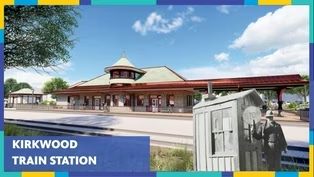
Kirkwood Train Station Remodel
Video has Closed Captions
Clip: S2026 Ep7 | 4m 26s | Since 1893, the historic train station has served as both a transportation hub and gathering place. (4m 26s)
Providing Support for PBS.org
Learn Moreabout PBS online sponsorship









Support for PBS provided by:
Living St. Louis is a local public television program presented by Nine PBS
Support for Living St. Louis is provided by the Betsy & Thomas Patterson Foundation.