Living St. Louis
October 19, 2026
Season 2026 Episode 16 | 28m 13sVideo has Closed Captions
Syberg’s Shark, WildCare Park, Loryn Nalic: Best Chef in the Midwest, Adrienne Outlaw, Plastic Sculp
The story behind the quirky Syberg’s restaurant shark; endangered hoofed animals settle into their new habitat at WildCare Park; chef Loryn Nalic draws national attention; and Adrienne Outlaw transforms discarded plastic materials into sculptures that inspire joy and encourage conversations about consumerism.
Problems playing video? | Closed Captioning Feedback
Problems playing video? | Closed Captioning Feedback
Living St. Louis is a local public television program presented by Nine PBS
Support for Living St. Louis is provided by the Betsy & Thomas Patterson Foundation.
Living St. Louis
October 19, 2026
Season 2026 Episode 16 | 28m 13sVideo has Closed Captions
The story behind the quirky Syberg’s restaurant shark; endangered hoofed animals settle into their new habitat at WildCare Park; chef Loryn Nalic draws national attention; and Adrienne Outlaw transforms discarded plastic materials into sculptures that inspire joy and encourage conversations about consumerism.
Problems playing video? | Closed Captioning Feedback
Where to Watch Living St. Louis
Living St. Louis is available to stream on pbs.org and the PBS app.
Providing Support for PBS.org
Learn Moreabout PBS online sponsorshipWelcome to Living St.
Louis.
I'm Brooke Butler.
This week we're in Blackburn Park in Webster Groves.
As you know, St.
Louis has no shortage of extraordinary destinations across our region, but sometimes it's the everyday places that become the most meaningful.
A neighborhood park, a local restaurant, or a community institution.
These are the places where identity truly takes root.
On This Living St.
Louis, how a restaurant mascot became a local landmark on and off the menu.
We check in on the progress of the wild care park and their newest residents.
Meet the James Beard award-winning chef making Balkan cuisine a St.
Louis staple.
And discover an artist turning everyday plastics into powerful sculptures.
It's all next on Living St.
Louis.
♪♪ - Have you ever met someone with an irrational fear of sharks?
Well, I'm one of those people.
And while most can trace their fear back to a childhood viewing of Jaws, mine started in a very different way.
1983, squeezed between my parents in the front seat of the Caprice Classic, driving down Gravois Road.
Of course, I can't exactly remember the first time that I noticed the giant cyborg shark floating above me.
But once I did, it became a dreaded part of the ride home.
Over four decades later, I decided to face my fears and get the story behind the iconic landmark.
♪♪ Walking in here today to do this interview, there's some customers downstairs.
They've been our customers for 46 years.
You know, and we've met so many wonderful people, a lot of friends.
You know, a lot of our customers become our friends.
When his parents, Richard and Sally, opened the original Syberg's restaurant on St.
Patrick's Day in 1980, 18-year-old Kirk started out in the kitchen.
It was a big family affair.
It was six kids and my mom and dad, and we had an aunt and a grandma working here.
And, you know, there was apartments where we're standing today.
My brothers and I lived upstairs and we never ate up here.
We had the restaurant downstairs, so we didn't think we had a foosball table in our kitchen up here.
So, yeah, it was a party for sure.
So how did a shark become the symbol of a family-owned restaurant in our Midwestern city?
What happened was Rick, he was a neighbor that we grew up in, in the neighborhood.
Rick Monrodis was his name.
He was a customer and he was an artist.
He was a very good sculptor and the first shark we ever purchased, he brought it in and just put it up there just like some of the other stuff we have on the walls.
There's no rhyme or reason to it.
It's just let's put a shark up on a wall.
The unique thing about the head that he made, it's like fiberglass, but he actually put real shark teeth in the mold.
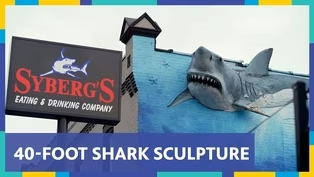
So then Rick Monrodus wanted to maybe get some publicity for himself as an artist, so he created this, you know, 40-foot shark.
He did the head and then he did the tail, and then he painted a body in between the two, and then he did a big mural out on the wall, and I mean, we definitely got a lot of publicity out of it.
The global success of Steven Spielberg's 1975 film, Jaws, had, for better or worse, given sharks the ability to swim around rent-free in people's minds, and Sybergsdecided to lean in to their accidental mascot.
My brother had come up with the idea, "Let's start serving shark."
Well, you know, nobody eats shark, nobody had eaten shark.
Sybergsbegan offering shark steaks, shark bites, and even shark tacos, with a side of irresistible advertising.
We had bumper stickers made, and it was "Get Even, Eat a Shark."
But for Cybergs, serving shark meat wasn't about the revenge.
Shark was a bycatch, so they were fishing for other fish, and the Mako shark would get on the line, and they would die, so they were just throwing them out.
I mean, our customers loved it.
It was really a good product for us, you know, very lean, you know, very tender.
By the end, we were serving 60,000 pounds of shark a year.
- But just like a film franchise with increasingly disappointing sequels, the enormous consumption of the shortfin Mako shark was deemed unsustainable.
The species was not only being overfished, but it is also slow to reproduce and often does so only once or twice in its lifetime.
So even accidental hookings or bycatches were banned by U.S.
federal law in 2022.
So we don't serve it anymore.
And, you know, it's probably at the end of the day, it's probably a good thing.
The Sybergsfamily now has several restaurant locations, all sporting at least one signature shark in the dining room.
But none can compare with the 40-foot beast that has been cruising above Gravois Road since 1982.
We were living upstairs and the shark tail got stolen off the wall.
Come to find out some some girls had saw it at a party and it was a conversation piece for whoever took it.
And we found out who it was and got it back from them.
So it worked out good.
And when we put it back up there, yeah, so there was a little bit of history there.
You know, not a lot of people know that story.
As the original Sybergsexpanded and added a patio, the shark and the mural see that it swims in got its own updates.
Rick Monrodus redid the mural a few times and then Ray Harvey, another muralist in St.
Louis who's locally known well, he's come back and he's redid it like when we put the new awning out there.
It's been a great piece of history for us.
We still put the shark on all of our logos and hats and, you know, and everybody knows us by it.
I still have kids, you know, talk about today.
They drive up and down Gravois just to see the shark on the wall.
As for me, I've made my peace with the Sybergs shark.
It was never personal.
For many St.
Louisans, some of our first encounters with wildlife happen at the St.
Louis Zoo.
But now, a new adventure is unfolding in Spanish Lake, where Wild Care Park is welcoming endangered animals and eventually, the public.
As the St.
Louis Zoo's Wild Care Park nears its public opening, pastures of tall native grasses and plants cover the grounds.
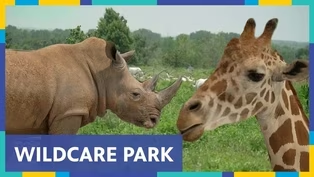
And across the 425-acre property, giraffes, grubby zebras, and horned oryx are among more than 17 species, many endangered, that are settling into their new home.
A year and a half ago, I think we had one barn complete.
Now there's 11.
And the barns, of course, are where the animals are going to go to when it's bitter cold.
Now we have buildings for our guest area popping up.
We're a little bit more than halfway through the project.
And we should be hitting the opening date of sometime in 2027.
Visitors will explore the grounds through a woodland or savanna driving safari, a walking safari, an interactive museum, and more.
And while these attractions can be exciting, another part of the park will focus solely on maintaining and growing populations of endangered hooved mammals.
What General Curator Martha Fischer and I are looking at is a private pasture that's part of the Kent Family Conservation and Animal Science Center.
Our animal population has grown tremendously.
We're up to 125 animals.
Oh wow!
17 different species.
Some of that has happened because we have incorporated new animals from other associations of zoos and aquariums, zoos, from around the country.
But the other part of the growth is that we've had 27 births from six different species.
So we're growing both by acquiring animals from the outside, but also growing from the inside as well.
Wildlife parks and zoos are not without critics.
Some animal advocates question whether zoos and safari parks provide the right environment for large mammals.
But Martha tells me conservation efforts like this are essential to maintain endangered species populations.
The St.
Louis Zoo in general is familiar with these efforts and recognized worldwide for innovative approaches to animal care.
Wild Care Park is just their latest endeavor to strengthen that conservation and research with a more open approach.
You know, it's been a lot of time working on this, but it's such a big, big project.
And getting the animals acclimated to the space and each other, that also takes time, I imagine, too.
It does take quite a bit of time for them to get used to it.
You know, this, this group is very cohesive now, this group of oryx, but they came from, I have to stop and think, but probably six or seven different zoos.
And so it was a lot to get them all here and then to introduce them to each other and introduce them to their new home.
But obviously you can tell they're very comfortable now and very satisfied with being at Wildcare Park.
Yeah, they all seem like good friends now.
They do seem like good friends.
Many major city zoos, including St.
Louis, are accredited by the Association of Zoos and Aquariums, a nonprofit focused on advancing zoos while requiring high standards of animal care and welfare.
When it comes to wild or safari themed parks, there are only 17 accredited in their system.
This can make Wild Care Park a regional draw, with an expected economic impact of nearly $660 million by 2034.
And for Spanish Lake, a community often overlooked, supporters see the project as an opportunity to bring new visitors and positive attention to an area that's experienced decades of disinvestment and population decline.
While admission cost is still unknown for city residents, it will be free for county residents.
We have the the know how to do a safari.
And really that know how comes with our animal keepers and our animal care team.
They've been all over the world.
We are in so many countries right now trying to help.
If an animal goes extinct, we have the animals on campus that if Africa or those areas are in need of those animals, then we can breed them here.
And then we can send the little ones to a to a holding area, which they may be released into the wild.
So it's just one of those things.
If you're going to have a conservation campus, we may as well have the public enjoy it.
So we decided that we would do a full blown safari for everyone to come and visit.
But long before visitors arrive, that conservation work begins with the staff responsible for helping each animal adjust to its new surroundings.
During our visit to Wild Care Park, a zoological manager gave me some insight into what this type of care really looks like.
A lot of patience.
It's taking things very slow.
That's what I've learned with this whole process is just being patient and taking it day by day and letting the animals kind of tell you what they want and whatnot.
There are some times where you think that you're going to open the doors and they're going to run out on pasture and like you're going to have to be like calm down, but they'll take two days before they go out or something that and you just have to be patient with them and let them go at their own pace and letting them kind of tell us what they need and what they want so they're kind of in charge here they always are they really are well it may seem odd to see a southern white rhino in Missouri the animals at Wild Care Park were specifically selected for our region they are hardy species used to harsh temperatures and already familiar with the zoo or safari park system.
Jamie tells me that these animals are ambassadors for their wild counterparts with potential for reintroduction into the wild, providing a unique experience for visitors when the park officially opens in 2027.
People are going to have so much fun.
And every single time you come, you're going to experience something different.
And you're going to experience some like them running and them sparring and them just laying and being lazy, but a different adventure every single time you come.
St.
Louis is home to some delicious dishes like toasted ravioli, St.
Paul sandwiches, and gooey butter cake, just to name a few.
But one local chef is gaining national recognition for her Balkan dishes like cevapi and pide.
I spoke with Chef Loryn Nalic about what winning a James Beard award means for her restaurants and for St.
Louis.
Even on a Monday, the Balkan Treat Box in Webster Groves is busy.
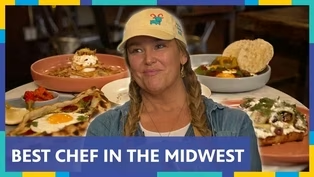
But it's no surprise, considering one of the owners is this year's best chef in the Midwest.
And the winner is Loryn Nalic from Balkan Treat Box.
A James Beard Award is one of the highest honors a chef can earn.
Loryn Nalic of the Balkan Treat Box and Telva at the Ridge is the first St.
Louis chef to win this category in nine years.
No, it was shocking.
It's a huge deal to be, have a cuisine recognized at that level.
Her journey to become one of St.
Louis' most well-known chefs is a love story.
Edo Nalic, Co-Owner, Baker, Loryn 's Husband, "It was 2006.
I was working at the Bosnian restaurant at the Bevo Mill neighborhood.
That's where the largest Bosnian concentration was.
And she was working for the Cisco food service.
She was selling on the restaurant.
That's how we met."
That's Edo Nalic, co-owner, baker, and Loryn 's husband.
He was born in Bosnia and helped introduce Loryn to Balkan food.
"Food is comfort.
He was missing a lot of that at the time that we met and I took an interest in learning some things just to be able to kind of make him comfortable and happy and as I got into it I started cooking with his family and he let me know if it was good or not.
She made me very happy.
Edo came to the U.S.
in 2001.
He and his brother Emir were only children when the Bosnian War began in 1992.
He says their hometown became dangerous early on in the war.
We all just woke up one day and fled.
We ended up in Slovenia and then in Germany.
But after a few months and, you know, living in different sheds and basements and, you know, you kind of realize, well, there's no stopping to this, unfortunately, you know.
And then you hear some of your neighbors got killed, your friends.
Yeah, very traumatic.
Emir is also a co-owner of the restaurants.
In 2021, he came to St.
Louis, which has the largest Bosnian population outside of his home country.
This is home now.
I think a huge part of that is having these restaurants where you get to tell your story and you get to invite people in and show them what you do.
Around 2012, Loryn and Edo began discussing opening a food truck with Balkan Cuisine.
You know, I'm coming up with like a menu and he was like shaking his head from across the table and I'm going like, what?
And he was like, you don't know.
Like you have to go there and experience it for yourself.
And I have said I've never I'd never left the country before and I thought he was crazy.
But it ended up being and continues.
- I knew she was crazy enough to do it.
(laughing) - In 2013, Loryn went to stay with Edo's family in Bosnia and Herzegovina on her own for about a month.
- We had been married at that point for like six years, but I had never met his parents.
And so like flew into Bosnia and like met them for the first time, you know, kind of immersed myself in as much as I could.
- Traveling with Edo's brother, Emir, Loryn spent weeks learning from home cooks, bakers, and restaurant owners all over the Balkans.
When she returned to St.
Louis, she began developing a menu, but says the most important thing she brought home wasn't a recipe.
It was Bosnian hospitality.
- There was a level of hospitality within a community and a culture that I had never experienced before.
And it helped me to understand, you know, what needed to happen within the four walls of whatever we were opening, whether that was a truck or a restaurant.
It was important that that was something that people felt 'cause it was so overwhelmingly beautiful.
- The Balkan Treat Box Food Truck opened in 2017 and the restaurant in Webster Groves in 2019.
Both serve Balkan food staples with Loryn 's spin on them.
The menu features items like pide, lahmacun, and cevapi.
Most items are also served on somun, a traditional wood-fired flatbread with roots in Sarajevo, dating back centuries.
Staying true to the bread's origins, the restaurant bakes its salmon in a wood-burning oven, both at the Balkan Treat Box restaurant and even in the food truck.
- And, you know, there was some backlash from friends and people in the industry being like, "Why?
You know, you can have it easier."
But Loryn was very determined that, you know, we do it right if we're gonna do it.
The Nalic's restaurants have seen major growth over the last several years.
In 2022, Balkan Treat Box was added as a vendor in Energizer Park.
Their most recent venture is Telva at the Ridge, which serves Balkan-inspired coffee and brunch.
It's in the same building as Rolling Ridge Nursery and opened in 2023.
When we opened Balkan, I really thought we would be open for breakfast, lunch and dinner.
It really proved that that was not possible.
There was this whole other part of like the experience that we could offer here that we can't do at Balkan and coffee culture is huge in Bosnia and it's it slows you down a little bit.
You know, I always say Balkan's a party and this place is like more zen chill.
Recognition from national media outlets like Food and Wine and Bon Appetit followed the restaurant's success and spread the word about her cuisine even more.
Loryn has also been nominated several times for James Beard Awards and this June she was named the Best Chef in the Midwest.
When her name came up as winner I blacked out for five seconds or something.
We were jumping and hugging and then I remember like all of us, I'm getting goosebumps right now, walking to that stage like such an amount of pride and happiness and you know it's like it feels like all the hard work that everyone's putting in that's payoff.
That thing was not coming off my neck for like a long time.
She wore the medal everywhere.
Everywhere, I took it with me everywhere.
It was like because I can, like why not?
Loryn 's win came around the same time that Bosnia captured international attention in the 2026 World Cup.
So she says the honor felt especially meaningful.
And it was like amazing for me of course to hear like how proud they were and to have that alongside with the all eyes on Bosnia at the time like it felt really good.
It was really a lot of fun.
Many people visit Balkan Treat Box for its award winning food.
But the restaurant is also part of a larger St.
Louis story.
The Bosnian community has become an integral part of this region's identity.
And for many, Nalic's success is a source of pride that extends far beyond the menu.
I think it's a pretty big deal for St.
Louis in general.
I always thought she deserves it, so now you have the stamp of approval, I think.
I like to make people happy with food.
I think it's one of the great joys of my life.
Art has a way of helping us see ordinary things from a new perspective.
For St.
Louis artist Adrienne Outlaw, that perspective begins with trash.
Her vibrant sculptures invite viewers to consider consumer habits while sparking joy through unexpected materials.
I think of myself first and foremost as a sculptor, but I'm a socially engaged sculptor.
So everything with my work involves people.
So it's not just me being isolated in the studio trying to make something that I find aesthetically pleasing.
It is also about me meeting people, getting them involved, giving them an opportunity to help really shape the piece.
And Adrienne means that quite literally.
What you're looking at here is one of two 10 feet by 17 feet geodesic domes.
Called Double Bloom, it's one of the latest projects through Adrienne's national artist-led initiative that partners with river cities to create large-scale sculptural environments.
Made from more than 100,000 pieces of recycled plastic, the project was funded through community partnerships and brought to life by hundreds of volunteers who spent months collecting, sorting, and assembling the material piece by piece.
So what I'm doing with my work is recontextualizing plastic, meaning I am taking this very familiar material.
I mean, it's a lot of fun to run up to this and say, like, that's the orange juice I drink, or my mom buys that kind of milk.
And so it brings you into this familiarity with it.
But when you start collecting it at home for the work, which is part of this whole body, and you start seeing those caps pile up in your house, and then you bring them to the studio, and every single little contribution adds up.
So when you see it all together, you really start understanding the environmental impact that our consumption patterns have on the world.
You know, in here, you're just kind of looking at the white ceiling.
But as the sun sets and the sky turns, the piece is constantly changing.
It is absolutely in concert with its environment when it's outside.
- The double-bloomed domes were recently showcased at the 2026 Earth Day Festival in Forest Park, and they can be licensed for temporary exhibitions.
But the larger goal of Make Waves is to help communities create their own public art.
Cities like Nashville and Grand Rapids have already developed sculptures built from locally collected material and community involvement.
And not just in dome form.
If you've been to Lambert Airport recently, you've probably seen another one of Adrienne's creations called Sea Change.
For a long time, I was working with issues of global consumption, but on a much higher intellectual level.
And I kept thinking, I'm just talking to the choir.
What is this actually doing for the greater good?
The changing factor in my work is I got to go to Singapore in 2019 and spend the summer there with my family.
And I worked with some socially engaged artists there.
And like there's this brilliant piece of work by Ernest Goh, and he created this gorgeous dinner table.
And in the middle was sand and microplastics.
And you were invited to sit down at the dinner table and pick out microplastics that they had literally just gotten from the beach.
And I and then I came back and being relatively new to St.
Louis, I just then kind of like put that together with the Mississippi because the Mississippi is a watershed for 40 percent of the United States.
I mean, it is wild the impact we have in St.
Louis to stop this.
And so the more research I did, I was like, if we could get this stuff off the streets, that means our streets are more attractive.
Our water is cleaner.
We're not sending it down to the Gulf of Mexico and out to the ocean.
I want to really give credit to younger people and particularly children.
I think it was about 2020, my daughter was in middle school and she was mad as a hornet.
And she looks at us and she says, you know, y'all have just created a climate disaster for the world and how am I supposed to trust any adult?
I was like, oh my God.
Do what you can as you have time.
If you are stressed out and you've got to feed your family and you've got ten minutes to do it and you need to pick up some food and it comes in a styrofoam container, that is not the time to yell at the restaurant or berate yourself for doing that.
That is the time to just eat and try to be a good human.
The time to do all that other stuff is as you've got the mental bandwidth.
And if that means you just slowly start collecting your plastic and make something awesome, if that leads to something bigger, even better.
But don't try to take it on all at once.
Just do what you can when you can without beating yourself up.
And that's Living St.
Louis.
Where are the extraordinarily ordinary places that you like to visit in your neighborhood?
Let us know.
We love hearing from you at ninepbs.org/lsl.
I'm Brooke Butler.
Thanks for joining us.
♪♪ - Living St.
Louis is funded in part by the Betsy and Thomas Patterson Foundation and the members of Nine PBS.
♪♪ - Major support provided by ♪♪ Additional support provided by ♪♪
 New
How Did a Shark Become Syberg's Mascot?
Video has Closed Captions
Clip: S2026 Ep16 | 5m 4s | The story behind the Syberg’s shark, a quirky mascot that has become an iconic symbol. (5m 4s)
 New
James Beard Award Winner Loryn Nalic
Video has Closed Captions
Clip: S2026 Ep16 | 7m 49s | Loryn Nalic earned the James Beard Award for Best Chef: Midwest. (7m 49s)
 New
New Safari Park Coming to St. Louis in 2027
Video has Closed Captions
Clip: S2026 Ep16 | 6m 28s | Endangered hoofed animals are settling into their new habitat at WildCare Park in Spanish Lake. (6m 28s)
Providing Support for PBS.org
Learn Moreabout PBS online sponsorship












Support for PBS provided by:
Living St. Louis is a local public television program presented by Nine PBS
Support for Living St. Louis is provided by the Betsy & Thomas Patterson Foundation.